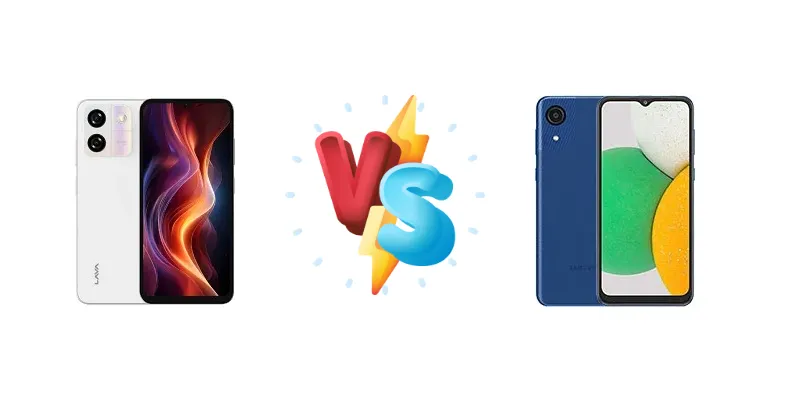
In the fiercely competitive ultra-budget smartphone market, differentiation is key. The Lava Yuva Star and Samsung Galaxy A03 Core present a fascinating case study: both devices are powered by the identical Unisoc SC9863A chipset. This comparison dissects the nuances beyond the core hardware, focusing on how software, branding, and potential pricing strategies impact the user experience.
🏆 Quick Verdict
For the average user prioritizing brand recognition and a potentially more refined software experience, the Samsung Galaxy A03 Core is the slightly safer bet. However, the Lava Yuva Star offers a compelling alternative if cost is the absolute primary concern, as it's likely to be priced more aggressively given its brand positioning.
| Network |
|---|
| 2G bands | GSM 900 / 1800 | GSM 850 / 900 / 1800 / 1900 |
| 3G bands | HSDPA 850 / 900 / 1900 / 2100 | HSDPA 850 / 900 / 2100 |
| 4G bands | 1, 3, 5, 7, 8, 20, 28, 38, 40, 41 | 1, 3, 5, 7, 8, 20, 28, 38, 40, 41 |
| Speed | HSPA, LTE | HSPA 21.1/5.76 Mbps, LTE |
| Technology | GSM / HSPA / LTE | GSM / HSPA / LTE |
| Launch |
|---|
| Announced | 2024, August 06 | 2021, November 15 |
| Status | Available. Released 2024, September | Available. Released 2021, December 06 |
| Body |
|---|
| Build | - | Plastic back, plastic frame |
| Dimensions | 165 x 76.1 x 8.8 mm (6.50 x 3.00 x 0.35 in) | 164.2 x 75.9 x 9.1 mm (6.46 x 2.99 x 0.36 in) |
| SIM | Nano-SIM + Nano-SIM | · Nano-SIM· Nano-SIM + Nano-SIM |
| Weight | 193 g (6.81 oz) | 211 g (7.44 oz) |
| Display |
|---|
| Resolution | 720 x 1600 pixels, 20:9 ratio (~260 ppi density) | 720 x 1600 pixels, 20:9 ratio (~270 ppi density) |
| Size | 6.75 inches, 110.0 cm2 (~87.6% screen-to-body ratio) | 6.5 inches, 102.0 cm2 (~81.8% screen-to-body ratio) |
| Type | IPS LCD | PLS LCD |
| Platform |
|---|
| CPU | Octa-core (4x1.6 GHz Cortex-A55 & 4x1.2 GHz Cortex-A55) | Octa-core (4x1.6 GHz Cortex-A55 & 4x1.2 GHz Cortex-A55) |
| Chipset | Unisoc SC9863A (28 nm) | Unisoc SC9863A (28 nm) |
| GPU | IMG8322 | IMG8322 |
| OS | Android 14 (Go edition) | Android 11 (Go edition) |
| Memory |
|---|
| Card slot | microSDXC (dedicated slot) | microSDXC (dedicated slot) |
| Internal | 64GB 3GB RAM, 64GB 4GB RAM | 32GB 2GB RAM |
| | - | eMMC 5.1 |
| Main Camera |
|---|
| Dual | 13 MP, (wide), AF
auxiliary lens | - |
| Features | LED flash, HDR, panorama | LED flash |
| Single | - | 8 MP, f/2.0, AF |
| Video | 1080p@30fps | 1080p@30fps |
| Selfie camera |
|---|
| Single | 5 MP | 5 MP, f/2.2 |
| Video | Yes | - |
| Sound |
|---|
| 3.5mm jack | - | Yes |
| 35mm jack | Yes | Yes |
| Loudspeaker | Yes | Yes |
| Comms |
|---|
| Bluetooth | 4.2, A2DP | 4.2, A2DP |
| Infrared port | Yes | - |
| NFC | No | No |
| Positioning | GPS, GLONASS | GPS, GLONASS |
| Radio | FM radio | Unspecified |
| USB | USB Type-C 2.0, OTG | microUSB 2.0, OTG |
| WLAN | Wi-Fi 802.11 b/g/n/ac | Wi-Fi 802.11 b/g/n, Wi-Fi Direct |
| Features |
|---|
| Sensors | Fingerprint (side-mounted), accelerometer, proximity | Accelerometer, proximity |
| Battery |
|---|
| Charging | 10W wired | - |
| Type | Li-Ion 5000 mAh | Li-Ion 5000 mAh |
| Misc |
|---|
| Colors | Glossy Black, Glossy Lavender, Glossy White | Black, Blue |
| Models | LZG409 | SM-A032F, SM-A032F/DS, SM-A032M |
| Price | About 70 EUR | £ 74.99 |
| SAR | - | 0.30 W/kg (head) |
| SAR EU | - | 0.24 W/kg (head) 1.39 W/kg (body) |
Lava Yuva Star
- Potentially lower price point
- May offer a cleaner Android experience (depending on Lava's software skin)
- Identical performance to the A03 Core
- Less established brand reputation
- Potentially limited software updates
- Smaller service network
Samsung Galaxy A03 Core
- Stronger brand recognition and trust
- Samsung's software ecosystem and potential for longer updates
- Wider service network and support
- Likely to be more expensive than the Lava Yuva Star
- Software skin may include bloatware
- Identical performance to the Yuva Star
Display Comparison
Both the Lava Yuva Star and Samsung Galaxy A03 Core utilize displays that are likely to be similar in resolution and panel technology, given their price bracket. However, specific details like peak brightness (nits) and color accuracy are unavailable. Expect both to feature LCD panels, prioritizing power efficiency over vibrant colors. The 28nm chipset suggests limited graphical processing power, meaning neither display will be pushing high refresh rates or HDR content. Bezels are likely to be substantial on both devices, maximizing screen real estate within a compact form factor.
Camera Comparison
Camera performance is likely to be similar on both devices, relying heavily on software processing to enhance image quality. Given the target market, expect a primary camera sensor paired with potentially a 2MP depth or macro sensor (the latter often offering limited practical benefit). Sensor size and lens aperture are unknown, but likely to be small, resulting in subpar low-light performance. Image processing will likely focus on boosting saturation and contrast to create visually appealing images, but detail preservation will be limited. The Unisoc SC9863A's ISP (Image Signal Processor) is not known for advanced features like HDR or computational photography.
Performance
The core of both devices is the Unisoc SC9863A, an octa-core processor featuring four Cortex-A55 cores clocked at 1.6 GHz and another four at 1.2 GHz. This configuration is geared towards basic tasks like web browsing, social media, and light app usage. The 28nm manufacturing process is relatively dated, meaning thermal efficiency won't be a strong suit. While both phones *can* run Android Go Edition for smoother performance, the identical chipset means performance will be virtually indistinguishable in real-world scenarios. RAM capacity (not specified) will be a key factor; more RAM will improve multitasking capabilities on both devices.
Battery Life
Battery capacity is not specified for either device, but both will likely feature batteries in the 4000-5000 mAh range, typical for this price segment. Both phones support 10W wired charging, which is relatively slow by modern standards. Expect a full charge to take several hours. The power-efficient Unisoc SC9863A and LCD displays should contribute to reasonable battery life, potentially lasting a full day with moderate usage. However, heavy gaming or prolonged video streaming will drain the battery quickly.
Buying Guide
Buy the Lava Yuva Star if you need the absolute lowest possible price point and are comfortable with a less established brand. You'll likely get similar performance to the A03 Core for less money. Buy the Samsung Galaxy A03 Core if you prefer the reliability and software support associated with the Samsung brand, and are willing to pay a small premium for that peace of mind. The A03 Core also benefits from Samsung's wider service network.
Frequently Asked Questions
❓ Will the Unisoc SC9863A struggle with popular games like PUBG Mobile or Call of Duty?
Yes, the Unisoc SC9863A is an entry-level chipset and will likely struggle to run demanding games like PUBG Mobile or Call of Duty at high settings. You may be able to play at the lowest settings with reduced frame rates, but expect significant lag and stuttering. These phones are better suited for casual gaming and less graphically intensive titles.
❓ Does either phone support VoWiFi (WiFi Calling)?
Support for VoWiFi (WiFi Calling) is dependent on carrier compatibility and software implementation. Neither Lava nor Samsung explicitly lists VoWiFi support for these models. It's best to check with your mobile carrier to confirm compatibility before purchasing.
❓ What version of Android do these phones run?
Both phones are likely to run Android 13 (Go Edition). This is a lightweight version of Android designed for devices with limited RAM and storage. It offers a smoother experience on lower-end hardware by optimizing resource usage and pre-installing Go versions of popular apps.
❓ Is the 2MP macro camera on either phone actually useful?
Generally, 2MP macro cameras on ultra-budget phones offer limited practical benefit. The low resolution results in images lacking detail and sharpness. While they can be fun to experiment with, don't expect professional-quality macro photography.