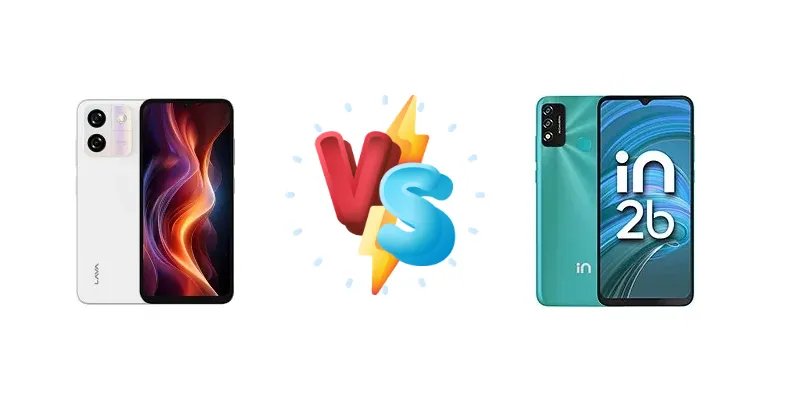
The Lava Yuva Star and Micromax In 2b represent the fiercely competitive sub-$100 smartphone market. Both devices aim to deliver essential smartphone functionality at an incredibly low price point, but they take different approaches to achieving this, primarily through their choice of Unisoc chipsets. This comparison will dissect the key differences to determine which device offers the best value for users prioritizing performance and efficiency.
🏆 Quick Verdict
For the average user prioritizing responsiveness and future-proofing, the Micromax In 2b emerges as the better choice. Its Unisoc T610, built on a more efficient 12nm process, delivers noticeably improved CPU performance compared to the Lava Yuva Star’s SC9863A, making everyday tasks smoother and more enjoyable.
| Network |
|---|
| 2G bands | GSM 900 / 1800 | GSM 850 / 900 / 1800 / 1900 |
| 3G bands | HSDPA 850 / 900 / 1900 / 2100 | HSDPA 850 / 2100 |
| 4G bands | 1, 3, 5, 7, 8, 20, 28, 38, 40, 41 | 1, 3, 5, 8, 38, 40, 41 |
| Speed | HSPA, LTE | HSPA, LTE |
| Technology | GSM / HSPA / LTE | GSM / HSPA / LTE |
| Launch |
|---|
| Announced | 2024, August 06 | 2021, July 30. Released 2021, August 06 |
| Status | Available. Released 2024, September | Discontinued |
| Body |
|---|
| Dimensions | 165 x 76.1 x 8.8 mm (6.50 x 3.00 x 0.35 in) | 164.3 x 75.7 x 8.6 mm (6.47 x 2.98 x 0.34 in) |
| SIM | Nano-SIM + Nano-SIM | Nano-SIM + Nano-SIM |
| Weight | 193 g (6.81 oz) | 190 g (6.70 oz) |
| Display |
|---|
| Resolution | 720 x 1600 pixels, 20:9 ratio (~260 ppi density) | 720 x 1600 pixels, 20:9 ratio (~269 ppi density) |
| Size | 6.75 inches, 110.0 cm2 (~87.6% screen-to-body ratio) | 6.52 inches, 102.6 cm2 (~82.5% screen-to-body ratio) |
| Type | IPS LCD | IPS LCD, 400 nits (typ) |
| Platform |
|---|
| CPU | Octa-core (4x1.6 GHz Cortex-A55 & 4x1.2 GHz Cortex-A55) | Octa-core (2x1.8 GHz Cortex-A75 & 6x1.8 GHz Cortex-A55) |
| Chipset | Unisoc SC9863A (28 nm) | Unisoc T610 (12 nm) |
| GPU | IMG8322 | Mali-G52 MP2 |
| OS | Android 14 (Go edition) | Android 11 |
| Memory |
|---|
| Card slot | microSDXC (dedicated slot) | microSDXC (dedicated slot) |
| Internal | 64GB 3GB RAM, 64GB 4GB RAM | 64GB 4GB RAM, 64GB 6GB RAM |
| | - | eMMC 5.1 |
| Main Camera |
|---|
| Dual | 13 MP, (wide), AF
auxiliary lens | 13 MP, f/1.8, 27mm (wide), 1/3.0", 1.12µm, PDAF
Auxiliary lens |
| Features | LED flash, HDR, panorama | LED flash, HDR, panorama |
| Single | - | 5 MP, f/2.2 |
| Video | 1080p@30fps | 1080p@30fps |
| Selfie camera |
|---|
| Features | - | HDR |
| Single | 5 MP | 5 MP, f/2.2 |
| Video | Yes | Unspecified |
| Sound |
|---|
| 3.5mm jack | - | Yes |
| 35mm jack | Yes | Yes |
| Loudspeaker | Yes | Yes |
| Comms |
|---|
| Bluetooth | 4.2, A2DP | 5.0, A2DP, LE |
| Infrared port | Yes | - |
| NFC | No | No |
| Positioning | GPS, GLONASS | GPS, GLONASS, GALILEO, BDS |
| Radio | FM radio | Unspecified |
| USB | USB Type-C 2.0, OTG | USB Type-C 2.0, OTG |
| WLAN | Wi-Fi 802.11 b/g/n/ac | Wi-Fi 802.11 a/b/g/n/ac, Wi-Fi Direct |
| Features |
|---|
| Sensors | Fingerprint (side-mounted), accelerometer, proximity | Fingerprint (rear-mounted), accelerometer, proximity |
| Battery |
|---|
| Charging | 10W wired | 10W wired |
| Type | Li-Ion 5000 mAh | Li-Po 5000 mAh |
| Misc |
|---|
| Colors | Glossy Black, Glossy Lavender, Glossy White | Blue, Black, Green |
| Models | LZG409 | E7544 |
| Price | About 70 EUR | About 90 EUR |
| SAR | - | 0.85 W/kg (head) 1.13 W/kg (body) |
Lava Yuva Star
- Potentially lower price point
- Simple and easy-to-use interface
- Reliable for basic communication
- Significantly weaker processor
- Less efficient chipset
- Limited multitasking capabilities
Micromax In 2b
- More powerful Unisoc T610 chipset
- Improved power efficiency
- Smoother user experience
- Slightly higher price
- Still limited by budget components
- Camera performance likely remains basic
Display Comparison
Neither Lava nor Micromax provide detailed display specifications. Given the price bracket, both likely utilize LCD panels with 720p+ resolution. However, the lack of information prevents a detailed comparison of brightness, color accuracy, or viewing angles. Bezels are expected to be substantial on both devices, maximizing screen real estate within their budget constraints. The absence of features like high refresh rates or PWM dimming control is standard for this segment.
Camera Comparison
Both devices are expected to feature basic camera setups. Without detailed sensor information, it’s safe to assume both rely on primary sensors with modest resolutions. The presence of a 2MP macro camera on either device is largely a marketing tactic, offering limited practical benefit due to the low resolution and lack of optical image stabilization (OIS). Image processing will likely be minimal, relying heavily on software algorithms to enhance photos. The Micromax In 2b *may* have a slight edge due to the more capable ISP within the T610 chipset, potentially leading to better dynamic range and noise reduction.
Performance
The core difference lies in the chipsets. The Micromax In 2b’s Unisoc T610 (12nm) is a clear upgrade over the Lava Yuva Star’s Unisoc SC9863A (28nm). The 12nm process node inherently offers better power efficiency, translating to less heat generation and potentially longer battery life under load. The CPU configuration further emphasizes this advantage: the T610 features 2x 1.8GHz Cortex-A75 cores alongside 6x 1.8GHz Cortex-A55 cores, while the Yuva Star has 4x 1.6GHz Cortex-A55 and 4x 1.2GHz Cortex-A55. The A75 cores in the In 2b provide a significant boost in single-core performance, crucial for app launch times and general responsiveness. While both phones likely feature similar RAM configurations, the superior chipset will allow the In 2b to handle multitasking more effectively.
Battery Life
Both the Lava Yuva Star and Micromax In 2b support 10W wired charging, indicating similar charging speeds. While battery capacity isn’t specified, both are likely in the 4000-5000 mAh range. The Unisoc T610’s superior power efficiency in the In 2b will likely translate to longer real-world battery life, even with a similar capacity. Users should expect approximately 5-6 hours of screen-on time with moderate usage on the In 2b, compared to potentially 4-5 hours on the Yuva Star.
Buying Guide
Buy the Lava Yuva Star if you need a basic, reliable smartphone for extremely light use – primarily calls, texts, and occasional WhatsApp. Its lower price point makes it ideal for first-time smartphone users or as a secondary device. Buy the Micromax In 2b if you prefer a more responsive experience for social media, browsing, and light gaming. The T610 chipset provides a tangible performance boost that justifies the slightly higher cost, offering a more future-proof experience.
Frequently Asked Questions
❓ Will the Micromax In 2b handle popular social media apps like Facebook and Instagram smoothly?
Yes, the Unisoc T610 in the Micromax In 2b provides sufficient processing power to run social media apps smoothly. The Cortex-A75 cores will contribute to faster app loading times and a more responsive scrolling experience compared to the Lava Yuva Star.
❓ Is the Lava Yuva Star suitable for playing mobile games?
The Lava Yuva Star is only suitable for very light gaming. The Unisoc SC9863A will struggle with demanding titles, resulting in low frame rates and potential lag. The Micromax In 2b offers a slightly better gaming experience, but neither phone is designed for serious mobile gaming.
❓ How long will it take to fully charge both phones with the 10W charger?
Both phones, utilizing 10W charging, will likely take around 3-4 hours to fully charge from 0% to 100%. The actual charging time may vary depending on usage during charging and the battery's overall health.
❓ Does either phone support VoLTE or VoWiFi calling?
Support for VoLTE and VoWiFi will depend on the carrier and region. It's recommended to check with your mobile carrier to confirm compatibility with either the Lava Yuva Star or the Micromax In 2b before purchasing.