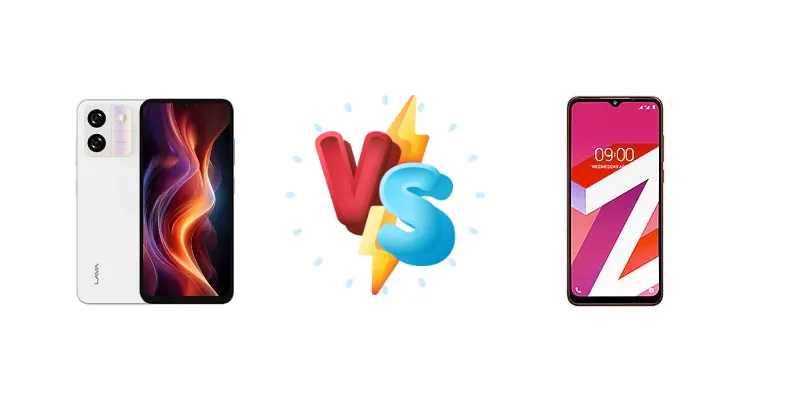
Lava is aggressively targeting the entry-level smartphone market with the Yuva Star and Z4. Both devices aim to deliver essential smartphone functionality at incredibly affordable price points. However, they diverge significantly in their core processing power, making the choice less straightforward than it appears. This comparison dissects the key differences to determine which phone offers the best value.
🏆 Quick Verdict
For most users, the Lava Z4 emerges as the better choice. Its Mediatek Helio G35 chipset, built on a more efficient 12nm process, provides a noticeable performance uplift over the Yuva Star’s Unisoc SC9863A, especially in multitasking and light gaming. While both offer basic functionality, the Z4’s processing advantage justifies the potential price difference.
| Network |
|---|
| 2G bands | GSM 900 / 1800 | GSM 900 / 1800 |
| 3G bands | HSDPA 850 / 900 / 1900 / 2100 | HSDPA 900 / 2100 |
| 4G bands | 1, 3, 5, 7, 8, 20, 28, 38, 40, 41 | 1, 3, 5, 8, 40, 41 |
| Speed | HSPA, LTE | HSPA 42.2/5.76 Mbps, LTE Cat4 150/50 Mbps |
| Technology | GSM / HSPA / LTE | GSM / HSPA / LTE |
| Launch |
|---|
| Announced | 2024, August 06 | 2021, January 07 |
| Status | Available. Released 2024, September | Available. Released 2021, January 11 |
| Body |
|---|
| Build | - | Glass front, plastic back, plastic frame |
| Dimensions | 165 x 76.1 x 8.8 mm (6.50 x 3.00 x 0.35 in) | 164.5 x 75.8 x 9 mm (6.48 x 2.98 x 0.35 in) |
| SIM | Nano-SIM + Nano-SIM | Nano-SIM + Nano-SIM |
| Weight | 193 g (6.81 oz) | 190 g (6.70 oz) |
| Display |
|---|
| Protection | - | Corning Gorilla Glass 3 |
| Resolution | 720 x 1600 pixels, 20:9 ratio (~260 ppi density) | 720 x 1600 pixels, 20:9 ratio (~270 ppi density) |
| Size | 6.75 inches, 110.0 cm2 (~87.6% screen-to-body ratio) | 6.51 inches, 102.3 cm2 (~82.1% screen-to-body ratio) |
| Type | IPS LCD | IPS LCD |
| Platform |
|---|
| CPU | Octa-core (4x1.6 GHz Cortex-A55 & 4x1.2 GHz Cortex-A55) | Octa-core (4x2.3 GHz Cortex-A53 & 4x1.8 GHz Cortex-A53) |
| Chipset | Unisoc SC9863A (28 nm) | Mediatek MT6765G Helio G35 (12 nm) |
| GPU | IMG8322 | PowerVR GE8320 |
| OS | Android 14 (Go edition) | Android 10 |
| Memory |
|---|
| Card slot | microSDXC (dedicated slot) | microSDXC (dedicated slot) |
| Internal | 64GB 3GB RAM, 64GB 4GB RAM | 64GB 4GB RAM |
| | - | eMMC 5.1 |
| Main Camera |
|---|
| Dual | 13 MP, (wide), AF
auxiliary lens | - |
| Features | LED flash, HDR, panorama | LED flash |
| Single | - | 13 MP, f/2.0 AF |
| Triple | - | 13 MP, f/1.9, (wide), 1/3.0", 1.12µm, AF
5 MP, (ultrawide)
Auxiliary lens |
| Video | 1080p@30fps | 1080p@30fps |
| Selfie camera |
|---|
| Features | - | LED flash |
| Single | 5 MP | 16 MP, f/2.0, (wide), 1/3.06" 1.0µm |
| Video | Yes | 1080p@30fps |
| Sound |
|---|
| 3.5mm jack | - | Yes |
| 35mm jack | Yes | Yes |
| Loudspeaker | Yes | Yes |
| Comms |
|---|
| Bluetooth | 4.2, A2DP | 5.0, A2DP, LE |
| Infrared port | Yes | - |
| NFC | No | No |
| Positioning | GPS, GLONASS | GPS |
| Radio | FM radio | FM radio |
| USB | USB Type-C 2.0, OTG | USB Type-C |
| WLAN | Wi-Fi 802.11 b/g/n/ac | Wi-Fi 802.11 b/g/n, Wi-Fi Direct |
| Features |
|---|
| Sensors | Fingerprint (side-mounted), accelerometer, proximity | Fingerprint (rear-mounted), accelerometer, proximity |
| Battery |
|---|
| Charging | 10W wired | - |
| Stand-by | - | Up to 270 h |
| Talk time | - | Up to 24 h (2G) / Up to 15 h 30 min (3G) |
| Type | Li-Ion 5000 mAh | Li-Po 5000 mAh |
| Misc |
|---|
| Colors | Glossy Black, Glossy Lavender, Glossy White | Blue, Red |
| Models | LZG409 | S7 |
| Price | About 70 EUR | About 100 EUR |
| SAR | - | 0.52 W/kg (head) 0.64 W/kg (body) |
Lava Yuva Star
- Potentially lower price point
- Sufficient for basic tasks
- Reliable for calls and texts
- Significantly weaker performance
- Less efficient chipset
- Likely more thermal throttling
Lava Z4
- More powerful Helio G35 chipset
- Better power efficiency
- Smoother multitasking experience
- Potentially higher price
- 10W charging is slow
- Camera performance likely still limited
Display Comparison
Neither Lava provides detailed display specifications. Assuming typical LCD panels for this price bracket, the display experience will likely be similar. However, the chipset powering the Z4 may allow for slightly smoother animations and transitions. Bezels are expected to be substantial on both devices, and color accuracy will likely be standard for budget phones.
Camera Comparison
Both phones likely feature basic camera setups. Without detailed sensor information, it’s difficult to make a definitive judgment. However, the Z4’s more capable chipset could potentially handle image processing tasks more efficiently, resulting in slightly better image quality. The presence of a 2MP macro camera on either device is largely a marketing gimmick and shouldn’t be a deciding factor. Expect similar performance in good lighting conditions, but both will struggle in low-light scenarios.
Performance
The core difference lies in the chipsets. The Lava Z4’s Mediatek Helio G35 (12nm) is a clear upgrade over the Yuva Star’s Unisoc SC9863A (28nm). The 12nm fabrication process inherently offers better power efficiency, translating to potentially longer battery life under load. Furthermore, the Helio G35’s Cortex-A53 cores, clocked at up to 2.3 GHz, are significantly faster than the Yuva Star’s Cortex-A55 cores peaking at 1.6 GHz. This difference will be most noticeable when launching apps, switching between tasks, and playing games. The Yuva Star’s older, larger node will likely result in more thermal throttling during sustained workloads.
Battery Life
Battery capacity isn’t specified for either device. However, the Helio G35’s 12nm process in the Z4 offers a significant advantage in power efficiency. This means the Z4 is likely to achieve comparable or better battery life despite potentially having a similar or even slightly smaller battery capacity. Both phones feature 10W charging, which is slow by modern standards, meaning a full charge will take a considerable amount of time.
Buying Guide
Buy the Lava Yuva Star if your primary needs are basic communication – calls, texts, and light social media – and you prioritize absolute affordability. It’s a suitable option for first-time smartphone users or as a reliable backup device. Buy the Lava Z4 if you anticipate more demanding tasks like occasional gaming, running multiple apps simultaneously, or require a smoother overall user experience. The Z4’s more powerful chipset offers a tangible improvement in responsiveness and usability.
Frequently Asked Questions
❓ Will the Lava Z4 be able to run popular games like PUBG Mobile?
The Helio G35 in the Lava Z4 can run PUBG Mobile, but expect to play at lower graphics settings and frame rates to maintain a stable experience. It won't deliver a flagship-level gaming experience, but it's significantly more capable than the Yuva Star's chipset.
❓ How much faster is the Lava Z4 in everyday tasks compared to the Yuva Star?
The Z4 will feel noticeably snappier when launching apps, switching between them, and browsing the web. The difference is due to the Helio G35’s faster CPU cores and more efficient architecture. The Yuva Star will likely exhibit more lag and slowdowns during these common tasks.
❓ Is the 10W charging on either phone a significant drawback?
Yes, 10W charging is quite slow compared to modern standards. Expect a full charge to take over 3 hours. Neither phone offers fast charging capabilities, so patience is required.
❓ Which phone is better for someone who primarily uses WhatsApp and makes calls?
For basic communication, the Lava Yuva Star is sufficient. Its lower price point makes it a viable option if WhatsApp and calls are your primary use cases. However, the Z4 will still provide a smoother experience even for these basic tasks.