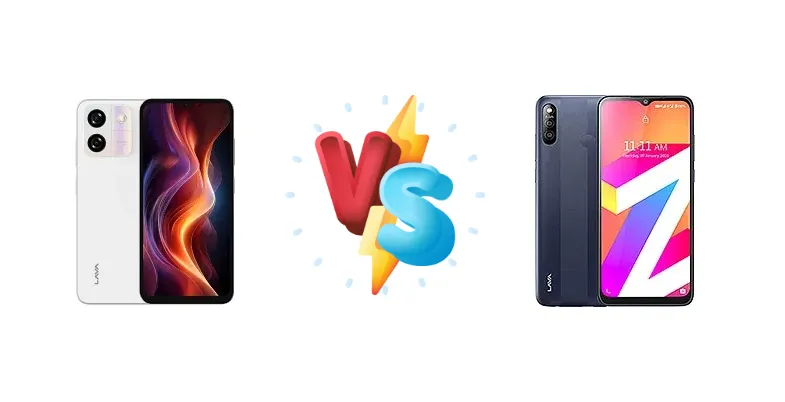
Lava is aggressively targeting the entry-level smartphone market with the Yuva Star and Z3 Pro. Both devices aim to deliver essential smartphone functionality at incredibly competitive prices. However, they diverge significantly in their core hardware, particularly the chipset. This comparison dissects those differences to determine which phone offers the best value for your money.
🏆 Quick Verdict
For most users, the Lava Z3 Pro emerges as the better choice. Its Mediatek Helio A25, built on a more efficient 12nm process, provides a noticeable performance advantage over the Yuva Star’s Unisoc SC9863A, despite similar core counts. While both phones are budget-focused, the Z3 Pro offers a smoother experience for everyday tasks.
| Network |
|---|
| 2G bands | GSM 900 / 1800 | GSM 900 / 1800 |
| 3G bands | HSDPA 850 / 900 / 1900 / 2100 | HSDPA 900 / 2100 |
| 4G bands | 1, 3, 5, 7, 8, 20, 28, 38, 40, 41 | 1, 3, 5, 8, 40, 41 |
| Speed | HSPA, LTE | HSPA 42.2/5.76 Mbps, LTE Cat4 150/50 Mbps |
| Technology | GSM / HSPA / LTE | GSM / HSPA / LTE |
| Launch |
|---|
| Announced | 2024, August 06 | 2022, May 18 |
| Status | Available. Released 2024, September | Available. Released 2022, May 18 |
| Body |
|---|
| Build | - | Glass front, plastic back, plastic frame |
| Dimensions | 165 x 76.1 x 8.8 mm (6.50 x 3.00 x 0.35 in) | 164.5 x 75.8 x 8.9 mm (6.48 x 2.98 x 0.35 in) |
| SIM | Nano-SIM + Nano-SIM | Nano-SIM + Nano-SIM |
| Weight | 193 g (6.81 oz) | 192 g (6.77 oz) |
| Display |
|---|
| Resolution | 720 x 1600 pixels, 20:9 ratio (~260 ppi density) | 720 x 1600 pixels, 20:9 ratio (~269 ppi density) |
| Size | 6.75 inches, 110.0 cm2 (~87.6% screen-to-body ratio) | 6.52 inches, 102.6 cm2 (~82.3% screen-to-body ratio) |
| Type | IPS LCD | IPS LCD |
| Platform |
|---|
| CPU | Octa-core (4x1.6 GHz Cortex-A55 & 4x1.2 GHz Cortex-A55) | Octa-core (4x1.8 GHz Cortex-A53 & 4x1.5 GHz Cortex-A53) |
| Chipset | Unisoc SC9863A (28 nm) | Mediatek MT6762D Helio A25 (12 nm) |
| GPU | IMG8322 | PowerVR GE8320 |
| OS | Android 14 (Go edition) | Android 11 |
| Memory |
|---|
| Card slot | microSDXC (dedicated slot) | microSDXC (dedicated slot) |
| Internal | 64GB 3GB RAM, 64GB 4GB RAM | 32GB 3GB RAM |
| Main Camera |
|---|
| Dual | 13 MP, (wide), AF
auxiliary lens | 8 MP, f/2.0, (wide), 1.12µm, AF
Auxiliary lens |
| Features | LED flash, HDR, panorama | LED flash |
| Video | 1080p@30fps | 1080p@30fps |
| Selfie camera |
|---|
| Single | 5 MP | 5 MP, f/2.2, (wide) |
| Video | Yes | - |
| Sound |
|---|
| 35mm jack | Yes | Yes |
| Loudspeaker | Yes | Yes |
| Comms |
|---|
| Bluetooth | 4.2, A2DP | 5.0, A2DP, LE |
| Infrared port | Yes | - |
| NFC | No | No |
| Positioning | GPS, GLONASS | GPS |
| Radio | FM radio | FM radio |
| USB | USB Type-C 2.0, OTG | USB Type-C 2.0, OTG |
| WLAN | Wi-Fi 802.11 b/g/n/ac | Wi-Fi 802.11 b/g/n/ac, Wi-Fi Direct |
| Features |
|---|
| Sensors | Fingerprint (side-mounted), accelerometer, proximity | Fingerprint (rear-mounted), accelerometer, proximity |
| Battery |
|---|
| Charging | 10W wired | - |
| Type | Li-Ion 5000 mAh | Li-Po 5000 mAh |
| Misc |
|---|
| Colors | Glossy Black, Glossy Lavender, Glossy White | Blue, Dark Blue |
| Models | LZG409 | - |
| Price | About 70 EUR | About 80 EUR |
Lava Yuva Star
- Potentially lower price point
- Functional for basic tasks
- Simple and straightforward user experience
- Less powerful processor
- Less efficient chipset
- Likely slower app loading times
Lava Z3 Pro
- More powerful and efficient processor
- Smoother multitasking experience
- Better potential for future software updates
- Slightly higher price
- 10W charging is slow
- Camera performance likely still limited
Display Comparison
Neither Lava provides detailed display specifications. Assuming typical LCD panels for this price bracket, the display experience will likely be similar. However, the more powerful GPU in the Z3 Pro *could* translate to slightly smoother scrolling and animations, even with identical resolution and refresh rates. Bezels are likely substantial on both devices, and color accuracy will be standard for the segment.
Camera Comparison
Both phones likely feature basic camera setups. Without detailed sensor information, it’s difficult to make a definitive judgment. However, the Z3 Pro’s slightly more powerful processor could enable marginally better image processing, potentially leading to improved dynamic range and noise reduction. The presence of a 2MP macro camera on either device is largely a marketing gimmick and shouldn’t be a deciding factor. Expect similar performance in good lighting conditions, with both struggling in low-light scenarios.
Performance
The core difference lies in the chipsets. The Lava Z3 Pro’s Mediatek Helio A25 (12nm) boasts a more modern fabrication process than the Yuva Star’s Unisoc SC9863A (28nm). This 12nm process inherently offers better power efficiency and thermal characteristics. While both are octa-core CPUs, the A25 utilizes Cortex-A53 cores clocked at 1.8GHz, compared to the Yuva Star’s Cortex-A55 cores at 1.6GHz and 1.2GHz. The A53 cores, while older architecture, benefit from the higher clock speed and more efficient node, resulting in faster application loading and smoother multitasking. The Unisoc chip's larger process node will likely lead to more heat generation under sustained load.
Battery Life
Both phones feature 10W charging, indicating a similar charging experience – expect over 3 hours for a full charge. The battery capacity is not specified, but given the target market, both are likely in the 3000-4000 mAh range. The Helio A25’s superior power efficiency in the Z3 Pro could translate to slightly longer battery life, especially during moderate usage. However, the difference will likely be marginal and dependent on user habits.
Buying Guide
Buy the Lava Yuva Star if your primary need is a basic, functional smartphone for calls, messaging, and light social media use, and you prioritize absolute affordability. Buy the Lava Z3 Pro if you want a more responsive experience for multitasking, occasional gaming, and a slightly more future-proofed device, even if it means spending a little more.
Frequently Asked Questions
❓ Will the Helio A25 in the Lava Z3 Pro struggle with popular games like PUBG Mobile?
While the Helio A25 isn't a gaming powerhouse, it should be capable of running PUBG Mobile at lower settings (balanced graphics, medium frame rate). Expect some frame drops during intense action. The Yuva Star’s Unisoc chip will likely struggle even more, offering a less playable experience.
❓ Is the 10W charging on either phone a significant drawback?
Yes, 10W charging is quite slow by modern standards. Expect over three hours to fully charge either device from 0%. This isn't ideal for users who need a quick top-up, but it's typical for phones in this price range. Consider a faster charger if this is a concern.
❓ How will software updates be handled on these devices?
Lava's track record with software updates is limited. Expect minimal updates, primarily security patches. Don't anticipate major Android version upgrades on either the Yuva Star or the Z3 Pro. The Z3 Pro's more capable processor *might* receive updates for a slightly longer period.