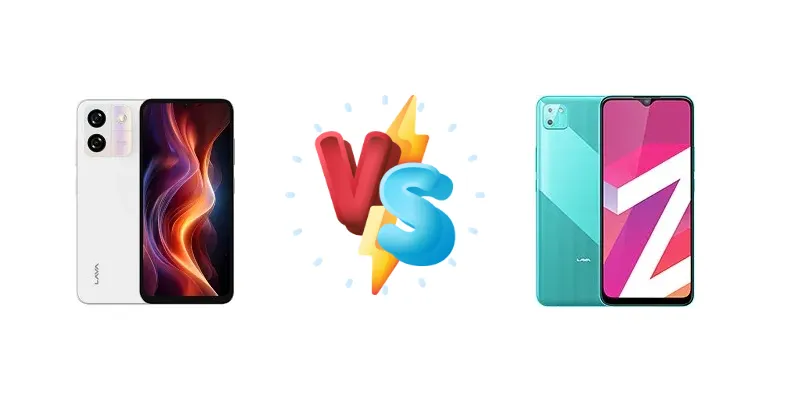
Lava is targeting the entry-level smartphone market with both the Yuva Star and the Z2 Max. While both aim to deliver affordability, they take distinctly different approaches to hardware. The Yuva Star boasts a modern, if modest, octa-core Unisoc chipset, while the Z2 Max relies on a quad-core processor. This comparison will dissect the implications of these choices, helping you determine which device best suits your needs.
🏆 Quick Verdict
For the average user prioritizing responsiveness and multitasking, the Lava Yuva Star is the clear winner. Its Unisoc SC9863A chipset, despite its 28nm process, offers significantly more processing power than the Z2 Max’s quad-core CPU, resulting in a smoother user experience. The Z2 Max may suffice for extremely basic tasks, but the Yuva Star provides a more future-proofed and enjoyable experience.
| Network |
|---|
| 2G bands | GSM 900 / 1800 | GSM 850 / 900 / 1800 / 1900 |
| 3G bands | HSDPA 850 / 900 / 1900 / 2100 | HSDPA 900 / 2100 |
| 4G bands | 1, 3, 5, 7, 8, 20, 28, 38, 40, 41 | 1, 3, 5, 8, 40, 41 |
| Speed | HSPA, LTE | HSPA 42.2/5.76 Mbps, LTE Cat4 150/50 Mbps |
| Technology | GSM / HSPA / LTE | GSM / HSPA / LTE |
| Launch |
|---|
| Announced | 2024, August 06 | 2021, May 11 |
| Status | Available. Released 2024, September | Available. Released 2021, May 11 |
| Body |
|---|
| Build | - | Glass front, plastic back, plastic frame |
| Dimensions | 165 x 76.1 x 8.8 mm (6.50 x 3.00 x 0.35 in) | 174.7 x 78.6 x 9.1 mm (6.88 x 3.09 x 0.36 in) |
| SIM | Nano-SIM + Nano-SIM | Nano-SIM + Nano-SIM |
| Weight | 193 g (6.81 oz) | 216 g (7.62 oz) |
| Display |
|---|
| Protection | - | Corning Gorilla Glass 3 |
| Resolution | 720 x 1600 pixels, 20:9 ratio (~260 ppi density) | 720 x 1640 pixels (~256 ppi density) |
| Size | 6.75 inches, 110.0 cm2 (~87.6% screen-to-body ratio) | 7.0 inches, 116.4 cm2 (~84.7% screen-to-body ratio) |
| Type | IPS LCD | IPS LCD |
| Platform |
|---|
| CPU | Octa-core (4x1.6 GHz Cortex-A55 & 4x1.2 GHz Cortex-A55) | Quad-core 1.8 GHz |
| Chipset | Unisoc SC9863A (28 nm) | - |
| GPU | IMG8322 | - |
| OS | Android 14 (Go edition) | Android 10 (Go edition) |
| Memory |
|---|
| Card slot | microSDXC (dedicated slot) | microSDXC (dedicated slot) |
| Internal | 64GB 3GB RAM, 64GB 4GB RAM | 32GB 2GB RAM |
| | - | eMMC 5.1 |
| Main Camera |
|---|
| Dual | 13 MP, (wide), AF
auxiliary lens | 13 MP, f/1.9, (wide), 1/3.0", 1.12µm, AF
Auxiliary lens |
| Features | LED flash, HDR, panorama | LED flash |
| Single | - | 8 MP, f/2.0, (wide), 1.12µm |
| Video | 1080p@30fps | 720p@30fps |
| Selfie camera |
|---|
| Single | 5 MP | 8 MP, f/2.0, (wide), 1.12µm |
| Video | Yes | - |
| Sound |
|---|
| 3.5mm jack | - | Yes |
| 35mm jack | Yes | Yes |
| Loudspeaker | Yes | Yes |
| Comms |
|---|
| Bluetooth | 4.2, A2DP | 5.0, A2DP, LE |
| Infrared port | Yes | - |
| NFC | No | No |
| Positioning | GPS, GLONASS | GPS |
| Radio | FM radio | FM radio |
| USB | USB Type-C 2.0, OTG | USB Type-C 2.0, OTG |
| WLAN | Wi-Fi 802.11 b/g/n/ac | Wi-Fi 802.11 b/g/n, Wi-Fi Direct |
| Features |
|---|
| Sensors | Fingerprint (side-mounted), accelerometer, proximity | Accelerometer |
| Battery |
|---|
| Charging | 10W wired | - |
| Type | Li-Ion 5000 mAh | Li-Po 6000 mAh |
| Misc |
|---|
| Colors | Glossy Black, Glossy Lavender, Glossy White | Stroked Blue, Stroked Cyan |
| Models | LZG409 | LS0001 |
| Price | About 70 EUR | About 90 EUR |
Lava Yuva Star
- Octa-core processor offers better multitasking.
- More responsive user experience.
- Potentially better camera processing.
- 10W charging is slow.
- 28nm process is less energy efficient.
Lava Z2 Max
- Potentially longer battery life under very light use.
- Simpler operating system may be easier to navigate for beginners.
- Likely the more affordable option.
- Quad-core processor struggles with multitasking.
- Slow and laggy user experience.
- Limited future-proofing.
Display Comparison
Neither Lava provides display specifications beyond size, making a direct comparison difficult. However, given the target market, it’s safe to assume both utilize LCD panels. The absence of details like resolution or refresh rate suggests a focus on cost reduction. The Yuva Star’s chipset, being more capable, *could* theoretically support a higher resolution display in future iterations, offering a potential upgrade path. The Z2 Max’s limited processing power likely restricts it to a basic display configuration.
Camera Comparison
Both devices likely feature basic camera setups, but specific details are lacking. It’s reasonable to assume the Z2 Max utilizes a simpler image signal processor (ISP) due to its less powerful CPU. The Yuva Star’s Unisoc chipset, while not a photography powerhouse, offers a more capable ISP, potentially resulting in slightly better image quality and faster processing times. Without sensor size or aperture information, a definitive camera comparison is impossible, but the Yuva Star has a processing advantage.
Performance
The core difference lies in the chipset. The Lava Yuva Star’s Unisoc SC9863A is an octa-core processor, featuring four Cortex-A55 cores clocked at 1.6 GHz and four at 1.2 GHz. This configuration allows for better multitasking and handling of more demanding applications compared to the Lava Z2 Max’s quad-core 1.8 GHz CPU. While the Z2 Max’s cores are individually faster, the Yuva Star’s eight cores provide superior parallel processing capabilities. The 28nm process of the Unisoc chip is less efficient than modern nodes, but the core count advantage is significant in this price bracket.
Battery Life
Battery capacity is not specified for either device. However, the Lava Yuva Star’s 10W charging suggests a smaller battery, prioritizing cost savings over rapid charging. The Z2 Max’s charging speed is also unknown, but its less powerful processor *could* translate to slightly better battery life under light usage. However, the Yuva Star’s more efficient multitasking capabilities might offset this advantage if the user frequently switches between apps.
Buying Guide
Buy the Lava Yuva Star if you need a phone capable of handling multiple apps, light gaming, and general daily tasks without significant lag. It’s ideal for students, seniors, or anyone seeking a reliable and responsive device on a tight budget. Buy the Lava Z2 Max if your smartphone usage is limited to calls, texts, and very occasional browsing – it’s a bare-bones option for those with the most basic requirements and lowest budget.
Frequently Asked Questions
❓ Will the Lava Yuva Star handle popular social media apps like Facebook and WhatsApp smoothly?
Yes, the Unisoc SC9863A’s octa-core architecture is more than capable of running social media apps like Facebook and WhatsApp without significant lag. The multiple cores allow for efficient multitasking, ensuring a smoother experience even with several apps open.
❓ Is the Lava Z2 Max suitable for playing games?
The Lava Z2 Max is not recommended for gaming. Its quad-core processor lacks the graphical power and processing speed required for even basic mobile games. Expect significant lag and a poor gaming experience.
❓ What type of storage does the Lava Yuva Star use, and is it expandable?
Storage type and expandability are not specified. However, given the price point, it's likely to use eMMC storage. Expandability via microSD card is probable, but not confirmed. Check the product listing for specific details.