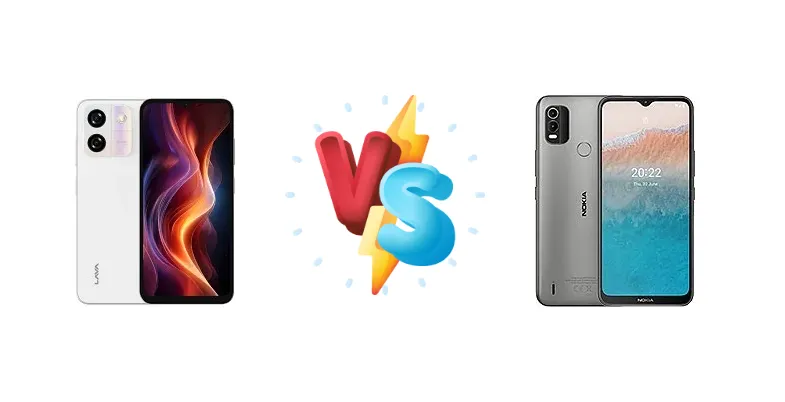
The Lava Yuva Star 2 and Nokia C21 Plus occupy the ultra-budget smartphone segment, a space where incremental differences can be crucial. Both devices share the same Unisoc SC9863A chipset, making a direct hardware comparison less about raw power and more about software optimization, brand reputation, and potential long-term support.
🏆 Quick Verdict
For the average user prioritizing brand trust and potential software updates, the Nokia C21 Plus is the slightly better choice. However, the Lava Yuva Star 2 may offer a more competitive price, making it attractive for those solely focused on minimizing upfront cost, despite the identical core hardware.
| Network |
|---|
| 2G bands | GSM 900 / 1800 | GSM 850 / 900 / 1800 / 1900 |
| 3G bands | HSDPA 850 / 900 / 1900 / 2100 | HSDPA 850 / 900 / 2100 |
| 4G bands | LTE | LTE |
| Speed | HSPA, LTE | HSPA 42.2/5.76 Mbps, LTE Cat4 150/50 Mbps |
| Technology | GSM / HSPA / LTE | GSM / HSPA / LTE |
| | - | HSDPA 850 / 900 / 1700(AWS) / 1900 / 2100 |
| Launch |
|---|
| Announced | 2025, May 05 | 2022, February 28 |
| Status | Available. Released 2025, May 05 | Available. Released 2022, April 29 |
| Body |
|---|
| Build | - | Glass front, aluminum frame, plastic back |
| Dimensions | - | 164.8 x 75.9 x 8.6 mm (6.49 x 2.99 x 0.34 in) |
| SIM | Nano-SIM + Nano-SIM | · Nano-SIM· Nano-SIM + Nano-SIM |
| Weight | - | 178 g or 191 g (6.28 oz) |
| | - | Splash protection |
| Display |
|---|
| Protection | - | Scratch-resistant glass |
| Resolution | 720 x 1600 pixels, 20:9 ratio (~260 ppi density) | 720 x 1600 pixels, 20:9 ratio (~269 ppi density) |
| Size | 6.75 inches, 110.0 cm2 (~87.6% screen-to-body ratio) | 6.52 inches, 102.6 cm2 (~82.1% screen-to-body ratio) |
| Type | IPS LCD | IPS LCD |
| Platform |
|---|
| CPU | Octa-core (4x1.6 GHz Cortex-A55 & 4x1.2 GHz Cortex-A55) | Octa-core (4x1.6 GHz Cortex-A55 & 4x1.2 GHz Cortex-A55) |
| Chipset | Unisoc SC9863A (28 nm) | Unisoc SC9863A (28 nm) |
| GPU | IMG8322 | IMG8322 |
| OS | Android 14 (Go edition) | Android 11 (Go edition) |
| Memory |
|---|
| Card slot | microSDXC (dedicated slot) | microSDXC (dedicated slot) |
| Internal | 64GB 4GB RAM | 32GB 2GB RAM, 32GB 3GB RAM, 64GB 2GB RAM, 64GB 3GB RAM, 64GB 4GB RAM |
| | - | eMMC 5.1 |
| Main Camera |
|---|
| Dual | 13 MP, (wide), AF
auxiliary lens | 13 MP, (wide), AF
Auxiliary lens |
| Features | LED flash, HDR, panorama | LED flash, HDR, panorama |
| Single | - | 5 MP |
| Video | 1080p@30fps | 1080p@30fps |
| Selfie camera |
|---|
| Features | - | LED flash |
| Single | 5 MP | 5 MP |
| Video | Yes | 720p |
| Sound |
|---|
| 3.5mm jack | - | Yes |
| 35mm jack | Yes | Yes |
| Loudspeaker | Yes | Yes |
| Comms |
|---|
| Bluetooth | 4.2, A2DP | 4.2, A2DP |
| Infrared port | Yes | - |
| NFC | No | No |
| Positioning | GPS, GLONASS | GPS |
| Radio | FM radio | FM radio |
| USB | USB Type-C 2.0, OTG | microUSB 2.0 |
| WLAN | Wi-Fi 802.11 b/g/n/ac | Wi-Fi 802.11 b/g/n |
| Features |
|---|
| Sensors | Fingerprint (side-mounted), accelerometer, proximity | Fingerprint (rear-mounted), accelerometer, proximity |
| Battery |
|---|
| Charging | 10W wired | 10W wired |
| Type | Li-Ion 5000 mAh | Li-Ion 4000/5050 mAh |
| Misc |
|---|
| Colors | Radiant Black, Sparkling Ivory | Dark Cyan, Warm Gray |
| Models | - | TA-1433, TA-1431, TA-1426, TA-1424 |
| Price | About 70 EUR | About 120 EUR |
| SAR | - | 0.57 W/kg (head) 0.65 W/kg (body) |
| SAR EU | - | 0.40 W/kg (head) 0.99 W/kg (body) |
Lava Yuva Star 2
- Potentially lower price point
- May offer more aggressive promotions
- Lava's growing presence in the Indian market
- Less established brand reputation
- Potentially slower software updates
- Uncertain long-term support
Nokia C21 Plus
- Stronger brand recognition and trust
- Likely more frequent software updates
- Nokia's commitment to Android Go Edition
- Potentially higher price
- May have limited availability in some regions
- Similar hardware to the Lava Yuva Star 2
Display Comparison
Both the Lava Yuva Star 2 and Nokia C21 Plus are expected to feature basic LCD panels, given their price bracket. Without specific display specs like resolution or brightness, it's difficult to differentiate. However, Nokia often focuses on color calibration, potentially offering a slightly more accurate display experience. The 28nm Unisoc chipset will likely limit the complexity of the display driver, meaning neither phone will support high refresh rates or advanced features like HDR.
Camera Comparison
Camera performance is likely to be similar on both devices, relying heavily on software processing to enhance image quality. Given the target price point, expect a primary sensor of modest resolution, potentially around 8-13MP. The inclusion of a 2MP macro camera on either device is largely a marketing tactic, offering limited practical benefit due to the low resolution and lack of optical image stabilization. Image processing algorithms will be the primary differentiator, and Nokia's software may offer slightly better results.
Performance
The core of both devices is the Unisoc SC9863A, an octa-core processor with a split core configuration of 4x1.6 GHz Cortex-A55 and 4x1.2 GHz Cortex-A55. This means performance will be largely identical in CPU-bound tasks like web browsing and basic app usage. The 28nm manufacturing process is relatively inefficient, suggesting both phones will struggle with sustained workloads and may exhibit thermal throttling during extended gaming sessions. RAM capacity, which is not specified, will be a key factor; more RAM will improve multitasking performance.
Battery Life
Both phones utilize 10W wired charging, indicating a slow charging experience. Battery capacity is not specified, but both are likely to feature batteries in the 3000-4000 mAh range. The power efficiency of the Unisoc SC9863A and the LCD display will dictate real-world battery life. Expect a full charge to take well over two hours, and battery life to be sufficient for a day of light usage, but potentially requiring a midday top-up with more demanding tasks.
Buying Guide
Buy the Lava Yuva Star 2 if you need the absolute lowest possible price point and are comfortable with a less established brand. You're prioritizing immediate savings over potential software longevity. Buy the Nokia C21 Plus if you prefer a brand with a stronger history of Android updates and a generally more refined software experience, even if it means paying a small premium. You value reliability and potential future features.
Frequently Asked Questions
❓ Will either of these phones receive major Android version updates?
Given the Unisoc SC9863A chipset and the target price point, major Android version updates are unlikely. Both devices are likely candidates for Android Go Edition, which prioritizes lightweight performance and receives security patches, but not full OS upgrades.
❓ How will the Unisoc SC9863A handle popular games like PUBG Mobile?
The Unisoc SC9863A will struggle with demanding games like PUBG Mobile. Expect to play at the lowest graphics settings and potentially experience frame rate drops and stuttering, even with reduced resolutions. The 28nm process and limited thermal headroom will contribute to performance throttling.
❓ Is the 10W charging speed acceptable for daily use?
10W charging is slow by modern standards. Expect a full charge to take over 3 hours. It's sufficient for overnight charging, but topping up during the day will be time-consuming. Consider a faster charger if frequent charging is necessary.
❓ What kind of storage options are available on these phones?
Storage options are not explicitly stated, but both are likely to offer 32GB or 64GB of internal storage, expandable via microSD card. Given the limited internal storage, a microSD card is highly recommended for storing photos, videos, and apps.