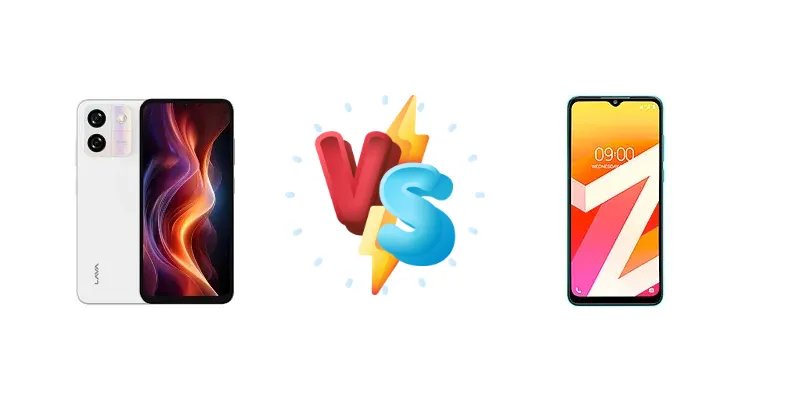
Lava is targeting the entry-level smartphone market with the Yuva Star 2 and Z6, both aiming to deliver essential features at incredibly competitive prices. However, beneath the similar price points lie significant differences in their core hardware, particularly in their chipsets. This comparison dissects those differences to determine which device offers the best value for your money.
🏆 Quick Verdict
For most users, the Lava Z6 emerges as the better choice. Its MediaTek Helio G35, built on a more efficient 12nm process, delivers noticeably improved CPU performance compared to the Yuva Star 2’s Unisoc SC9863A. While both phones offer basic functionality, the Z6 provides a smoother user experience for everyday tasks.
| Network |
|---|
| 2G bands | GSM 900 / 1800 | GSM 900 / 1800 |
| 3G bands | HSDPA 850 / 900 / 1900 / 2100 | HSDPA 900 / 2100 |
| 4G bands | LTE | 1, 3, 5, 8, 40, 41 |
| Speed | HSPA, LTE | HSPA 42.2/5.76 Mbps, LTE Cat4 150/50 Mbps |
| Technology | GSM / HSPA / LTE | GSM / HSPA / LTE |
| Launch |
|---|
| Announced | 2025, May 05 | 2021, January 07 |
| Status | Available. Released 2025, May 05 | Available. Released 2021, January 11 |
| Body |
|---|
| Build | - | Glass front, plastic back, plastic frame |
| Dimensions | - | 164.5 x 75.8 x 9 mm (6.48 x 2.98 x 0.35 in) |
| SIM | Nano-SIM + Nano-SIM | Nano-SIM + Nano-SIM |
| Weight | - | 190 g (6.70 oz) |
| Display |
|---|
| Protection | - | Corning Gorilla Glass 3 |
| Resolution | 720 x 1600 pixels, 20:9 ratio (~260 ppi density) | 720 x 1600 pixels, 20:9 ratio (~270 ppi density) |
| Size | 6.75 inches, 110.0 cm2 (~87.6% screen-to-body ratio) | 6.51 inches, 102.3 cm2 (~82.1% screen-to-body ratio) |
| Type | IPS LCD | IPS LCD |
| Platform |
|---|
| CPU | Octa-core (4x1.6 GHz Cortex-A55 & 4x1.2 GHz Cortex-A55) | Octa-core (4x2.3 GHz Cortex-A53 & 4x1.8 GHz Cortex-A53) |
| Chipset | Unisoc SC9863A (28 nm) | Mediatek MT6765G Helio G35 (12 nm) |
| GPU | IMG8322 | PowerVR GE8320 |
| OS | Android 14 (Go edition) | Android 10 |
| Memory |
|---|
| Card slot | microSDXC (dedicated slot) | microSDXC (dedicated slot) |
| Internal | 64GB 4GB RAM | 64GB 6GB RAM |
| | - | eMMC 5.1 |
| Main Camera |
|---|
| Dual | 13 MP, (wide), AF
auxiliary lens | - |
| Features | LED flash, HDR, panorama | LED flash |
| Triple | - | 13 MP, f/1.9, (wide), 1/3.0", 1.12µm, AF
5 MP, (ultrawide)
Auxiliary lens |
| Video | 1080p@30fps | 1080p@30fps |
| Selfie camera |
|---|
| Features | - | LED flash |
| Single | 5 MP | 16 MP, f/2.0, (wide), 1/3.06" 1.0µm |
| Video | Yes | 1080p@30fps |
| Sound |
|---|
| 3.5mm jack | - | Yes |
| 35mm jack | Yes | Yes |
| Loudspeaker | Yes | Yes |
| Comms |
|---|
| Bluetooth | 4.2, A2DP | 5.0, A2DP, LE |
| Infrared port | Yes | - |
| NFC | No | No |
| Positioning | GPS, GLONASS | GPS |
| Radio | FM radio | FM radio |
| USB | USB Type-C 2.0, OTG | USB Type-C |
| WLAN | Wi-Fi 802.11 b/g/n/ac | Wi-Fi 802.11 b/g/n, Wi-Fi Direct |
| Features |
|---|
| Sensors | Fingerprint (side-mounted), accelerometer, proximity | Fingerprint (rear-mounted), accelerometer, proximity |
| Battery |
|---|
| Charging | 10W wired | - |
| Type | Li-Ion 5000 mAh | Li-Po 5000 mAh |
| Misc |
|---|
| Colors | Radiant Black, Sparkling Ivory | Blue, Red |
| Models | - | LMX06 |
| Price | About 70 EUR | About 110 EUR |
Lava Yuva Star 2
- Potentially lower price point
- Basic functionality for essential tasks
- Simple and straightforward user experience
- Less powerful chipset
- Lower performance in demanding apps
- Less efficient power consumption
Lava Z6
- More powerful and efficient chipset
- Smoother multitasking and app loading
- Better overall user experience
- Slightly higher price
- Still limited by budget components
- Slow charging speed
Display Comparison
Neither Lava provides detailed display specifications. Assuming typical LCD panels for this price segment, the display experience will likely be similar. However, the focus should be on the chipset's ability to drive the display smoothly, rather than panel quality. Expect basic viewing angles and color reproduction on both.
Camera Comparison
Given the target market, camera performance is unlikely to be a key differentiator. Both phones likely feature basic camera setups. Without specific sensor details, it’s difficult to make a definitive judgment. However, the Z6’s slightly more powerful chipset *could* translate to faster image processing, but this is speculative. Expect similar image quality in good lighting conditions and poor performance in low light on both devices. Any 2MP macro or depth sensors on either phone should be considered marketing features rather than genuinely useful components.
Performance
The core difference lies in the chipsets. The Lava Z6’s MediaTek Helio G35 (12nm) boasts a significant advantage over the Yuva Star 2’s Unisoc SC9863A (28nm). The 12nm process node of the Helio G35 translates to better power efficiency and, crucially, higher clock speeds – 2.3 GHz vs 1.6 GHz for the faster cores. While both are octa-core, the Helio G35 utilizes Cortex-A53 cores, which, despite being an older architecture, generally outperform the Cortex-A55 cores in the SC9863A at these clock speeds. This means faster app loading times and smoother multitasking on the Z6. The larger fabrication process of the SC9863A will likely result in more heat generation under load, potentially leading to performance throttling.
Battery Life
Both phones are likely equipped with similar battery capacities, typical for this price range (around 4000-5000 mAh). However, the Helio G35’s superior power efficiency gives the Z6 an edge in battery life. The Yuva Star 2’s less efficient chipset and larger fabrication process will consume more power, resulting in shorter usage times between charges. Both phones feature 10W charging, meaning slow charging speeds – expect several hours to reach a full charge from empty.
Buying Guide
Buy the Lava Yuva Star 2 if your primary need is a very basic smartphone for calls, texts, and light social media use, and you prioritize minimizing cost above all else. Buy the Lava Z6 if you want a more responsive device capable of handling slightly more demanding apps and multitasking, even if it means spending a little more. The Z6 is the better option for users who want a phone that feels less sluggish in daily use.
Frequently Asked Questions
❓ Will the Lava Z6 be able to run popular games like PUBG Mobile?
While the Helio G35 can technically run PUBG Mobile, expect to play at the lowest graphics settings and frame rates for a playable experience. It's not designed for demanding gaming, and you'll likely encounter lag and stuttering. The Yuva Star 2 would struggle even more.
❓ Is the 10W charging on either phone a significant drawback?
Yes, 10W charging is quite slow by modern standards. Expect a full charge to take 3-4 hours. Neither phone prioritizes fast charging, focusing instead on keeping the cost down. Consider this if you frequently need to top up your battery quickly.
❓ How much of a difference will the chipset make for everyday tasks like browsing and social media?
The difference will be noticeable. The Helio G35 in the Z6 will result in faster app loading times, smoother scrolling, and a more responsive overall experience when browsing the web or using social media apps. The Yuva Star 2’s chipset may feel sluggish and unresponsive during these tasks.