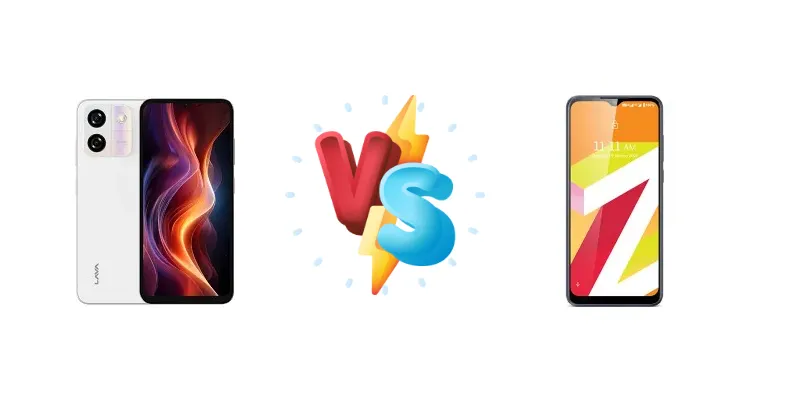
Lava is targeting the entry-level smartphone market with the Yuva Star 2 and Z2s, both aiming to deliver essential features at incredibly affordable prices. However, beneath the similar price points lie significant differences in their core hardware, particularly in their chipsets. This comparison dissects those differences to determine which device offers the best value for your money.
🏆 Quick Verdict
For the average user prioritizing responsiveness and a slightly smoother experience, the Lava Z2s is the better choice. Its Mediatek Helio G35, built on a 12nm process, offers a performance advantage over the Yuva Star 2’s older 28nm Unisoc SC9863A, despite similar core counts. While the Yuva Star 2 may offer slightly better battery efficiency due to its less powerful chip, the Z2s’ performance gains are more noticeable in daily use.
| Network |
|---|
| 2G bands | GSM 900 / 1800 | GSM 900 / 1800 |
| 3G bands | HSDPA 850 / 900 / 1900 / 2100 | HSDPA 900 / 2100 |
| 4G bands | LTE | 1, 3, 5, 8, 40, 41 |
| Speed | HSPA, LTE | HSPA 42.2/5.76 Mbps, LTE Cat4 150/50 Mbps |
| Technology | GSM / HSPA / LTE | GSM / HSPA / LTE |
| Launch |
|---|
| Announced | 2025, May 05 | 2021, January 07 |
| Status | Available. Released 2025, May 05 | Available. Released 2021, January 11 |
| Body |
|---|
| Build | - | Glass front, plastic back, plastic frame |
| Dimensions | - | 164.5 x 75.8 x 9 mm (6.48 x 2.98 x 0.35 in) |
| SIM | Nano-SIM + Nano-SIM | Nano-SIM + Nano-SIM |
| Weight | - | 190 g (6.70 oz) |
| Display |
|---|
| Protection | - | Corning Gorilla Glass 3 |
| Resolution | 720 x 1600 pixels, 20:9 ratio (~260 ppi density) | 720 x 1600 pixels, 20:9 ratio (~270 ppi density) |
| Size | 6.75 inches, 110.0 cm2 (~87.6% screen-to-body ratio) | 6.51 inches, 102.3 cm2 (~82.1% screen-to-body ratio) |
| Type | IPS LCD | IPS LCD |
| Platform |
|---|
| CPU | Octa-core (4x1.6 GHz Cortex-A55 & 4x1.2 GHz Cortex-A55) | Octa-core (4x2.3 GHz Cortex-A53 & 4x1.8 GHz Cortex-A53) |
| Chipset | Unisoc SC9863A (28 nm) | Mediatek MT6765G Helio G35 (12 nm) |
| GPU | IMG8322 | PowerVR GE8320 |
| OS | Android 14 (Go edition) | Android 11 (Go edition) |
| Memory |
|---|
| Card slot | microSDXC (dedicated slot) | microSDXC (dedicated slot) |
| Internal | 64GB 4GB RAM | 32GB 2GB RAM |
| | - | eMMC 5.1 |
| Main Camera |
|---|
| Dual | 13 MP, (wide), AF
auxiliary lens | - |
| Features | LED flash, HDR, panorama | LED flash |
| Single | - | 8 MP, f/2.0, (wide), 1.12µm, AF |
| Video | 1080p@30fps | 1080p@30fps |
| Selfie camera |
|---|
| Single | 5 MP | 5 MP, f/2.2, (wide) |
| Video | Yes | 1080p@30fps |
| Sound |
|---|
| 3.5mm jack | - | Yes |
| 35mm jack | Yes | Yes |
| Loudspeaker | Yes | Yes |
| Comms |
|---|
| Bluetooth | 4.2, A2DP | 5.0, A2DP, LE |
| Infrared port | Yes | - |
| NFC | No | No |
| Positioning | GPS, GLONASS | GPS |
| Radio | FM radio | FM radio |
| USB | USB Type-C 2.0, OTG | USB Type-C |
| WLAN | Wi-Fi 802.11 b/g/n/ac | Wi-Fi 802.11 b/g/n, Wi-Fi Direct |
| Features |
|---|
| Sensors | Fingerprint (side-mounted), accelerometer, proximity | Accelerometer |
| Battery |
|---|
| Charging | 10W wired | - |
| Type | Li-Ion 5000 mAh | Li-Po 5000 mAh |
| Misc |
|---|
| Colors | Radiant Black, Sparkling Ivory | Striped Blue |
| Price | About 70 EUR | About 80 EUR |
Lava Yuva Star 2
- Potentially longer battery life due to less powerful chipset.
- Lower price point (likely).
- Simpler user experience for basic tasks.
- Significantly slower performance compared to the Z2s.
- Older chipset architecture.
- Less responsive user interface.
Lava Z2s
- More responsive performance thanks to the Helio G35.
- More modern chipset architecture.
- Better suited for casual gaming and multitasking.
- Potentially shorter battery life.
- May be slightly more expensive.
- 10W charging is relatively slow.
Display Comparison
Neither Lava provides detailed display specifications beyond resolution. However, given the price point, both likely utilize IPS LCD panels. The absence of information regarding peak brightness, color gamut coverage, or refresh rates suggests a focus on cost reduction. Bezels are expected to be noticeable on both devices. Without further data, a direct comparison is impossible, but the display quality is unlikely to be a differentiating factor.
Camera Comparison
Both phones likely feature basic camera setups geared towards casual photography. Without detailed sensor information, it’s difficult to make a meaningful comparison. The presence of a 2MP macro camera on either device is largely a marketing tactic, as image quality will be limited. The primary sensor’s size and aperture are the key determinants of image quality, but this information is unavailable. Image processing will likely be minimal on both devices, relying heavily on software algorithms to enhance photos.
Performance
The core difference lies in the chipsets. The Lava Z2s’ Mediatek Helio G35 (12nm) is a more modern design than the Yuva Star 2’s Unisoc SC9863A (28nm). While both are octa-core CPUs, the Helio G35 utilizes Cortex-A53 cores clocked at 2.3 GHz and 1.8 GHz, while the SC9863A uses Cortex-A55 cores at 1.6 GHz and 1.2 GHz. The A53 architecture is older and less efficient than the A55. The 12nm process node of the Helio G35 also contributes to better power efficiency and thermal performance compared to the 28nm node of the SC9863A. This translates to snappier app launches and smoother multitasking on the Z2s. The GPU within the Helio G35 will also provide a more capable gaming experience, even if limited to low settings.
Battery Life
Battery capacity is not specified for either device. However, the Unisoc SC9863A in the Yuva Star 2, being less powerful, will likely consume less energy, potentially resulting in longer battery life. The Z2s’ 10W charging is standard for this price segment, and both phones will likely take several hours to fully charge. The difference in charging time will be minimal, and real-world battery life will depend heavily on usage patterns.
Buying Guide
Buy the Lava Yuva Star 2 if you primarily need a phone for basic communication – calls, texts, and light social media – and prioritize maximizing battery life above all else. Its older chipset consumes less power. Buy the Lava Z2s if you want a more responsive experience for app switching, browsing, and casual gaming, and are willing to trade a small amount of potential battery life for improved performance. The Z2s is better suited for users who don't want to feel limited by their phone's processing power.
Frequently Asked Questions
❓ Will the Lava Z2s be able to run popular games like PUBG Mobile?
The Mediatek Helio G35 in the Z2s can run PUBG Mobile, but you'll need to lower the graphics settings to the lowest possible levels and accept a lower frame rate. It's not designed for high-end gaming, but it offers a playable experience for casual gamers.
❓ Is the Unisoc SC9863A in the Yuva Star 2 sufficient for everyday tasks like WhatsApp and browsing?
Yes, the Unisoc SC9863A is adequate for basic tasks like WhatsApp, web browsing, and making calls. However, you may experience noticeable lag when switching between apps or opening multiple tabs in a browser. It's best suited for users with minimal smartphone needs.
❓ How long will it take to fully charge the Lava Z2s with the 10W charger?
With the included 10W charger, expect the Lava Z2s to take approximately 3-4 hours to fully charge from 0% to 100%. This is typical for budget smartphones with slower charging capabilities.
❓ Does either phone support VoLTE and ViLTE for improved call quality?
While not explicitly stated, both the Lava Yuva Star 2 and Z2s are likely to support VoLTE (Voice over LTE) given current network standards. ViLTE (Video over LTE) support is less certain and would depend on carrier compatibility. Check with your mobile carrier for specific support details.