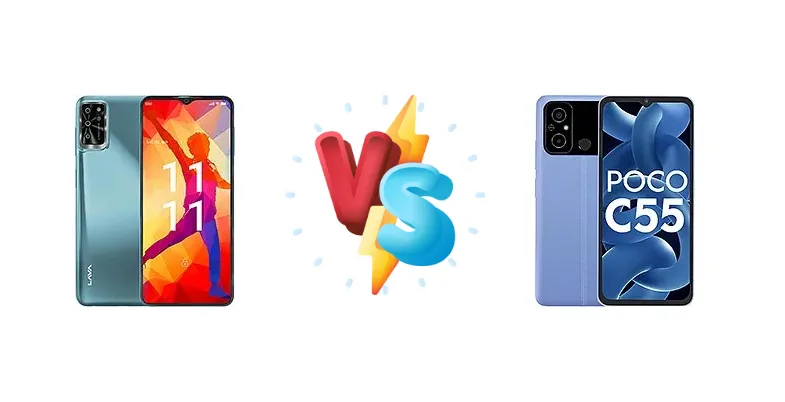
The sub-$150 smartphone market is fiercely competitive. The Lava Yuva Pro and Xiaomi Poco C55 represent two contenders vying for the attention of first-time smartphone buyers and those seeking a reliable secondary device. While both devices share a similar price point and 10W charging, a crucial difference lies in the Poco C55’s Mediatek Helio G85 chipset, offering a significant performance advantage over the Yuva Pro’s unspecified processor.
🏆 Quick Verdict
For the average user prioritizing everyday tasks and occasional gaming, the Xiaomi Poco C55 is the clear winner. The Helio G85 chipset delivers a noticeably smoother experience and better app loading times. However, the Lava Yuva Pro may appeal to those seeking a potentially more durable build, though this is speculative given the limited data.
| Network |
|---|
| 2G bands | GSM 900 / 1800 | GSM 850 / 900 / 1800 / 1900 |
| 3G bands | HSDPA 900 / 2100 | HSDPA 850 / 900 / 2100 |
| 4G bands | 1, 3, 5, 8, 40, 41 | 1, 3, 5, 8, 40, 41 |
| Speed | HSPA, LTE | HSPA, LTE |
| Technology | GSM / HSPA / LTE | GSM / HSPA / LTE |
| Launch |
|---|
| Announced | 2022, October 11 | 2023, February 21 |
| Status | Available. Released 2022, October 11 | Available. Released 2023, February 28 |
| Body |
|---|
| Build | - | Glass front (Panda Glass), eco leather back |
| Dimensions | 164.4 x 75.8 x 8.9 mm (6.47 x 2.98 x 0.35 in) | 168.8 x 76.4 x 8.8 mm (6.65 x 3.01 x 0.35 in) |
| SIM | Nano-SIM + Nano-SIM | Nano-SIM + Nano-SIM |
| Weight | 191 g (6.74 oz) | 192 g (6.77 oz) |
| | - | Dust and splash resistant |
| Display |
|---|
| Protection | - | Panda Glass |
| Resolution | 720 x 1600 pixels, 20:9 ratio (~269 ppi density) | 720 x 1650 pixels (~268 ppi density) |
| Size | 6.52 inches, 102.6 cm2 (~82.4% screen-to-body ratio) | 6.71 inches, 106.5 cm2 (~82.6% screen-to-body ratio) |
| Type | IPS LCD | IPS LCD |
| Platform |
|---|
| CPU | - | Octa-core (2x2.0 GHz Cortex-A75 & 6x1.8 GHz Cortex-A55) |
| Chipset | - | Mediatek MT6769Z Helio G85 (12 nm) |
| GPU | - | Mali-G52 MC2 |
| OS | Android 12 | Android 12, MIUI 13 for POCO |
| Memory |
|---|
| Card slot | microSDXC (dedicated slot) | microSDXC (dedicated slot) |
| Internal | 32GB 3GB RAM | 64GB 4GB RAM, 128GB 6GB RAM |
| | eMMC 5.1 | eMMC 5.1 |
| Main Camera |
|---|
| Dual | - | 50 MP, f/1.8, (wide), PDAF
0.08 MP (depth) |
| Features | LED flash | LED flash, HDR |
| Single | 13 MP, (wide), PDAF
Auxiliary lenses | 50 MP, f/1.8, (wide), PDAF
Auxiliary lens |
| Triple | 13 MP, (wide), AF
other unspecified cameras | - |
| Video | 1080p@30fps | 1080p@30fps |
| Selfie camera |
|---|
| Features | - | HDR |
| Single | 8 MP | 5 MP |
| Video | Yes | 1080p@30fps |
| Sound |
|---|
| 3.5mm jack | Yes | Yes |
| 35mm jack | Yes | Yes |
| Loudspeaker | Yes | Yes |
| Comms |
|---|
| Bluetooth | 5.0, A2DP, LE | 5.0, A2DP, LE |
| NFC | No | No |
| Positioning | GPS | GPS, GLONASS, GALILEO, BDS, QZSS |
| Radio | FM radio | FM radio, recording |
| USB | USB Type-C 2.0, OTG | microUSB 2.0, OTG |
| WLAN | Wi-Fi 802.11 b/g/n/ac | Wi-Fi 802.11 a/b/g/n/ac, dual-band |
| Features |
|---|
| Sensors | Fingerprint (side-mounted), accelerometer, proximity | Fingerprint (rear-mounted), accelerometer |
| | - | Virtual proximity sensing |
| Battery |
|---|
| Charging | 10W wired | 10W wired |
| Type | Li-Po 5000 mAh | Li-Po 5000 mAh |
| Misc |
|---|
| Colors | Metallic Black, Metallic Blue, Metallic Grey | Cool Blue, Power Black, Forest Green |
| Models | LIX402 | 22127PC95I |
| Price | About 100 EUR | About 110 EUR |
| SAR | - | 0.87 W/kg (head) 0.77 W/kg (body) |
Lava Yuva Pro
- Potentially more durable build quality (based on brand reputation)
- Simple and straightforward user experience
- Lower price point (potentially)
- Significantly weaker performance due to unspecified chipset
- Likely limited multitasking capabilities
- Poor gaming performance
Xiaomi Poco C55
- Superior performance with the Mediatek Helio G85
- Better multitasking and app loading speeds
- More capable for light gaming
- Slow 10W charging
- Basic camera system
- Potential for thermal throttling during extended gaming
Display Comparison
Both the Lava Yuva Pro and Xiaomi Poco C55 lack detailed display specifications in the provided data. However, given their price bracket, it’s safe to assume both utilize LCD panels. The absence of information regarding resolution, peak brightness, or color gamut suggests neither device will excel in display quality. Bezels are likely to be substantial on both, and color accuracy will likely be standard for this segment. Without further data, a direct comparison is impossible.
Camera Comparison
Camera details are sparse for both devices. Without sensor size, aperture information, or image processing details, a meaningful comparison is difficult. It’s reasonable to assume both phones feature basic camera setups geared towards casual photography. The presence of a 2MP macro camera on the Poco C55 is unlikely to provide significant value, as image quality from such sensors is typically poor. The Poco C55’s processor may offer slightly better image processing capabilities, but the overall camera experience will likely be similar on both devices.
Performance
The Xiaomi Poco C55’s Mediatek Helio G85 (12nm) is the defining performance differentiator. This octa-core processor, featuring 2x2.0 GHz Cortex-A75 and 6x1.8 GHz Cortex-A55 cores, provides a substantial uplift in CPU and GPU performance compared to the Lava Yuva Pro, which lacks a specified chipset. The Helio G85’s architecture allows for smoother multitasking and more responsive app launches. While neither phone is a gaming powerhouse, the Poco C55 will handle titles like PUBG Mobile at lower settings with a playable frame rate, something the Yuva Pro will likely struggle with. The 12nm process node of the Helio G85 is reasonably efficient, but thermal throttling could become a factor during extended gaming sessions.
Battery Life
Both the Lava Yuva Pro and Xiaomi Poco C55 are equipped with 10W wired charging. This slow charging speed means a full 0-100% charge will take a considerable amount of time – likely over 3 hours. While battery capacity isn’t specified for either device, the Poco C55’s more efficient processor may translate to slightly better battery life during typical usage. The slow charging speed is a significant drawback for both phones, making overnight charging essential.
Buying Guide
Buy the Lava Yuva Pro if you prioritize a potentially more robust build quality (based on Lava’s brand reputation for durability) and are primarily focused on basic communication tasks like calls and messaging. Buy the Xiaomi Poco C55 if you need a phone capable of handling social media, streaming video, and light gaming without significant lag, thanks to the Helio G85’s octa-core architecture.
Frequently Asked Questions
❓ Will the Poco C55’s Helio G85 overheat during prolonged gaming sessions?
The Helio G85 is a reasonably efficient chip, but it can experience thermal throttling during extended gaming. Expect frame rate drops after 30-45 minutes of demanding gameplay. It’s best suited for casual gaming at lower settings.
❓ Is the 10W charging on either phone a significant drawback?
Yes, 10W charging is quite slow by modern standards. Expect a full charge to take over 3 hours. It’s best to charge these phones overnight to ensure they’re ready for the day.
❓ Can the Poco C55 handle popular social media apps like Facebook and Instagram smoothly?
Yes, the Helio G85 is more than capable of handling social media apps like Facebook and Instagram without significant lag. Multitasking between these apps should also be relatively smooth.
❓ What type of storage does the Poco C55 use, and is it expandable?
While not specified in the provided data, the Poco C55 typically comes with eMMC storage, which is slower than UFS storage. It also usually includes a dedicated microSD card slot for expandable storage, allowing you to add more space for photos, videos, and apps.