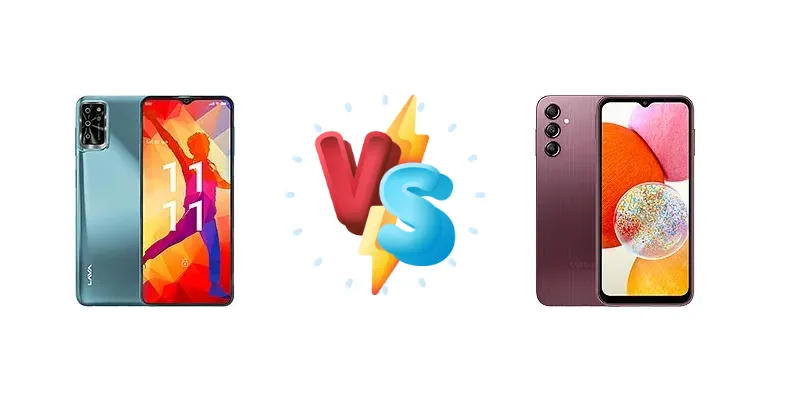
The sub-$150 smartphone market is fiercely competitive. The Lava Yuva Pro and Samsung Galaxy A14 both aim to deliver essential smartphone functionality at an accessible price point. However, they take different approaches: the Yuva Pro focuses on simplicity, while the Galaxy A14 offers chipset variations and a more established brand ecosystem. This comparison dissects their key differences to help you choose the right device.
🏆 Quick Verdict
For most users, the Samsung Galaxy A14 (specifically the Exynos 850 variant) is the better choice. Its more powerful processor provides a smoother experience for multitasking and gaming, and the 15W charging offers a slight convenience advantage. However, the Lava Yuva Pro remains a viable option for those prioritizing extreme affordability.
| Network |
|---|
| 2G bands | GSM 900 / 1800 | GSM 850 / 900 / 1800 / 1900 |
| 3G bands | HSDPA 900 / 2100 | HSDPA 850 / 900 / 2100 |
| 4G bands | 1, 3, 5, 8, 40, 41 | 1, 3, 5, 7, 8, 20, 28, 38, 40, 41 |
| Speed | HSPA, LTE | HSPA, LTE |
| Technology | GSM / HSPA / LTE | GSM / HSPA / LTE |
| Launch |
|---|
| Announced | 2022, October 11 | 2023, February 28 |
| Status | Available. Released 2022, October 11 | Available. Released 2023, March 27 |
| Body |
|---|
| Build | - | Glass front, plastic back, plastic frame |
| Dimensions | 164.4 x 75.8 x 8.9 mm (6.47 x 2.98 x 0.35 in) | 167.7 x 78 x 9.1 mm (6.60 x 3.07 x 0.36 in) |
| SIM | Nano-SIM + Nano-SIM | · Nano-SIM· Nano-SIM + Nano-SIM |
| Weight | 191 g (6.74 oz) | 201 g (7.09 oz) |
| Display |
|---|
| Resolution | 720 x 1600 pixels, 20:9 ratio (~269 ppi density) | 1080 x 2408 pixels, 20:9 ratio (~400 ppi density) |
| Size | 6.52 inches, 102.6 cm2 (~82.4% screen-to-body ratio) | 6.6 inches, 104.9 cm2 (~80.2% screen-to-body ratio) |
| Type | IPS LCD | PLS LCD |
| Platform |
|---|
| CPU | - | Octa-core (2x2.0 GHz Cortex-A75 & 6x1.8 GHz Cortex-A55) - Version AOcta-core (4x2.0 GHz Cortex-A55 & 4x2.0 GHz Cortex-A55) - Version B |
| Chipset | - | Mediatek MT6769 Helio G80 (12 nm) - Version AExynos 850 (8 nm) - Version B |
| GPU | - | Mali-G52 MC2 |
| OS | Android 12 | Android 13, upgradable to Android 15, One UI 7 |
| Memory |
|---|
| Card slot | microSDXC (dedicated slot) | microSDXC (dedicated slot) |
| Internal | 32GB 3GB RAM | 64GB 4GB RAM, 128GB 4GB RAM, 128GB 6GB RAM |
| | eMMC 5.1 | - |
| Main Camera |
|---|
| Features | LED flash | LED flash, panorama, HDR |
| Single | 13 MP, (wide), PDAF
Auxiliary lenses | 13 MP, f/2.0, (wide) |
| Triple | 13 MP, (wide), AF
other unspecified cameras | 50 MP, f/1.8, 26mm (wide), 1/2.75", 0.64µm, PDAF
5 MP, f/2.2, 17mm (ultrawide), 1/5.0", 1.12µm
2 MP (macro) |
| Video | 1080p@30fps | 1080p@30fps |
| Selfie camera |
|---|
| Single | 8 MP | 13 MP, f/2.0, 26mm (wide), 1/3.1", 1.12µm |
| Video | Yes | 1080p@30fps |
| Sound |
|---|
| 3.5mm jack | Yes | Yes |
| 35mm jack | Yes | Yes |
| Loudspeaker | Yes | Yes |
| Comms |
|---|
| Bluetooth | 5.0, A2DP, LE | 5.1 or 5.3, A2DP, LE |
| NFC | No | Yes (market/region dependent) |
| Positioning | GPS | GPS, GALILEO, GLONASS, BDS, QZSS |
| Radio | FM radio | Unspecified |
| USB | USB Type-C 2.0, OTG | USB Type-C 2.0 |
| WLAN | Wi-Fi 802.11 b/g/n/ac | Wi-Fi 802.11 a/b/g/n/ac, dual-band, Wi-Fi Direct |
| Features |
|---|
| Sensors | Fingerprint (side-mounted), accelerometer, proximity | Fingerprint (side-mounted), accelerometer, proximity, compass |
| Battery |
|---|
| Charging | 10W wired | 15W wired |
| Type | Li-Po 5000 mAh | Li-Po 5000 mAh |
| Misc |
|---|
| Colors | Metallic Black, Metallic Blue, Metallic Grey | Black, Dark Red, Silver, Green |
| Models | LIX402 | SM-A145F, SM-A145F/DSN, SM-A145M, SM-A145M/DS, SM-A145P, SM-A145R |
| Price | About 100 EUR | € 85.76 / $ 147.60 / £ 79.95 |
| SAR EU | - | 0.46 W/kg (head) 1.37 W/kg (body) |
Lava Yuva Pro
- Extremely affordable price point
- Simple and straightforward user experience
- Likely durable build quality (Lava's reputation)
- Underpowered processor
- Slow charging speed (10W)
- Limited software support
Samsung Galaxy A14
- More powerful processor options (Helio G80 or Exynos 850)
- Faster charging (15W)
- Samsung’s software ecosystem and support
- Slightly higher price
- PLS LCD display isn't exceptional
- Potential for bloatware
Display Comparison
Neither device boasts a standout display. Details regarding the Lava Yuva Pro’s display are scarce, suggesting a standard LCD panel. The Samsung Galaxy A14 features a 6.6-inch PLS LCD, which is comparable in quality to a typical IPS LCD. The lack of high refresh rates or advanced features like LTPO on either device means the visual experience will be fairly standard for this price bracket. Bezels are likely to be noticeable on both, impacting the overall screen-to-body ratio.
Camera Comparison
Camera performance is likely to be similar on both devices, leaning towards adequate rather than exceptional. The Galaxy A14’s main sensor details are missing, but it’s reasonable to assume a 13MP or similar sensor. The Yuva Pro’s camera specifications are also unavailable. Both devices likely include a suite of secondary cameras, including a depth sensor and potentially a macro lens, but these are often of limited utility. Image processing will likely favor Samsung’s more refined algorithms, potentially resulting in more pleasing photos in challenging lighting conditions.
Performance
This is where the Galaxy A14 pulls ahead, but with a caveat. Samsung offers two versions: one with the MediaTek Helio G80 and another with the Exynos 850. The Helio G80 (12nm) features a dual-cluster CPU configuration with 2x2.0 GHz Cortex-A75 cores and 6x1.8 GHz Cortex-A55 cores. The Exynos 850 (8nm) uses a more efficient octa-core setup with 4x2.0 GHz Cortex-A55 cores and 4x2.0 GHz Cortex-A55 cores. The 8nm process node of the Exynos 850 provides a significant advantage in power efficiency, translating to better sustained performance and less thermal throttling compared to the 12nm Helio G80. The Lava Yuva Pro’s chipset is unspecified, but given its price point, it’s likely to be a significantly less powerful MediaTek Helio A series or similar, resulting in noticeably slower app loading times and less fluid multitasking.
Battery Life
Battery capacity details for the Lava Yuva Pro are unavailable, but it’s likely to be in the 4000-5000 mAh range, typical for this segment. The Samsung Galaxy A14 packs a 5000 mAh battery. The charging speeds differ: the Yuva Pro supports 10W wired charging, while the A14 supports 15W. While not fast charging by modern standards, the 15W charging on the A14 will result in a noticeably quicker 0-100% charge time compared to the Yuva Pro. The Exynos 850’s efficiency further contributes to potentially longer battery life on the A14.
Buying Guide
Buy the Lava Yuva Pro if you need a basic, reliable smartphone for calls, texts, and light social media use, and your budget is extremely limited. You're willing to sacrifice performance and charging speed for the lowest possible price. Buy the Samsung Galaxy A14 if you prefer a more responsive user experience, enjoy occasional gaming, and value the Samsung brand's software support and wider feature set. The A14’s chipset options provide a performance boost over the Yuva Pro.
Frequently Asked Questions
❓ Does the Exynos 850 chip in the Samsung Galaxy A14 overheat during prolonged gaming sessions?
The Exynos 850 is an 8nm chip, which is relatively efficient. While it won't deliver flagship-level gaming performance, it's unlikely to overheat significantly during moderate gaming. Expect some throttling after extended periods, but it shouldn't lead to a complete shutdown.
❓ Is the 2MP macro camera on the Samsung Galaxy A14 actually useful for taking detailed close-up photos?
Generally, 2MP macro cameras on budget phones are of limited utility. The low resolution results in images lacking detail and sharpness. It can be fun to experiment with, but don't expect professional-quality macro photography.
❓ What kind of software updates can I expect on the Lava Yuva Pro?
Lava's software update track record is less established than Samsung's. Expect limited updates, primarily security patches, and potentially one major Android version upgrade. Don't anticipate the same level of long-term support as you'd receive with a Samsung device.
❓ Will the Samsung Galaxy A14 run PUBG Mobile smoothly?
The Samsung Galaxy A14 with the Exynos 850 should be able to run PUBG Mobile at medium settings with a stable frame rate. The Helio G80 variant may require lower settings for a smooth experience. Don't expect to max out the graphics settings.