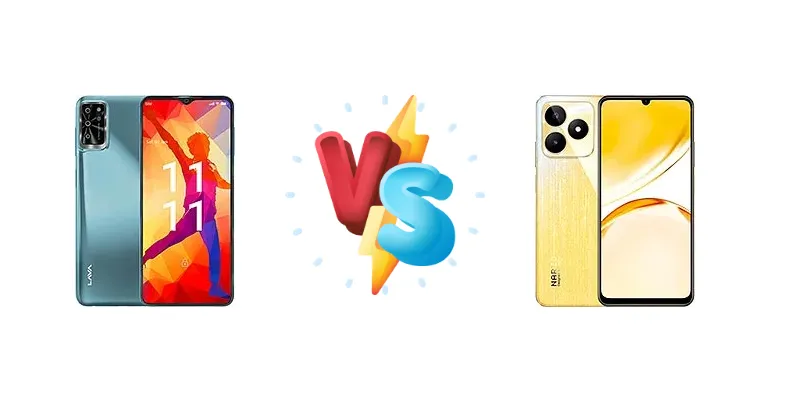
The sub-$150 smartphone market is fiercely competitive. The Lava Yuva Pro and Realme Narzo N53 represent two distinct approaches to delivering value. The Yuva Pro focuses on simplicity, while the Narzo N53 introduces a more modern chipset and significantly faster charging. This comparison will dissect their strengths and weaknesses to determine which device best suits your needs.
🏆 Quick Verdict
For the average user prioritizing quick top-ups and a more responsive experience, the Realme Narzo N53 is the clear winner. Its 33W charging and Unisoc Tiger T612 chipset offer a tangible advantage over the Lava Yuva Pro's slower charging and unspecified processor. However, the Yuva Pro may appeal to those seeking a basic, reliable device.
| Network |
|---|
| 2G bands | GSM 900 / 1800 | GSM 850 / 900 / 1800 / 1900 |
| 3G bands | HSDPA 900 / 2100 | HSDPA 850 / 900 / 2100 |
| 4G bands | 1, 3, 5, 8, 40, 41 | 1, 3, 5, 8, 38, 40, 41 |
| Speed | HSPA, LTE | HSPA, LTE |
| Technology | GSM / HSPA / LTE | GSM / HSPA / LTE |
| Launch |
|---|
| Announced | 2022, October 11 | 2023, May 18 |
| Status | Available. Released 2022, October 11 | Available. Released 2023, May 22 |
| Body |
|---|
| Build | - | Glass front, plastic frame, plastic back |
| Dimensions | 164.4 x 75.8 x 8.9 mm (6.47 x 2.98 x 0.35 in) | 167.3 x 76.7 x 7.5 mm (6.59 x 3.02 x 0.30 in) |
| SIM | Nano-SIM + Nano-SIM | Nano-SIM + Nano-SIM |
| Weight | 191 g (6.74 oz) | 182 g (6.42 oz) |
| Display |
|---|
| Resolution | 720 x 1600 pixels, 20:9 ratio (~269 ppi density) | 1080 x 2400 pixels, 20:9 ratio (~390 ppi density) |
| Size | 6.52 inches, 102.6 cm2 (~82.4% screen-to-body ratio) | 6.74 inches, 109.7 cm2 (~85.5% screen-to-body ratio) |
| Type | IPS LCD | IPS LCD, 90Hz, 450 nits (peak) |
| Platform |
|---|
| CPU | - | Octa-core (2x1.8 GHz Cortex-A75 & 6x1.8 GHz Cortex-A55) |
| Chipset | - | Unisoc Tiger T612 (12 nm) |
| GPU | - | Mali-G57 |
| OS | Android 12 | Android 13, Realme UI T |
| Memory |
|---|
| Card slot | microSDXC (dedicated slot) | microSDXC (dedicated slot) |
| Internal | 32GB 3GB RAM | 64GB 4GB RAM, 128GB 6GB RAM, 128GB 8GB RAM |
| | eMMC 5.1 | - |
| Main Camera |
|---|
| Dual | - | 50 MP, f/1.8, (wide), PDAF
Auxiliary lens |
| Features | LED flash | LED flash, HDR, panorama |
| Single | 13 MP, (wide), PDAF
Auxiliary lenses | - |
| Triple | 13 MP, (wide), AF
other unspecified cameras | - |
| Video | 1080p@30fps | 1080p@30fps |
| Selfie camera |
|---|
| Features | - | HDR |
| Single | 8 MP | 8 MP, f/2.0, (wide) |
| Video | Yes | 720p@30fps |
| Sound |
|---|
| 3.5mm jack | Yes | Yes |
| 35mm jack | Yes | Yes |
| Loudspeaker | Yes | Yes |
| Comms |
|---|
| Bluetooth | 5.0, A2DP, LE | 5.0, A2DP, LE |
| NFC | No | No |
| Positioning | GPS | GPS, GLONASS, GALILEO |
| Radio | FM radio | Unspecified |
| USB | USB Type-C 2.0, OTG | USB Type-C 2.0 |
| WLAN | Wi-Fi 802.11 b/g/n/ac | Wi-Fi 802.11 a/b/g/n/ac, dual-band |
| Features |
|---|
| Sensors | Fingerprint (side-mounted), accelerometer, proximity | Fingerprint (side-mounted), accelerometer, gyro, proximity, compass |
| Battery |
|---|
| Charging | 10W wired | 33W wired, 50% in 31 min |
| Type | Li-Po 5000 mAh | 5000 mAh |
| Misc |
|---|
| Colors | Metallic Black, Metallic Blue, Metallic Grey | Black, Gold |
| Models | LIX402 | RMX3761 |
| Price | About 100 EUR | About 100 EUR |
Lava Yuva Pro
- Potentially lower price point
- Simple and easy to use interface (assumed)
- Reliable for basic communication
- Slow 10W charging
- Unspecified and likely underpowered chipset
- Limited performance for multitasking and gaming
Realme Narzo N53
- Fast 33W charging (50% in 31 min)
- Unisoc Tiger T612 chipset for improved performance
- More responsive user experience
- May be slightly more expensive than the Yuva Pro
- LCD display may not be as vibrant as AMOLED alternatives
- Software updates may be less frequent than established brands
Display Comparison
Both devices likely feature LCD panels, common in this price bracket. However, detailed display specifications like resolution, peak brightness, and color gamut are missing for the Lava Yuva Pro. The Realme Narzo N53, while also likely LCD, benefits from a more modern design and potentially better viewing angles. Without specific data on the Yuva Pro's panel, it's difficult to assess its color accuracy or outdoor visibility compared to the Narzo N53.
Camera Comparison
Camera details are sparse for both devices. It's safe to assume both will feature a primary camera and potentially a secondary depth or macro sensor. However, the Realme Narzo N53 likely benefits from more sophisticated image processing algorithms thanks to its more modern chipset. Without sensor size or aperture information for either device, a direct comparison is difficult. The presence of a more powerful ISP (Image Signal Processor) within the T612 suggests the Narzo N53 will produce more detailed and vibrant photos, especially in challenging lighting conditions.
Performance
The Realme Narzo N53’s Unisoc Tiger T612 (12 nm) chipset is the defining performance difference. Its octa-core configuration, with 2x1.8 GHz Cortex-A75 and 6x1.8 GHz Cortex-A55 cores, provides a significant uplift in CPU performance compared to the Lava Yuva Pro, which lacks chipset details. The T612’s 12nm process node, while not leading-edge, offers a reasonable balance of power and efficiency. This translates to smoother multitasking, faster app loading times, and a more enjoyable gaming experience on the Narzo N53. The Yuva Pro, lacking a specified chipset, is likely to struggle with demanding tasks.
Battery Life
The Realme Narzo N53’s 33W wired charging is a game-changer in this segment, capable of reaching 50% charge in just 31 minutes. This drastically reduces downtime compared to the Lava Yuva Pro’s slow 10W charging. While battery capacity isn’t specified for either device, the faster charging of the Narzo N53 effectively mitigates any potential capacity disadvantage. Users who frequently top up their phones will greatly appreciate the convenience of the Narzo N53’s charging speed.
Buying Guide
Buy the Lava Yuva Pro if you need a supremely basic smartphone for essential communication – calls, texts, and light app usage – and prioritize simplicity above all else. You're willing to trade performance and charging speed for a potentially lower price point. Buy the Realme Narzo N53 if you prefer a more modern smartphone experience with faster charging, a more capable processor for multitasking and casual gaming, and a device that feels less constrained in everyday use.
Frequently Asked Questions
❓ Is the Unisoc Tiger T612 in the Realme Narzo N53 powerful enough for PUBG Mobile?
The Unisoc Tiger T612 can run PUBG Mobile, but expect to play at medium settings with a stable frame rate. Demanding graphics settings will likely result in frame drops. It's a capable chipset for casual gaming, but not a dedicated gaming powerhouse.
❓ How long will it take to fully charge the Realme Narzo N53 from 0% to 100%?
While the Narzo N53 reaches 50% in 31 minutes with 33W charging, a full 0-100% charge will take approximately 65-75 minutes, depending on usage during charging. This is still significantly faster than the Lava Yuva Pro’s 10W charging.
❓ Does the Lava Yuva Pro support any form of fast charging?
No, the Lava Yuva Pro only supports 10W wired charging, which is considerably slower than the 33W charging offered by the Realme Narzo N53. Expect a full charge to take several hours.
❓ What type of USB port do both phones use?
Both devices are expected to use a USB-C port, which is standard for modern smartphones. This allows for faster data transfer and more versatile connectivity.