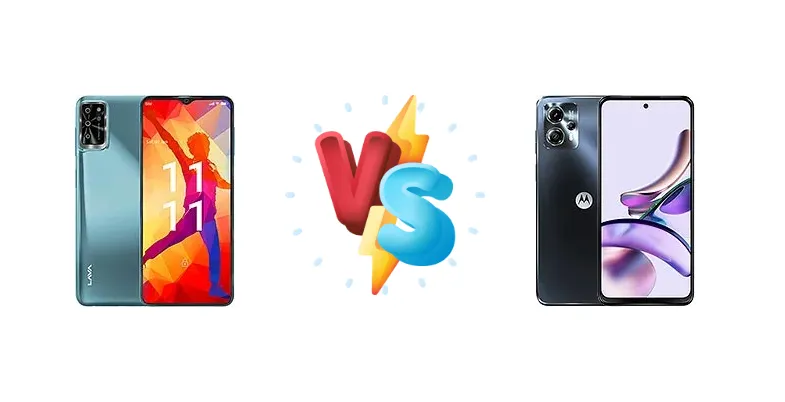
The sub-$150 smartphone market is fiercely competitive. The Lava Yuva Pro and Motorola Moto G13 both aim to deliver essential smartphone functionality at an accessible price point. However, they take different approaches: the Lava Yuva Pro focuses on simplicity, while the Moto G13 prioritizes processing power with its Mediatek Helio G85 chipset. This comparison will dissect their key differences to help you determine which device best suits your needs.
🏆 Quick Verdict
For the average user, the Motorola Moto G13 is the superior choice. Its Mediatek Helio G85 chipset provides a noticeable performance boost over the Lava Yuva Pro, making it better suited for multitasking, gaming, and demanding applications. While the Lava Yuva Pro may offer slightly better battery life due to its lower power chipset, the G13’s faster charging mitigates this difference.
| Network |
|---|
| 2G bands | GSM 900 / 1800 | GSM 850 / 900 / 1800 / 1900 |
| 3G bands | HSDPA 900 / 2100 | HSDPA 850 / 900 / 1900 / 2100 |
| 4G bands | 1, 3, 5, 8, 40, 41 | 1, 2, 3, 5, 7, 8, 20, 38, 40, 41 |
| Speed | HSPA, LTE | HSPA, LTE |
| Technology | GSM / HSPA / LTE | GSM / HSPA / LTE |
| Launch |
|---|
| Announced | 2022, October 11 | 2023, January 24 |
| Status | Available. Released 2022, October 11 | Available. Released 2023, January 24 |
| Body |
|---|
| Build | - | Glass front, plastic frame, plastic back |
| Dimensions | 164.4 x 75.8 x 8.9 mm (6.47 x 2.98 x 0.35 in) | 162.7 x 74.7 x 8.2 mm (6.41 x 2.94 x 0.32 in) |
| SIM | Nano-SIM + Nano-SIM | · Nano-SIM· Nano-SIM + Nano-SIM |
| Weight | 191 g (6.74 oz) | 183.5 g (6.49 oz) |
| | - | Water-resistant design |
| Display |
|---|
| Protection | - | Panda glass |
| Resolution | 720 x 1600 pixels, 20:9 ratio (~269 ppi density) | 720 x 1600 pixels, 20:9 ratio (~270 ppi density) |
| Size | 6.52 inches, 102.6 cm2 (~82.4% screen-to-body ratio) | 6.5 inches, 102.0 cm2 (~83.9% screen-to-body ratio) |
| Type | IPS LCD | IPS LCD, 90Hz, 400 nits (peak) |
| Platform |
|---|
| CPU | - | Octa-core (2x2.0 GHz Cortex-A75 & 6x1.8 GHz Cortex-A55) |
| Chipset | - | Mediatek MT6769Z Helio G85 (12 nm) |
| GPU | - | Mali-G52 MC2 |
| OS | Android 12 | Android 13 |
| Memory |
|---|
| Card slot | microSDXC (dedicated slot) | microSDXC (dedicated slot) |
| Internal | 32GB 3GB RAM | 64GB 4GB RAM, 128GB 4GB RAM |
| | eMMC 5.1 | - |
| Main Camera |
|---|
| Features | LED flash | LED flash, HDR, panorama |
| Single | 13 MP, (wide), PDAF
Auxiliary lenses | - |
| Triple | 13 MP, (wide), AF
other unspecified cameras | 50 MP, f/1.8, (wide), 0.64µm, PDAF
2 MP (macro)
Auxiliary lens |
| Video | 1080p@30fps | 1080p@30fps |
| Selfie camera |
|---|
| Single | 8 MP | 8 MP, f/2.0, (wide), 1/4.0", 1.12µm |
| Video | Yes | 1080p@30fps |
| Sound |
|---|
| 3.5mm jack | Yes | Yes |
| 35mm jack | Yes | Yes |
| Loudspeaker | Yes | Yes, with stereo speakers |
| Comms |
|---|
| Bluetooth | 5.0, A2DP, LE | 5.1, A2DP, LE |
| NFC | No | Yes (market/region dependent) |
| Positioning | GPS | GPS, GLONASS, GALILEO |
| Radio | FM radio | Unspecified |
| USB | USB Type-C 2.0, OTG | USB Type-C 2.0 |
| WLAN | Wi-Fi 802.11 b/g/n/ac | Wi-Fi 802.11 a/b/g/n/ac, dual-band |
| Features |
|---|
| Sensors | Fingerprint (side-mounted), accelerometer, proximity | Fingerprint (side-mounted), accelerometer, gyro, proximity |
| Battery |
|---|
| Charging | 10W wired | 20W or 10W wired |
| Type | Li-Po 5000 mAh | Li-Po 5000 mAh |
| Misc |
|---|
| Colors | Metallic Black, Metallic Blue, Metallic Grey | Matte Charcoal, Blue Lavender, Rose Gold |
| Models | LIX402 | - |
| Price | About 100 EUR | About 160 EUR |
Lava Yuva Pro
- Potentially simpler software experience
- May offer slightly longer battery life with minimal usage
- Likely more affordable
- Significantly weaker performance
- Slow 10W charging
- Limited future-proofing
Motorola Moto G13
- Superior performance with Mediatek Helio G85
- Faster 20W charging (or 10W option)
- More versatile for multitasking and gaming
- May have slightly shorter battery life under heavy load
- Potentially higher price
- Motorola's software bloat (though generally minimal)
Display Comparison
Neither device boasts a standout display. The context data lacks specifics on panel technology (IPS, AMOLED) or resolution for the Lava Yuva Pro, suggesting a basic LCD panel typical of this price bracket. The Moto G13 also likely utilizes an LCD, but the focus is on its 6.5-inch size. Without brightness data for either, it's safe to assume both will struggle in direct sunlight. Bezels are expected to be substantial on both devices, prioritizing affordability over a premium aesthetic.
Camera Comparison
Camera performance is likely to be similar on both devices, leaning towards basic functionality. The absence of detailed camera specs for the Lava Yuva Pro suggests a standard configuration. The Moto G13’s camera setup is also not detailed, but the market segment suggests a primary sensor around 50MP. Both devices likely include secondary sensors for depth or macro photography, but these are typically of limited utility. Image processing will be crucial, and Motorola’s software optimizations may give the G13 a slight edge in image quality.
Performance
The Motorola Moto G13’s Mediatek Helio G85 (12 nm) is the clear performance winner. This octa-core processor, featuring 2x2.0 GHz Cortex-A75 and 6x1.8 GHz Cortex-A55 cores, offers a significant advantage over the Lava Yuva Pro, which lacks any chipset information. The Helio G85’s architecture allows for smoother multitasking and more responsive app launches. While the Lava Yuva Pro may be adequate for basic tasks, the G13 is better equipped to handle more demanding applications and light gaming. The 12nm process node of the Helio G85 also offers a reasonable balance between performance and power efficiency.
Battery Life
The Lava Yuva Pro’s 10W charging is a significant disadvantage compared to the Motorola Moto G13’s 20W or 10W charging. While the G13 offers a choice, even the 10W option is comparable to the Yuva Pro. The faster charging on the G13 allows for quicker top-ups, reducing downtime. The actual battery capacity of both devices is unknown, but the more powerful chipset in the G13 will likely consume more power. However, the faster charging speed effectively mitigates any potential battery life difference, making the G13 more convenient for users who need to recharge quickly.
Buying Guide
Buy the Lava Yuva Pro if you prioritize extreme simplicity and minimal software overhead, and your usage is limited to basic tasks like calls, texts, and light social media. You'll appreciate its potentially longer battery life in this scenario. Buy the Motorola Moto G13 if you value performance for the price, enjoy occasional gaming, or frequently use multiple apps simultaneously. The Helio G85 chipset and faster charging make it a more versatile and future-proof option.
Frequently Asked Questions
❓ Does the Mediatek Helio G85 in the Moto G13 get hot during extended gaming sessions?
The Helio G85 is a relatively efficient chipset. While it will generate heat during prolonged gaming, it's unlikely to experience severe throttling. Motorola's thermal management solutions should keep temperatures within acceptable limits for sustained gameplay, though performance may slightly decrease over time.
❓ Is the 10W charging on the Lava Yuva Pro noticeably slow compared to the Moto G13's 20W option?
Yes, 10W charging is significantly slower than 20W. Expect a much longer time to fully charge the Lava Yuva Pro – potentially double the time required for the Moto G13. This difference is particularly noticeable if you frequently need to top up your battery throughout the day.
❓ Will the Moto G13 handle popular games like PUBG Mobile or Call of Duty Mobile?
The Moto G13 with its Helio G85 chipset can run PUBG Mobile and Call of Duty Mobile, but you'll likely need to use medium or low graphics settings for a smooth experience. Don't expect maximum frame rates, but it's capable of providing a playable gaming experience.
❓ Does the Lava Yuva Pro receive regular software updates and security patches?
Lava's software update track record is less established than Motorola's. It's likely the Yuva Pro will receive fewer updates and security patches compared to the Moto G13, potentially leaving it vulnerable to security threats over time.