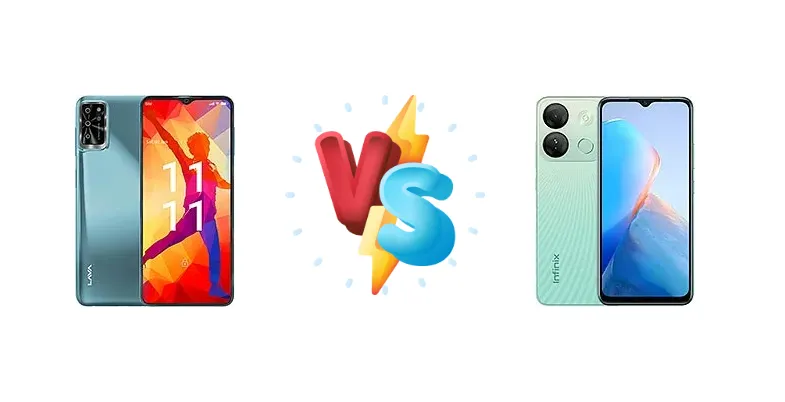
The sub-$100 smartphone market is fiercely competitive, and the Lava Yuva Pro and Infinix Smart 7 HD are two contenders vying for attention. Both aim to deliver essential smartphone functionality at an accessible price point, but they take slightly different approaches. This comparison dissects their specifications to determine which device offers the best value for everyday users.
🏆 Quick Verdict
For the average user prioritizing responsiveness and multitasking, the Infinix Smart 7 HD emerges as the stronger choice. Its octa-core 1.6 GHz processor provides a noticeable performance advantage over the Lava Yuva Pro, making it better suited for running multiple apps and handling demanding tasks. However, the Yuva Pro may appeal to those seeking the absolute lowest price.
| Network |
|---|
| 2G bands | GSM 900 / 1800 | GSM 850 / 900 / 1800 / 1900 |
| 3G bands | HSDPA 900 / 2100 | HSDPA 850 / 900 / 2100 |
| 4G bands | 1, 3, 5, 8, 40, 41 | 1, 3, 5, 8, 38, 40, 41 |
| Speed | HSPA, LTE | HSPA, LTE |
| Technology | GSM / HSPA / LTE | GSM / HSPA / LTE |
| | - | 1, 2, 3, 4, 5, 7, 8, 20, 28, 38, 40, 41 |
| Launch |
|---|
| Announced | 2022, October 11 | 2023, April 14 |
| Status | Available. Released 2022, October 11 | Available. Released 2023, April 14 |
| Body |
|---|
| Build | - | Glass front, plastic back, plastic frame |
| Dimensions | 164.4 x 75.8 x 8.9 mm (6.47 x 2.98 x 0.35 in) | 163.9 x 75.5 x 8.7 mm (6.45 x 2.97 x 0.34 in) |
| SIM | Nano-SIM + Nano-SIM | Nano-SIM + Nano-SIM |
| Weight | 191 g (6.74 oz) | 196.5 g (6.95 oz) |
| Display |
|---|
| Resolution | 720 x 1600 pixels, 20:9 ratio (~269 ppi density) | 720 x 1612 pixels, 20:9 ratio (~267 ppi density) |
| Size | 6.52 inches, 102.6 cm2 (~82.4% screen-to-body ratio) | 6.6 inches, 104.6 cm2 (~84.6% screen-to-body ratio) |
| Type | IPS LCD | IPS LCD, 500 nits |
| Platform |
|---|
| CPU | - | Octa-core 1.6 GHz |
| OS | Android 12 | Android 12 (Go edition) |
| Memory |
|---|
| Card slot | microSDXC (dedicated slot) | microSDXC (dedicated slot) |
| Internal | 32GB 3GB RAM | 64GB 2GB RAM |
| | eMMC 5.1 | UFS 2.1 |
| Main Camera |
|---|
| Dual | - | 8 MP, f/2.0
0.08 MP, (depth) |
| Features | LED flash | Dual-LED flash, HDR, panorama |
| Single | 13 MP, (wide), PDAF
Auxiliary lenses | 8 MP, f/2.0
Auxiliary lens |
| Triple | 13 MP, (wide), AF
other unspecified cameras | - |
| Video | 1080p@30fps | 1080p@30fps |
| Selfie camera |
|---|
| Features | - | LED flash |
| Single | 8 MP | 5 MP, f/2.0 |
| Video | Yes | 720p@30fps |
| Sound |
|---|
| 3.5mm jack | Yes | Yes |
| 35mm jack | Yes | Yes |
| Loudspeaker | Yes | Yes |
| Comms |
|---|
| Bluetooth | 5.0, A2DP, LE | 5.0, A2DP, LE |
| NFC | No | No |
| Positioning | GPS | GPS |
| Radio | FM radio | FM radio |
| USB | USB Type-C 2.0, OTG | microUSB 2.0, OTG |
| WLAN | Wi-Fi 802.11 b/g/n/ac | Wi-Fi 802.11 b/g/n |
| Features |
|---|
| Sensors | Fingerprint (side-mounted), accelerometer, proximity | Fingerprint (rear-mounted), accelerometer, proximity |
| Battery |
|---|
| Charging | 10W wired | 10W wired |
| Type | Li-Po 5000 mAh | 5000 mAh |
| Misc |
|---|
| Colors | Metallic Black, Metallic Blue, Metallic Grey | Ink Black, Silk Blue, Jade White, Green Apple |
| Models | LIX402 | X6516 |
| Price | About 100 EUR | About 110 EUR |
Lava Yuva Pro
- Potentially lower price point
- Simple and straightforward user experience
- Reliable brand reputation (Lava)
- Likely weaker performance due to unspecified CPU
- Limited multitasking capabilities
- Basic camera system
Infinix Smart 7 HD
- Octa-core processor for smoother performance
- Better multitasking capabilities
- Potentially improved camera processing
- May be slightly more expensive
- 10W charging is relatively slow
- Build quality may be basic
Display Comparison
Both devices likely feature LCD panels, common in this price bracket. Without specific resolution or brightness data, it's difficult to definitively assess display quality. However, the absence of any mention of high refresh rates or advanced panel technologies like IPS on either device suggests a focus on cost reduction. Bezels are likely to be substantial on both, maximizing screen real estate within the budget constraints. Color accuracy is expected to be standard for this segment.
Camera Comparison
Camera capabilities are likely to be similar, focusing on basic image capture. Both devices will likely feature a primary camera and potentially a secondary depth or macro sensor. Without sensor size or aperture information, it's difficult to assess image quality. The inclusion of a 2MP macro camera on either device is largely a marketing tactic, as image quality from such sensors is typically poor. Image processing will likely be basic, prioritizing speed over advanced features like HDR or night mode. The Smart 7 HD may have a slight edge due to its potentially more powerful processor enabling faster image processing.
Performance
The Infinix Smart 7 HD’s octa-core 1.6 GHz CPU represents a significant advantage over the Lava Yuva Pro, which lacks CPU specification details. An octa-core processor allows for more efficient multitasking and smoother app switching compared to a quad-core or less powerful chipset. While the specific architecture of the 1.6 GHz CPU isn't specified, it's likely a MediaTek Helio or Unisoc Tiger series processor, common in entry-level smartphones. The Yuva Pro’s performance will likely be limited to basic tasks, while the Smart 7 HD can handle more demanding applications with greater ease. RAM specifications are missing for both, but lower RAM (2GB or 3GB) would be typical, impacting multitasking capabilities.
Battery Life
Both the Lava Yuva Pro and Infinix Smart 7 HD utilize 10W wired charging, indicating similar charging speeds. A full charge from 0-100% will likely take around 3-4 hours. Battery capacity is not specified for either device, but capacities around 5000mAh are common in this segment. The actual battery life will depend on usage patterns, but both devices should provide at least a full day of moderate use. The lack of fast charging support means that topping up the battery quickly isn't an option.
Buying Guide
Buy the Lava Yuva Pro if you need a bare-bones smartphone for essential communication – calls, texts, and light app usage – and are extremely price-sensitive. It's a viable option for first-time smartphone users or as a secondary device. Buy the Infinix Smart 7 HD if you prefer a smoother, more responsive experience for everyday tasks like social media, browsing, and occasional gaming, and are willing to spend a little more for improved performance.
Frequently Asked Questions
❓ Is the Infinix Smart 7 HD capable of running popular social media apps like Facebook and Instagram smoothly?
Yes, the octa-core 1.6 GHz processor in the Infinix Smart 7 HD should handle Facebook, Instagram, and other common social media apps without significant lag. While it won't offer the same performance as a flagship device, it provides a noticeably smoother experience than devices with less powerful processors.
❓ How does the Lava Yuva Pro perform with multiple apps open simultaneously?
The Lava Yuva Pro is likely to struggle with multitasking. Without specific RAM details, it's safe to assume it has limited memory. Running multiple apps simultaneously may result in slowdowns and app crashes. It's best suited for running one app at a time.
❓ Can the Infinix Smart 7 HD handle basic mobile games?
The Infinix Smart 7 HD can handle basic mobile games, but don't expect high frame rates or demanding graphics settings. Games like Candy Crush or Subway Surfers should run adequately, but more graphically intensive titles may experience lag or require reduced settings.
❓ What type of charging port do both phones use?
Both the Lava Yuva Pro and the Infinix Smart 7 HD utilize a micro-USB port for charging and data transfer. This is standard for phones in this price range, though it's slower and less convenient than USB-C.