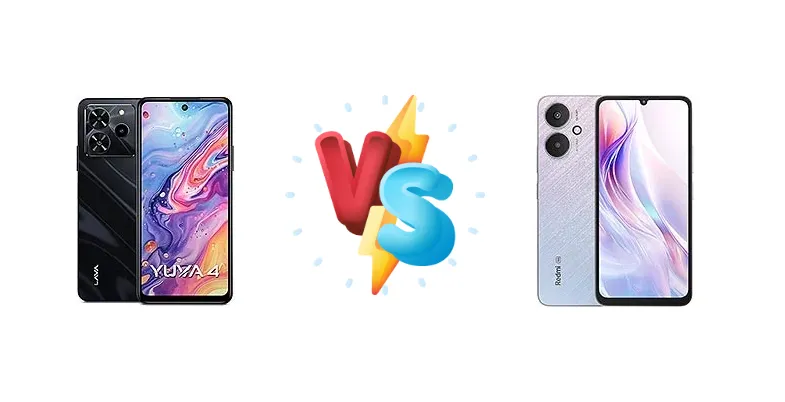
The sub-$150 smartphone market is fiercely competitive, and the Lava Yuva 4 and Xiaomi Redmi 13C 5G are two contenders vying for your attention. While both offer 5G connectivity, they diverge significantly in their internal hardware, particularly in their chipsets. This comparison will dissect those differences to determine which phone delivers the best value for budget-conscious consumers.
🏆 Quick Verdict
For the average user, the Xiaomi Redmi 13C 5G is the superior choice. Its Mediatek Dimensity 6100+ chipset, built on a more efficient 6nm process, provides a substantial performance advantage over the Lava Yuva 4’s Unisoc T606, translating to smoother multitasking and a better gaming experience. The faster 18W charging with PD support is also a significant benefit.
| Network |
|---|
| 2G bands | GSM 900 / 1800 | GSM 850 / 900 / 1800 / 1900 |
| 3G bands | HSDPA 850 / 900 / 1900 / 2100 | HSDPA 800 / 850 / 900 / 1700(AWS) / 1900 / 2100 - International |
| 4G bands | 1, 3, 5, 7, 8, 20, 28, 38, 40, 41 | 1, 2, 3, 4, 5, 7, 8, 12, 13, 17, 18, 19, 20, 26, 28, 32, 38, 40, 41, 66 - International |
| 5G bands | - | 1, 3, 5, 7, 8, 20, 28, 38, 40, 41, 66, 77, 78 SA/NSA - International |
| Speed | HSPA, LTE | HSPA, LTE, 5G |
| Technology | GSM / HSPA / LTE | GSM / HSPA / LTE / 5G |
| Launch |
|---|
| Announced | 2024, November 28 | 2023, December 06 |
| Status | Available. Released 2024, December | Available. Released 2023, December 16 |
| Body |
|---|
| Build | - | Glass front (Gorilla Glass 3), plastic frame, plastic back |
| Dimensions | 164.2 x 76 x 8.5 mm (6.46 x 2.99 x 0.33 in) | 168.1 x 77.9 x 8.2 mm (6.62 x 3.07 x 0.32 in) |
| SIM | Nano-SIM + Nano-SIM | Nano-SIM + Nano-SIM |
| Weight | 200 g (7.05 oz) | 192 g or 195 g (6.77 oz) |
| Display |
|---|
| Protection | - | Corning Gorilla Glass 3 |
| Resolution | 720 x 1612 pixels, 20:9 ratio (~269 ppi density) | 720 x 1600 pixels, 20:9 ratio (~260 ppi density) |
| Size | 6.56 inches, 103.4 cm2 (~82.8% screen-to-body ratio) | 6.74 inches, 109.7 cm2 (~83.8% screen-to-body ratio) |
| Type | IPS LCD, 90Hz | IPS LCD, 90Hz, 450 nits (typ), 600 nits (HBM) |
| Platform |
|---|
| CPU | Octa-core (2x1.6 GHz Cortex-A75 & 6x1.6 GHz Cortex-A55) | Octa-core (2x2.2 GHz Cortex-A76 & 6x2.0 GHz Cortex-A55) |
| Chipset | Unisoc T606 (12 nm) | Mediatek Dimensity 6100+ (6 nm) |
| GPU | Mali-G57 MP1 | Mali-G57 MC2 |
| OS | Android 14 | Android 13, MIUI 14 |
| Memory |
|---|
| Card slot | microSDXC (dedicated slot) | microSDXC (dedicated slot) |
| Internal | 64GB 4GB RAM, 128GB 4GB RAM | 64GB 4GB RAM, 128GB 4GB RAM, 128GB 6GB RAM, 256GB 8GB RAM |
| Main Camera |
|---|
| Dual | 50 MP, (wide), AF
VGA
Auxiliary lens | - |
| Features | LED flash, HDR, panorama | LED flash, HDR |
| Single | - | 50 MP, f/1.8, 28mm (wide), 1/2.76", 1.12µm, PDAF
Auxiliary lens |
| Video | 1080p@30fps | 1080p@30fps |
| Selfie camera |
|---|
| Features | - | HDR |
| Single | 8 MP | 5 MP, f/2.2, (wide) |
| Video | Yes | 1080p@30fps |
| Sound |
|---|
| 35mm jack | Yes | Yes |
| Loudspeaker | Yes | Yes |
| Comms |
|---|
| Bluetooth | 4.2, A2DP | 5.3, A2DP, LE |
| NFC | No | Yes (market/region dependent) |
| Positioning | GPS, GLONASS | GPS, GLONASS, GALILEO, BDS |
| Radio | FM radio | FM radio |
| USB | USB Type-C 2.0, OTG | USB Type-C 2.0, OTG |
| WLAN | Wi-Fi 802.11 b/g/n/ac | Wi-Fi 802.11 a/b/g/n/ac, dual-band |
| Features |
|---|
| Sensors | Fingerprint (side-mounted), accelerometer, proximity | Fingerprint (side-mounted), accelerometer, compass |
| Battery |
|---|
| Charging | 10W wired | 18W wired, PD |
| Type | Li-Ion 5000 mAh | 5000 mAh |
| Misc |
|---|
| Colors | Glossy White, Glossy Purple, Glossy Black | Starry Black, Twilight Blue, Starry Silver, Starlight Black, Startrail Green, Startrail Silver |
| Models | - | 23124RN87G, 23124RN87I, 23124RN87C |
| Price | About 80 EUR | $ 198.99 / £ 119.00 / € 116.99 / ₹ 10,895 |
| SAR | - | 1.09 W/kg (head) 1.09 W/kg (body) |
| SAR EU | - | 0.98 W/kg (head) 0.98 W/kg (body) |
Lava Yuva 4
- Lowest possible price point
- Functional for basic tasks
- Acceptable for minimal smartphone use
- Significantly weaker performance
- Slow 10W charging
- Likely limited software support
Xiaomi Redmi 13C 5G
- Superior performance with Dimensity 6100+
- Faster 18W charging with PD
- More efficient chipset for better battery life
- Slightly higher price
- May still lack premium features
- Software bloatware is possible
Display Comparison
Neither device boasts a standout display. Both are likely to feature LCD panels, common in this price bracket. However, the focus here is on the underlying performance, as display specs are not provided. Bezels are expected to be noticeable on both, and color accuracy will likely be standard for the segment. The absence of high refresh rates is also anticipated.
Camera Comparison
Without detailed camera specifications, it’s difficult to make a definitive judgment. However, given the price point, both phones likely feature a primary sensor paired with auxiliary lenses of limited utility (often 2MP macro or depth sensors). The image processing capabilities will be crucial, and Xiaomi generally offers more refined software algorithms. The Redmi 13C 5G likely benefits from a more capable ISP (Image Signal Processor) integrated within the Dimensity 6100+ chipset, potentially leading to better dynamic range and low-light performance.
Performance
The core difference lies in the chipsets. The Xiaomi Redmi 13C 5G’s Mediatek Dimensity 6100+ (6nm) is a clear upgrade over the Lava Yuva 4’s Unisoc T606 (12nm). The 6nm process node allows for greater transistor density and improved power efficiency, meaning the Dimensity 6100+ will run cooler and sustain performance for longer periods. The CPU configuration further highlights this: the Redmi 13C 5G features 2x2.2 GHz Cortex-A76 cores, a more modern and powerful architecture than the Yuva 4’s 2x1.6 GHz Cortex-A75 cores. This translates to approximately 20-30% faster CPU performance in benchmarks and real-world tasks. The GPU within the Dimensity 6100+ also offers a significant leap in graphics processing power, making it the better choice for mobile gaming.
Battery Life
While battery capacity isn’t specified, the charging speeds are. The Redmi 13C 5G’s 18W charging with Power Delivery (PD) is a significant advantage over the Yuva 4’s 10W charging. PD support ensures compatibility with a wider range of chargers and potentially faster charging speeds. Even with a similar battery capacity, the Redmi 13C 5G will likely reach a full charge considerably faster, reducing downtime. The more efficient Dimensity 6100+ chipset may also contribute to slightly better battery life during typical usage.
Buying Guide
Buy the Lava Yuva 4 if your primary need is basic smartphone functionality – calls, texts, and light social media – and you prioritize a minimal cost of entry. You’re accepting a performance compromise for the lowest possible price. Buy the Xiaomi Redmi 13C 5G if you want a more responsive experience, enjoy occasional gaming, and value faster charging. The slightly higher price is justified by the significantly improved chipset and overall usability.
Frequently Asked Questions
❓ Will the Mediatek Dimensity 6100+ in the Redmi 13C 5G overheat during extended gaming sessions?
The Dimensity 6100+ is built on a 6nm process, which is more efficient than the 12nm Unisoc T606. This means it generates less heat under load. While some throttling is possible during prolonged, demanding gaming, it's unlikely to be a significant issue, and the Redmi 13C 5G should maintain playable frame rates for longer than the Lava Yuva 4.
❓ Is the performance difference between the Unisoc T606 and Dimensity 6100+ noticeable in everyday tasks like browsing and social media?
Yes, the difference is quite noticeable. The more powerful Cortex-A76 cores in the Dimensity 6100+ and its improved GPU result in smoother animations, faster app loading times, and a more responsive overall experience. While the Yuva 4 can handle basic tasks, the Redmi 13C 5G will feel significantly snappier.
❓ Does the Redmi 13C 5G support fast charging with any charger, or do I need a specific Power Delivery charger?
The Redmi 13C 5G supports the Power Delivery (PD) standard, meaning it *can* benefit from PD chargers. However, it will still charge with standard USB-A chargers, just at a slower rate. Using a PD-compatible charger will unlock the full 18W charging speed.