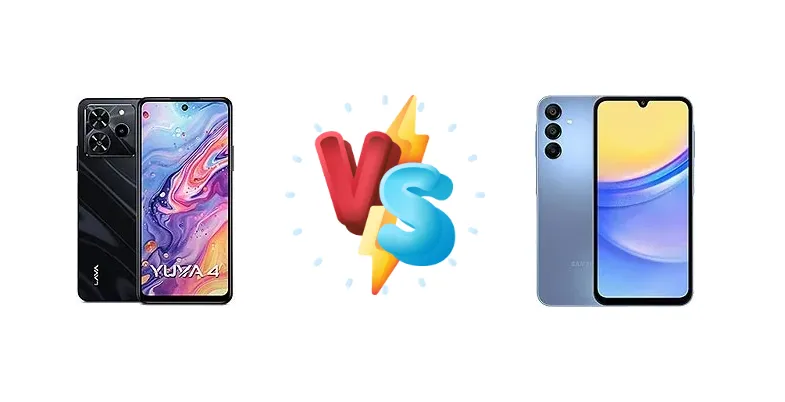
The sub-$150 5G smartphone market is heating up. The Lava Yuva 4 and Samsung Galaxy A15 5G represent compelling options for users prioritizing affordability and next-generation connectivity. However, significant differences in chipset architecture and display technology mean one phone will likely be a better fit depending on your needs.
🏆 Quick Verdict
For most users, the Samsung Galaxy A15 5G is the superior choice. Its Mediatek Dimensity 6100+ chipset delivers noticeably faster performance and better efficiency than the Lava Yuva 4’s Unisoc T606, while the brighter display enhances usability. The faster 25W charging is a significant convenience.
| Network |
|---|
| 2G bands | GSM 900 / 1800 | GSM 850 / 900 / 1800 / 1900 |
| 3G bands | HSDPA 850 / 900 / 1900 / 2100 | HSDPA 850 / 900 / 1700(AWS) / 1900 / 2100 |
| 4G bands | 1, 3, 5, 7, 8, 20, 28, 38, 40, 41 | 1, 2, 3, 4, 5, 7, 8, 12, 17, 20, 26, 28, 38, 40, 41, 66 |
| 5G bands | - | 1, 3, 5, 7, 8, 26, 28, 40, 41, 66, 77, 78 SA/NSA/Sub6 |
| Speed | HSPA, LTE | HSPA, LTE, 5G |
| Technology | GSM / HSPA / LTE | GSM / HSPA / LTE / 5G |
| Launch |
|---|
| Announced | 2024, November 28 | 2023, December 11 |
| Status | Available. Released 2024, December | Available. Released 2023, December 16 |
| Body |
|---|
| Build | - | Glass front, plastic back, plastic frame |
| Dimensions | 164.2 x 76 x 8.5 mm (6.46 x 2.99 x 0.33 in) | 160.1 x 76.8 x 8.4 mm (6.30 x 3.02 x 0.33 in) |
| SIM | Nano-SIM + Nano-SIM | · Nano-SIM· Nano-SIM + Nano-SIM |
| Weight | 200 g (7.05 oz) | 200 g (7.05 oz) |
| Display |
|---|
| Resolution | 720 x 1612 pixels, 20:9 ratio (~269 ppi density) | 1080 x 2340 pixels, 19.5:9 ratio (~396 ppi density) |
| Size | 6.56 inches, 103.4 cm2 (~82.8% screen-to-body ratio) | 6.5 inches, 103.7 cm2 (~84.3% screen-to-body ratio) |
| Type | IPS LCD, 90Hz | Super AMOLED, 90Hz, 800 nits (HBM) |
| Platform |
|---|
| CPU | Octa-core (2x1.6 GHz Cortex-A75 & 6x1.6 GHz Cortex-A55) | Octa-core (2x2.2 GHz Cortex-A76 & 6x2.0 GHz Cortex-A55) |
| Chipset | Unisoc T606 (12 nm) | Mediatek Dimensity 6100+ (6 nm) |
| GPU | Mali-G57 MP1 | Mali-G57 MC2 |
| OS | Android 14 | Android 14, upgradable to Android 16, One UI 8, up to 4 major Android upgrades |
| Memory |
|---|
| Card slot | microSDXC (dedicated slot) | microSDXC (uses shared SIM slot) |
| Internal | 64GB 4GB RAM, 128GB 4GB RAM | 64GB 4GB RAM, 128GB 4GB RAM, 128GB 6GB RAM, 128GB 8GB RAM, 256GB 8GB RAM |
| Main Camera |
|---|
| Dual | 50 MP, (wide), AF
VGA
Auxiliary lens | - |
| Features | LED flash, HDR, panorama | LED flash, panorama, HDR |
| Triple | - | 50 MP, f/1.8, (wide), AF
5 MP, f/2.2, (ultrawide)
2 MP (macro) |
| Video | 1080p@30fps | 1080p@30fps, gyro-EIS |
| Selfie camera |
|---|
| Single | 8 MP | 13 MP, f/2.0, (wide) |
| Video | Yes | 1080p@30fps |
| Sound |
|---|
| 35mm jack | Yes | Yes |
| Loudspeaker | Yes | Yes |
| Comms |
|---|
| Bluetooth | 4.2, A2DP | 5.3, A2DP, LE |
| NFC | No | Yes (market/region dependent) |
| Positioning | GPS, GLONASS | GPS, GALILEO, GLONASS, BDS, QZSS |
| Radio | FM radio | No |
| USB | USB Type-C 2.0, OTG | USB Type-C 2.0 |
| WLAN | Wi-Fi 802.11 b/g/n/ac | Wi-Fi 802.11 a/b/g/n/ac, dual-band, Wi-Fi Direct |
| Features |
|---|
| Sensors | Fingerprint (side-mounted), accelerometer, proximity | Fingerprint (side-mounted), accelerometer, gyro, compass |
| Battery |
|---|
| Charging | 10W wired | 25W wired |
| Type | Li-Ion 5000 mAh | 5000 mAh |
| Misc |
|---|
| Colors | Glossy White, Glossy Purple, Glossy Black | Brave Black, Personality Yellow, Magical Blue, Optimistic Blue |
| Models | - | SM-A156B, SM-A156B/DS, SM-A156P, SM-A156P/DS, SM-A156U, SM-A156U1, SM-A156U1/DS, SM-A156W, SM-A156P/N, SM-A156P/DSN, SM-S156VL, SM-A156M, SM-A156E, SM-A156E/DSN |
| Price | About 80 EUR | € 167.00 / $ 79.97 / ₹ 17,490 |
| SAR EU | - | 0.80 W/kg (head) 1.46 W/kg (body) |
Lava Yuva 4
- Extremely affordable price point
- 5G connectivity
- Functional for basic tasks
- Outdated Unisoc T606 chipset
- Slow 10W charging
- Likely lower display quality
Samsung Galaxy A15 5G
- Powerful Mediatek Dimensity 6100+ chipset
- Bright 786 nit display
- Fast 25W charging
- Long battery life (14:31h active use)
- Slightly higher price than Lava Yuva 4
- May still lack premium features found in higher-end phones
Display Comparison
The Samsung Galaxy A15 5G boasts a significantly brighter display, reaching a measured 786 nits. This is crucial for outdoor visibility, a clear advantage over the Lava Yuva 4, whose peak brightness is not specified but is expected to be considerably lower given its price point. While both likely utilize LCD panels, the higher brightness of the A15 5G translates to a more usable experience in direct sunlight. The A15 5G’s larger screen size (6.6 inches vs. the Yuva 4’s 6.5 inches) also contributes to a more immersive viewing experience.
Camera Comparison
Without detailed camera specs for the Lava Yuva 4, a direct comparison is limited. However, given its price point, it’s reasonable to assume a less sophisticated camera system. The Samsung Galaxy A15 5G likely features a more capable main sensor and image processing pipeline. While both phones likely include multiple rear cameras, the focus should be on the primary sensor’s resolution and aperture. The A15 5G’s image processing will likely deliver more consistent results in varying lighting conditions.
Performance
The core difference lies in the chipsets. The Samsung Galaxy A15 5G’s Mediatek Dimensity 6100+ (6nm) is a substantial upgrade over the Lava Yuva 4’s Unisoc T606 (12nm). The Dimensity 6100+ utilizes more modern Cortex-A76 cores clocked at 2.2 GHz, compared to the Yuva 4’s Cortex-A75 cores at 1.6 GHz. This architectural advantage, combined with the smaller 6nm process node, results in significantly improved CPU and GPU performance, and better power efficiency. The A15 5G will handle multitasking and demanding apps with greater ease. The Yuva 4 will struggle with graphically intensive games and heavier workloads.
Battery Life
The Samsung Galaxy A15 5G demonstrates a clear advantage in battery performance, achieving 14 hours and 31 minutes of active use. While the Lava Yuva 4’s battery capacity isn’t specified, the A15 5G’s longer runtime suggests a more efficient chipset and optimized power management. Furthermore, the A15 5G supports 25W wired charging, allowing for significantly faster top-ups compared to the Yuva 4’s slow 10W charging. This difference in charging speed is a major convenience factor.
Buying Guide
Buy the Lava Yuva 4 if you need a functional, extremely affordable 5G phone and prioritize minimal cost above all else. It’s a viable option for basic communication and light tasks. Buy the Samsung Galaxy A15 5G if you prefer a smoother user experience, a brighter and more enjoyable display, and faster charging – all while still remaining within a budget-friendly price range.
Frequently Asked Questions
❓ Is the Mediatek Dimensity 6100+ in the Samsung Galaxy A15 5G prone to overheating during extended gaming sessions?
The Dimensity 6100+ is a relatively efficient chipset built on a 6nm process. While some heat generation is inevitable during prolonged gaming, it's unlikely to experience significant throttling or overheating issues under normal usage conditions. Samsung's thermal management is generally adequate for this class of device.
❓ How does the 5G performance of the Lava Yuva 4 compare to the Samsung Galaxy A15 5G in real-world scenarios?
Both phones support 5G, but the Dimensity 6100+ in the A15 5G has a more advanced 5G modem. This translates to potentially faster and more stable 5G connections, especially in areas with congested networks. The Yuva 4’s Unisoc modem may experience slower speeds or intermittent connectivity in the same conditions.
❓ Does the Samsung Galaxy A15 5G support software updates beyond the initial Android release?
Samsung typically provides at least two major Android OS updates and several years of security patches for its A-series devices. While the exact update schedule for the A15 5G isn't confirmed, users can expect a reasonable level of software support, extending the phone's lifespan.