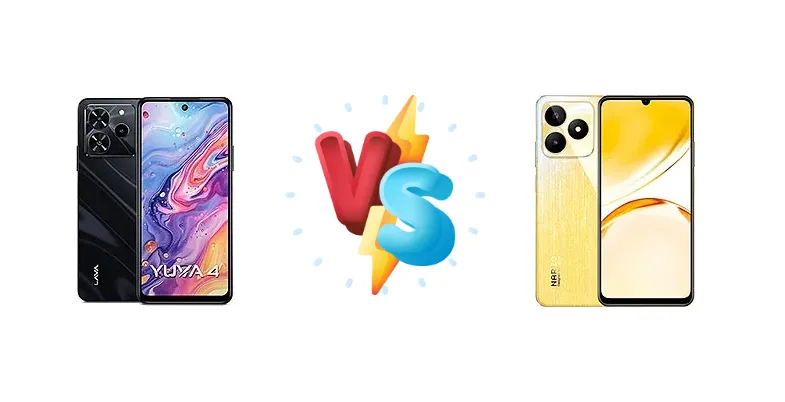
The sub-$150 smartphone market is fiercely competitive. Both the Lava Yuva 4 and Realme Narzo N53 aim to deliver the most features for the least amount of money, but they take different approaches. The Yuva 4 focuses on a streamlined experience, while the Narzo N53 prioritizes faster charging and a slightly more powerful chipset. This comparison will dissect the key differences to help you choose the right device.
🏆 Quick Verdict
For most users, the Realme Narzo N53 is the better buy. Its Unisoc Tiger T612 offers a noticeable performance uplift over the Lava Yuva 4’s T606, and the 33W charging is a game-changer, reducing downtime significantly. While the Yuva 4 is a capable device, the N53’s advantages justify the potential price difference.
| Network |
|---|
| 2G bands | GSM 900 / 1800 | GSM 850 / 900 / 1800 / 1900 |
| 3G bands | HSDPA 850 / 900 / 1900 / 2100 | HSDPA 850 / 900 / 2100 |
| 4G bands | 1, 3, 5, 7, 8, 20, 28, 38, 40, 41 | 1, 3, 5, 8, 38, 40, 41 |
| Speed | HSPA, LTE | HSPA, LTE |
| Technology | GSM / HSPA / LTE | GSM / HSPA / LTE |
| Launch |
|---|
| Announced | 2024, November 28 | 2023, May 18 |
| Status | Available. Released 2024, December | Available. Released 2023, May 22 |
| Body |
|---|
| Build | - | Glass front, plastic frame, plastic back |
| Dimensions | 164.2 x 76 x 8.5 mm (6.46 x 2.99 x 0.33 in) | 167.3 x 76.7 x 7.5 mm (6.59 x 3.02 x 0.30 in) |
| SIM | Nano-SIM + Nano-SIM | Nano-SIM + Nano-SIM |
| Weight | 200 g (7.05 oz) | 182 g (6.42 oz) |
| Display |
|---|
| Resolution | 720 x 1612 pixels, 20:9 ratio (~269 ppi density) | 1080 x 2400 pixels, 20:9 ratio (~390 ppi density) |
| Size | 6.56 inches, 103.4 cm2 (~82.8% screen-to-body ratio) | 6.74 inches, 109.7 cm2 (~85.5% screen-to-body ratio) |
| Type | IPS LCD, 90Hz | IPS LCD, 90Hz, 450 nits (peak) |
| Platform |
|---|
| CPU | Octa-core (2x1.6 GHz Cortex-A75 & 6x1.6 GHz Cortex-A55) | Octa-core (2x1.8 GHz Cortex-A75 & 6x1.8 GHz Cortex-A55) |
| Chipset | Unisoc T606 (12 nm) | Unisoc Tiger T612 (12 nm) |
| GPU | Mali-G57 MP1 | Mali-G57 |
| OS | Android 14 | Android 13, Realme UI T |
| Memory |
|---|
| Card slot | microSDXC (dedicated slot) | microSDXC (dedicated slot) |
| Internal | 64GB 4GB RAM, 128GB 4GB RAM | 64GB 4GB RAM, 128GB 6GB RAM, 128GB 8GB RAM |
| Main Camera |
|---|
| Dual | 50 MP, (wide), AF
VGA
Auxiliary lens | 50 MP, f/1.8, (wide), PDAF
Auxiliary lens |
| Features | LED flash, HDR, panorama | LED flash, HDR, panorama |
| Video | 1080p@30fps | 1080p@30fps |
| Selfie camera |
|---|
| Features | - | HDR |
| Single | 8 MP | 8 MP, f/2.0, (wide) |
| Video | Yes | 720p@30fps |
| Sound |
|---|
| 3.5mm jack | - | Yes |
| 35mm jack | Yes | Yes |
| Loudspeaker | Yes | Yes |
| Comms |
|---|
| Bluetooth | 4.2, A2DP | 5.0, A2DP, LE |
| NFC | No | No |
| Positioning | GPS, GLONASS | GPS, GLONASS, GALILEO |
| Radio | FM radio | Unspecified |
| USB | USB Type-C 2.0, OTG | USB Type-C 2.0 |
| WLAN | Wi-Fi 802.11 b/g/n/ac | Wi-Fi 802.11 a/b/g/n/ac, dual-band |
| Features |
|---|
| Sensors | Fingerprint (side-mounted), accelerometer, proximity | Fingerprint (side-mounted), accelerometer, gyro, proximity, compass |
| Battery |
|---|
| Charging | 10W wired | 33W wired, 50% in 31 min |
| Type | Li-Ion 5000 mAh | 5000 mAh |
| Misc |
|---|
| Colors | Glossy White, Glossy Purple, Glossy Black | Black, Gold |
| Models | - | RMX3761 |
| Price | About 80 EUR | About 100 EUR |
Lava Yuva 4
- Potentially longer battery life due to less power-hungry chipset.
- Simpler, streamlined user experience.
- Likely more affordable price point.
- Significantly slower charging speed.
- Lower overall performance compared to the Narzo N53.
- Less responsive for demanding apps and games.
Realme Narzo N53
- Faster performance with the Unisoc Tiger T612 chipset.
- 33W fast charging significantly reduces charging time.
- More responsive multitasking and app launches.
- Potentially shorter battery life due to higher power consumption.
- May run slightly warmer under heavy load.
- Likely a slightly higher price tag.
Display Comparison
Neither device boasts a standout display. Both utilize 12nm chipsets, suggesting similar power constraints impacting display capabilities. While specific display specs (resolution, panel type) are missing, the focus here is on performance. The absence of high refresh rates on either device indicates a cost-saving measure, prioritizing battery life over visual fluidity. Bezels are likely comparable given the price point, and color accuracy will likely be standard for this segment.
Camera Comparison
Without detailed camera specs, a direct comparison is difficult. However, it’s safe to assume both phones will feature a primary camera and potentially a depth or macro sensor. The image processing algorithms will likely be the biggest differentiator. Realme typically employs more aggressive image processing, aiming for vibrant, social media-ready photos. Lava tends towards a more natural look. The aperture of the main sensor will be critical; a wider aperture (lower f-number) will improve low-light performance. The presence of Optical Image Stabilization (OIS) is unlikely on either device at this price point.
Performance
The Realme Narzo N53’s Unisoc Tiger T612 is the key performance differentiator. Its CPU clocks 2x1.8 GHz Cortex-A75 cores compared to the Lava Yuva 4’s 2x1.6 GHz Cortex-A75 cores. This 10% clock speed increase, coupled with the T612’s architectural refinements, translates to snappier app launches and smoother multitasking. While both use the same Cortex-A55 efficiency cores, the T612’s overall processing power will be more noticeable in demanding tasks. The impact of RAM speed (LPDDR4X is likely on both) is secondary to the chipset difference. Thermal management will be crucial; the T612’s higher performance could lead to more heat, but Realme’s experience in optimizing Unisoc chips may mitigate this.
Battery Life
The Realme Narzo N53’s 33W charging is a significant advantage. The ability to reach 50% charge in just 31 minutes drastically reduces downtime compared to the Lava Yuva 4’s slow 10W charging. While battery capacity isn’t specified, the faster charging speed effectively mitigates any potential capacity difference. Users who frequently find themselves needing a quick top-up will greatly benefit from the Narzo N53’s charging capabilities. The 10W charging on the Yuva 4 will require significantly longer to achieve a full charge.
Buying Guide
Buy the Lava Yuva 4 if you prioritize simplicity and a longer-lasting, if slower-charging, experience. It’s ideal for users who primarily use their phone for calls, messaging, and light social media. Buy the Realme Narzo N53 if you value faster performance for gaming and multitasking, and if quick charging is a must-have feature for your on-the-go lifestyle. It’s the better choice for those who demand more from their budget smartphone.
Frequently Asked Questions
❓ Will the Realme Narzo N53’s Unisoc T612 overheat during prolonged gaming sessions?
While the T612 is more powerful than the T606, Realme has a history of optimizing Unisoc chipsets for thermal efficiency. Expect some warmth during extended gaming, but it’s unlikely to reach throttling temperatures unless in extremely hot ambient conditions. The phone’s plastic build will also help dissipate heat.
❓ Is the 10W charging on the Lava Yuva 4 realistically usable for someone who uses their phone heavily throughout the day?
10W charging is quite slow. For heavy users, it will likely require overnight charging to ensure a full battery. It’s best suited for users who primarily use their phone for basic tasks and can charge it opportunistically.
❓ Does the Realme Narzo N53 support reverse charging to top up accessories like earbuds?
Based on Realme’s typical feature set for this price range, reverse charging is unlikely to be supported on the Narzo N53. This feature is usually reserved for higher-end models.
❓ How does the software experience differ between Lava’s and Realme’s UI?
Realme UI is generally more feature-rich and customizable, but can also include more pre-installed apps (bloatware). Lava’s UI is typically closer to stock Android, offering a cleaner and simpler experience, but with fewer advanced features.