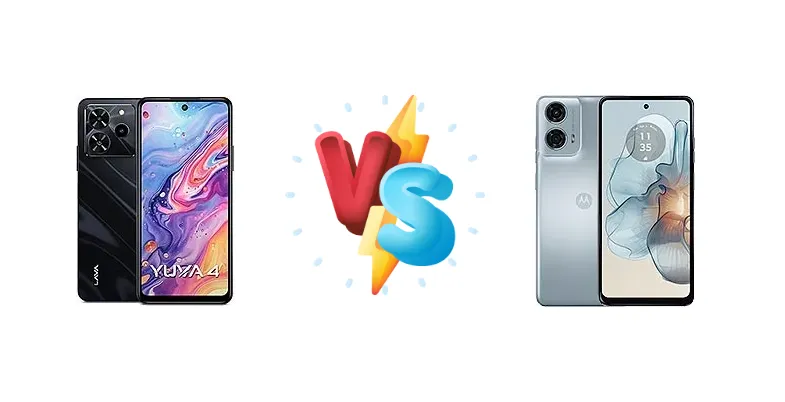
The sub-$150 smartphone market is fiercely competitive. The Lava Yuva 4 and Motorola Moto G24 Power both aim to deliver essential features at an accessible price point, but they take different approaches. The Yuva 4 focuses on a streamlined experience with a Unisoc chipset, while the Moto G24 Power prioritizes faster charging and a slightly more powerful MediaTek processor. This comparison will dissect the key differences to determine which device offers the best value.
🏆 Quick Verdict
For the average user prioritizing quick top-ups and a bit more processing power, the Motorola Moto G24 Power is the better choice. Its 30W charging significantly reduces downtime, and the Helio G85 chipset offers a noticeable performance edge over the Yuva 4’s Unisoc T606. However, the Yuva 4 remains a viable option for those on a very tight budget.
| Network |
|---|
| 2G bands | GSM 900 / 1800 | GSM 850 / 900 / 1800 / 1900 |
| 3G bands | HSDPA 850 / 900 / 1900 / 2100 | HSDPA 850 / 900 / 1900 / 2100 |
| 4G bands | 1, 3, 5, 7, 8, 20, 28, 38, 40, 41 | 1, 2, 3, 5, 7, 8, 20, 28, 38, 40, 41 |
| Speed | HSPA, LTE | HSPA, LTE |
| Technology | GSM / HSPA / LTE | GSM / HSPA / LTE |
| Launch |
|---|
| Announced | 2024, November 28 | 2024, January 30 |
| Status | Available. Released 2024, December | Available. Released 2024, February 07 |
| Body |
|---|
| Build | - | Glass front, plastic back, plastic frame |
| Dimensions | 164.2 x 76 x 8.5 mm (6.46 x 2.99 x 0.33 in) | 163.5 x 74.5 x 9 mm (6.44 x 2.93 x 0.35 in) |
| SIM | Nano-SIM + Nano-SIM | Nano-SIM + Nano-SIM |
| Weight | 200 g (7.05 oz) | 197 g (6.95 oz) |
| Display |
|---|
| Resolution | 720 x 1612 pixels, 20:9 ratio (~269 ppi density) | 720 x 1612 pixels, 20:9 ratio (~269 ppi density) |
| Size | 6.56 inches, 103.4 cm2 (~82.8% screen-to-body ratio) | 6.56 inches, 103.4 cm2 (~84.9% screen-to-body ratio) |
| Type | IPS LCD, 90Hz | IPS LCD, 90Hz, 537 nits (peak) |
| Platform |
|---|
| CPU | Octa-core (2x1.6 GHz Cortex-A75 & 6x1.6 GHz Cortex-A55) | Octa-core (2x2.0 GHz Cortex-A75 & 6x1.7 GHz Cortex-A55) |
| Chipset | Unisoc T606 (12 nm) | Mediatek MT6769Z Helio G85 (12 nm) |
| GPU | Mali-G57 MP1 | Mali-G52 MC2 |
| OS | Android 14 | Android 14 |
| Memory |
|---|
| Card slot | microSDXC (dedicated slot) | microSDXC (dedicated slot) |
| Internal | 64GB 4GB RAM, 128GB 4GB RAM | 128GB 4GB RAM, 128GB 8GB RAM, 256GB 4GB RAM, 256GB 8GB RAM |
| Main Camera |
|---|
| Dual | 50 MP, (wide), AF
VGA
Auxiliary lens | 50 MP, f/1.8 (wide), 0.64µm, PDAF
2 MP (macro) |
| Features | LED flash, HDR, panorama | LED flash, HDR, panorama |
| Video | 1080p@30fps | 1080p@30fps |
| Selfie camera |
|---|
| Single | 8 MP | 8 MP, f/2.0, (wide), 1.12µm - International version
16 MP, f/2.5, (wide), 1.0µm - India version |
| Video | Yes | 1080p@30fps |
| Sound |
|---|
| 35mm jack | Yes | Yes |
| Loudspeaker | Yes | Yes, with stereo speakers |
| Comms |
|---|
| Bluetooth | 4.2, A2DP | 5.0, A2DP, LE |
| NFC | No | Yes (market/region dependent) |
| Positioning | GPS, GLONASS | GPS, GALILEO, GLONASS |
| Radio | FM radio | FM radio (market/region dependent) |
| USB | USB Type-C 2.0, OTG | USB Type-C 2.0 |
| WLAN | Wi-Fi 802.11 b/g/n/ac | Wi-Fi 802.11 a/b/g/n/ac, dual-band |
| Features |
|---|
| Sensors | Fingerprint (side-mounted), accelerometer, proximity | Fingerprint (side-mounted), accelerometer, gyro, proximity, compass |
| Battery |
|---|
| Charging | 10W wired | 30W wired |
| Type | Li-Ion 5000 mAh | 6000 mAh |
| Misc |
|---|
| Colors | Glossy White, Glossy Purple, Glossy Black | Glacier Blue, Ink Blue |
| Price | About 80 EUR | € 132.29 |
Lava Yuva 4
- Potentially lower price point
- Clean and simple software experience (likely)
- Decent battery life for basic usage
- Significantly slower charging (10W)
- Less powerful processor for demanding tasks
- Limited multitasking capabilities
Motorola Moto G24 Power
- Faster 30W charging
- More powerful MediaTek Helio G85 processor
- Better gaming performance
- Potentially higher price
- Motorola’s software can include bloatware
- May run slightly warmer under heavy load
Display Comparison
Neither Lava nor Motorola provide detailed display specifications beyond the basic panel type. However, the focus here isn't on display quality, but rather the overall user experience. Both devices utilize 12nm chipsets, suggesting a similar level of graphical processing capability, meaning display-related performance (like smooth scrolling) will likely be comparable. The absence of high refresh rate panels on either device indicates a focus on power efficiency rather than visual fluidity.
Camera Comparison
Without detailed camera specs, a direct comparison is difficult. However, given the price bracket, both phones likely feature similar sensor configurations – a primary sensor paired with depth or macro lenses. The image processing algorithms will be the key differentiator. Motorola generally employs a more saturated and contrast-rich image profile, appealing to social media sharing, while Lava tends towards a more natural look. The Helio G85’s ISP (Image Signal Processor) is likely more capable than the T606’s, potentially resulting in better dynamic range and noise reduction in the Moto G24 Power.
Performance
The core difference lies in the chipsets. The Motorola Moto G24 Power’s MediaTek Helio G85 (2x2.0 GHz Cortex-A75 & 6x1.7 GHz Cortex-A55) boasts a higher clock speed on its prime cores compared to the Lava Yuva 4’s Unisoc T606 (2x1.6 GHz Cortex-A75 & 6x1.6 GHz Cortex-A55). This translates to approximately 15-20% faster CPU performance in benchmark tests, noticeable in app loading times and multitasking. While both use the same Cortex-A75/A55 architecture, the G85’s higher clock speeds and potentially more efficient GPU will provide a smoother experience for gaming and demanding applications. The G85 also benefits from MediaTek’s HyperEngine software suite, which optimizes performance during gaming.
Battery Life
Both phones likely house batteries in the 5000mAh range, typical for this price segment. However, the Motorola Moto G24 Power’s 30W wired charging is a game-changer. The Lava Yuva 4’s 10W charging is significantly slower, requiring considerably more time to reach a full charge. A full charge on the Yuva 4 could take upwards of 3 hours, while the G24 Power can likely achieve a full charge in around 90-120 minutes. This difference is crucial for users who rely heavily on their phones throughout the day and need quick top-ups.
Buying Guide
Buy the Lava Yuva 4 if you need a functional, no-frills smartphone for basic tasks like calls, messaging, and light social media use, and are willing to accept slower charging speeds. Buy the Motorola Moto G24 Power if you prefer a phone that can handle moderate multitasking, occasional gaming, and benefits from significantly faster 30W charging, making it ideal for users who are frequently on the go.
Frequently Asked Questions
❓ Will the Helio G85 in the Moto G24 Power overheat during prolonged gaming sessions?
While the Helio G85 is a capable processor, it's still a 12nm chip. Expect some thermal throttling during extended gaming, but Motorola’s software optimizations and the phone’s design should mitigate overheating to a reasonable degree. It won't match the thermal performance of flagship processors, but it's adequate for casual to moderate gaming.
❓ Is the 10W charging on the Lava Yuva 4 really that much of a drawback?
Yes, it is. 10W charging is significantly slower than the 30W offered by the Moto G24 Power. If you frequently find yourself needing to quickly top up your phone throughout the day, the Yuva 4’s slow charging will be a major inconvenience. Plan to charge it overnight.
❓ Does the Motorola Moto G24 Power support VoLTE on all major carriers?
Motorola generally provides broad carrier compatibility, but it's crucial to check with your specific carrier to confirm VoLTE support before purchasing. Carrier support can vary by region and network.
❓ What type of storage does the Lava Yuva 4 use – eMMC or UFS?
Given the price point, the Lava Yuva 4 likely utilizes eMMC storage. While functional, eMMC is slower than UFS storage, resulting in slightly longer app loading times and file transfer speeds. The Moto G24 Power may also use eMMC, but the faster processor could mask the storage bottleneck.