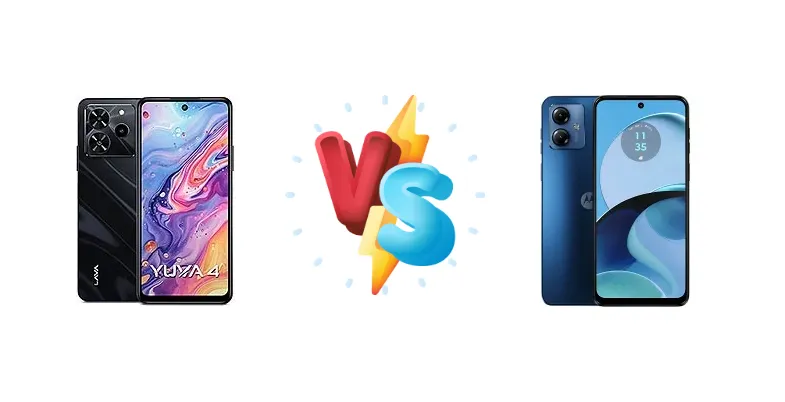
The Lava Yuva 4 and Motorola Moto G14 represent the fiercely competitive sub-$150 smartphone market. Both devices leverage Unisoc chipsets to deliver an affordable Android experience, but key differences in CPU clock speeds and charging capabilities create distinct user experiences. This comparison dissects these nuances to help you choose the right phone for your needs.
🏆 Quick Verdict
For most users, the Motorola Moto G14 emerges as the slightly better choice. The faster CPU clock speeds of the Unisoc Tiger T616, coupled with the 15W (or 20W in India) charging, provide a noticeable performance and convenience advantage over the Lava Yuva 4’s Unisoc T606 and 10W charging.
| Network |
|---|
| 2G bands | GSM 900 / 1800 | GSM 850 / 900 / 1800 / 1900 |
| 3G bands | HSDPA 850 / 900 / 1900 / 2100 | HSDPA 850 / 900 / 1900 / 2100 |
| 4G bands | 1, 3, 5, 7, 8, 20, 28, 38, 40, 41 | 1, 2, 3, 5, 7, 8, 20, 28, 38, 40, 41 |
| Speed | HSPA, LTE | HSPA, LTE |
| Technology | GSM / HSPA / LTE | GSM / HSPA / LTE |
| Launch |
|---|
| Announced | 2024, November 28 | 2023, August 01 |
| Status | Available. Released 2024, December | Available. Released 2023, August 08 |
| Body |
|---|
| Build | - | Glass front (Panda glass), plastic frame, plastic back |
| Dimensions | 164.2 x 76 x 8.5 mm (6.46 x 2.99 x 0.33 in) | 161.5 x 73.8 x 8 mm (6.36 x 2.91 x 0.31 in) |
| SIM | Nano-SIM + Nano-SIM | Nano-SIM + Nano-SIM |
| Weight | 200 g (7.05 oz) | 177 g (6.24 oz) |
| Display |
|---|
| Protection | - | Panda glass |
| Resolution | 720 x 1612 pixels, 20:9 ratio (~269 ppi density) | 1080 x 2400 pixels, 20:9 ratio (~405 ppi density) |
| Size | 6.56 inches, 103.4 cm2 (~82.8% screen-to-body ratio) | 6.5 inches, 102.0 cm2 (~85.6% screen-to-body ratio) |
| Type | IPS LCD, 90Hz | IPS LCD |
| Platform |
|---|
| CPU | Octa-core (2x1.6 GHz Cortex-A75 & 6x1.6 GHz Cortex-A55) | Octa-core (2x2.0 GHz Cortex-A75 & 6x1.8 GHz Cortex-A55) |
| Chipset | Unisoc T606 (12 nm) | Unisoc Tiger T616 (12 nm) |
| GPU | Mali-G57 MP1 | Mali-G57 MP1 |
| OS | Android 14 | Android 13, planned upgrade to Android 14 |
| Memory |
|---|
| Card slot | microSDXC (dedicated slot) | microSDXC (dedicated slot) |
| Internal | 64GB 4GB RAM, 128GB 4GB RAM | 128GB 4GB RAM, 256GB 8GB RAM |
| Main Camera |
|---|
| Dual | 50 MP, (wide), AF
VGA
Auxiliary lens | 50 MP, f/1.8, (wide), 0.64µm, PDAF
2 MP (macro) |
| Features | LED flash, HDR, panorama | LED flash, HDR, panorama |
| Video | 1080p@30fps | 1080p@30fps |
| Selfie camera |
|---|
| Single | 8 MP | 8 MP, f/2.0, (wide), 1/4.0", 1.12µm |
| Video | Yes | 1080p@30fps |
| Sound |
|---|
| 35mm jack | Yes | Yes |
| Loudspeaker | Yes | Yes, with stereo speakers |
| Comms |
|---|
| Bluetooth | 4.2, A2DP | 5.0, A2DP, LE |
| NFC | No | Yes (market/region dependent) |
| Positioning | GPS, GLONASS | GPS, GLONASS, GALILEO |
| Radio | FM radio | FM radio |
| USB | USB Type-C 2.0, OTG | USB Type-C 2.0 |
| WLAN | Wi-Fi 802.11 b/g/n/ac | Wi-Fi 802.11 a/b/g/n/ac, dual-band |
| Features |
|---|
| Sensors | Fingerprint (side-mounted), accelerometer, proximity | Fingerprint (side-mounted), accelerometer, gyro, proximity, compass (market/region dependent) |
| Battery |
|---|
| Charging | 10W wired | 15W wired
20W wired (India) |
| Type | Li-Ion 5000 mAh | Li-Po 5000 mAh |
| Misc |
|---|
| Colors | Glossy White, Glossy Purple, Glossy Black | Steel Gray, Sky Blue, Butter Cream, Pale Lilac |
| Models | - | PAYF0010IN |
| Price | About 80 EUR | $ 190.00 / £ 89.99 / € 149.90 |
Lava Yuva 4
- Potentially lower price point
- Simple and straightforward Android experience
- Reliable for basic tasks
- Slower processor
- Significantly slower charging (10W)
- Likely less responsive user interface
Motorola Moto G14
- Faster processor for smoother performance
- Faster charging (15W/20W)
- More responsive user experience
- Slightly higher price
- May include more pre-installed bloatware (typical of Motorola)
- Battery life may be comparable if capacity is similar
Display Comparison
Neither Lava nor Motorola provide detailed display specifications beyond the panel type. Given the price point, both likely utilize LCD panels. The absence of high refresh rates or advanced features like LTPO is expected. Bezels are likely comparable, prioritizing cost reduction over premium aesthetics. Color accuracy will likely be standard for this segment, leaning towards warmer tones for wider appeal.
Camera Comparison
Detailed camera specs are unavailable, but both phones likely feature a primary camera and potentially a depth or macro sensor. Given the price bracket, image processing will be heavily reliant on software algorithms to enhance detail and dynamic range. The absence of Optical Image Stabilization (OIS) is almost certain. The quality of the primary sensor will be the determining factor, but without knowing the sensor size or aperture, it’s difficult to definitively declare a winner. Expect similar performance in good lighting conditions, with noticeable noise and softness in low-light scenarios.
Performance
The core difference lies in the chipsets. The Motorola Moto G14’s Unisoc Tiger T616 boasts a 2.0 GHz Cortex-A75 paired with 1.8 GHz Cortex-A55 cores, compared to the Lava Yuva 4’s Unisoc T606 with 1.6 GHz Cortex-A75 and 1.6 GHz Cortex-A55 cores. This 0.4 GHz increase in the A75 core clock speed translates to a tangible performance boost in app loading times and multitasking. While both use a 12nm process, the T616’s higher clock speeds offer a clear advantage. RAM configurations are not specified, but the chipset’s performance will be the primary bottleneck, not RAM capacity, in typical usage scenarios.
Battery Life
Battery capacity is not specified for either device. However, the Motorola Moto G14’s 15W (or 20W in India) charging significantly outperforms the Lava Yuva 4’s 10W charging. This means a considerably faster 0-100% charge time for the Moto G14, reducing downtime. Even with a similar battery capacity, the faster charging speed provides a more convenient user experience. The Lava Yuva 4’s slower charging is a significant drawback for users who rely heavily on their phones throughout the day.
Buying Guide
Buy the Lava Yuva 4 if your primary concern is absolute affordability and you prioritize a simple, no-frills Android experience. It’s ideal for first-time smartphone users or those needing a reliable backup device. Buy the Motorola Moto G14 if you value slightly faster performance for everyday tasks and appreciate the convenience of quicker charging, even if it means spending a little more. This phone is better suited for users who actively use social media, browse the web, and occasionally play casual games.
Frequently Asked Questions
❓ Will the Unisoc Tiger T616 in the Moto G14 handle popular games like PUBG Mobile?
The Unisoc Tiger T616 can run PUBG Mobile, but expect to play at lower graphics settings (Balanced or Low) to maintain a stable frame rate. It’s not a gaming-focused chipset, so demanding titles will require compromises. The Lava Yuva 4’s T606 will struggle even more with graphically intensive games.
❓ How long will it take to fully charge the Lava Yuva 4 with its 10W charging?
With 10W charging, a full charge from 0% will likely take around 3-4 hours, depending on the battery capacity. This is significantly slower than the Moto G14’s 15W/20W charging, which could potentially reach 100% in around 2-2.5 hours.
❓ Does the Motorola Moto G14 have a dedicated microSD card slot for storage expansion?
While not explicitly stated, Motorola phones in this price range often include a hybrid SIM slot that can accommodate either a second SIM card or a microSD card for storage expansion. Check the official specifications for confirmation.
❓ Is the software experience on either phone heavily customized with bloatware?
Motorola is known for providing a relatively clean Android experience, but often includes some pre-installed apps. Lava’s software experience is less well-known, and may include more bloatware. Both phones will likely receive limited software updates.