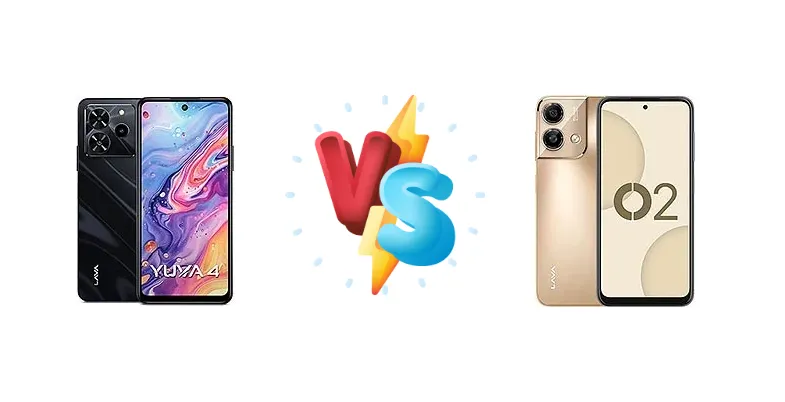
Lava is making waves in the budget smartphone space with the Yuva 4 and O2, both powered by Unisoc chipsets. While appearing similar on the surface, key differences in processing power and charging capabilities separate these devices. This comparison dissects those differences to determine which phone delivers the best value for your money.
🏆 Quick Verdict
For most users, the Lava O2 emerges as the better choice. Its Unisoc Tiger T616 chipset, with higher clocked Cortex-A75 cores and 18W charging, provides a noticeable performance boost and faster power-up times, justifying the likely price premium.
| Network |
|---|
| 2G bands | GSM 900 / 1800 | GSM 900 / 1800 |
| 3G bands | HSDPA 850 / 900 / 1900 / 2100 | HSDPA 900 / 2100 |
| 4G bands | 1, 3, 5, 7, 8, 20, 28, 38, 40, 41 | 1, 3, 5, 8, 40, 41 |
| Speed | HSPA, LTE | HSPA, LTE |
| Technology | GSM / HSPA / LTE | GSM / HSPA / LTE |
| Launch |
|---|
| Announced | 2024, November 28 | 2024, March 22 |
| Status | Available. Released 2024, December | Available. Released 2024, March 27 |
| Body |
|---|
| Dimensions | 164.2 x 76 x 8.5 mm (6.46 x 2.99 x 0.33 in) | 165 x 76.1 x 8.7 mm (6.50 x 3.00 x 0.34 in) |
| SIM | Nano-SIM + Nano-SIM | Nano-SIM + Nano-SIM |
| Weight | 200 g (7.05 oz) | 200 g (7.05 oz) |
| Display |
|---|
| Resolution | 720 x 1612 pixels, 20:9 ratio (~269 ppi density) | 720 x 1600 pixels, 20:9 ratio (~270 ppi density) |
| Size | 6.56 inches, 103.4 cm2 (~82.8% screen-to-body ratio) | 6.5 inches, 102.0 cm2 (~81.2% screen-to-body ratio) |
| Type | IPS LCD, 90Hz | IPS LCD, 90Hz |
| Platform |
|---|
| CPU | Octa-core (2x1.6 GHz Cortex-A75 & 6x1.6 GHz Cortex-A55) | Octa-core (2x2.0 GHz Cortex-A75 & 6x1.8 GHz Cortex-A55) |
| Chipset | Unisoc T606 (12 nm) | Unisoc Tiger T616 (12 nm) |
| GPU | Mali-G57 MP1 | Mali-G57 MP1 |
| OS | Android 14 | Android 13 |
| Memory |
|---|
| Card slot | microSDXC (dedicated slot) | microSDXC (dedicated slot) |
| Internal | 64GB 4GB RAM, 128GB 4GB RAM | 128GB 8GB RAM |
| Main Camera |
|---|
| Dual | 50 MP, (wide), AF
VGA
Auxiliary lens | - |
| Features | LED flash, HDR, panorama | LED flash, HDR, panorama |
| Single | - | 50 MP, (wide), AF
Auxiliary lens |
| Video | 1080p@30fps | 1080p@30fps |
| Selfie camera |
|---|
| Single | 8 MP | 8 MP |
| Video | Yes | 1080p@30fps |
| Sound |
|---|
| 35mm jack | Yes | Yes |
| Loudspeaker | Yes | Yes |
| Comms |
|---|
| Bluetooth | 4.2, A2DP | 5.0, A2DP, LE |
| NFC | No | No |
| Positioning | GPS, GLONASS | GPS |
| Radio | FM radio | FM radio |
| USB | USB Type-C 2.0, OTG | USB Type-C 2.0, OTG |
| WLAN | Wi-Fi 802.11 b/g/n/ac | Wi-Fi 802.11 b/g/n/ac |
| Features |
|---|
| Sensors | Fingerprint (side-mounted), accelerometer, proximity | Fingerprint (side-mounted), accelerometer, proximity |
| Battery |
|---|
| Charging | 10W wired | 18W wired |
| Type | Li-Ion 5000 mAh | Li-Po 5000 mAh |
| Misc |
|---|
| Colors | Glossy White, Glossy Purple, Glossy Black | Imperial Green, Majestic Purple, Royal Gold |
| Price | About 80 EUR | About 100 EUR |
Lava Yuva 4
- More affordable price point
- Sufficient for basic smartphone tasks
- Likely longer battery life with conservative use
- Slower processor performance
- Significantly slower charging speed
- Less responsive user experience
Lava O2
- Faster and more responsive performance
- 18W fast charging for quicker power-ups
- Potentially better camera image processing
- Likely higher price tag
- May experience slightly faster battery drain under heavy load
- No significant camera upgrades without further specs
Display Comparison
Both devices utilize 12nm chipsets, suggesting similar power efficiency considerations likely influenced display choices. While specific display specs (resolution, panel type) are not provided, the focus here is on performance. The lack of information prevents a detailed analysis of color accuracy or brightness, but the chipset differences will impact the smoothness of UI animations and video playback.
Camera Comparison
Without detailed camera specifications, a direct comparison is limited. However, the chipset’s image signal processor (ISP) plays a crucial role in image quality. The T616 in the O2 likely has a more advanced ISP, potentially leading to better noise reduction and dynamic range in photos and videos. The absence of information on sensor sizes and lens apertures makes a definitive statement impossible, but the O2’s superior processing power gives it an edge.
Performance
The core difference lies in the chipsets. The Lava O2’s Unisoc Tiger T616 boasts 2x2.0 GHz Cortex-A75 cores compared to the Yuva 4’s 2x1.6 GHz Cortex-A75 cores. This 20% clock speed increase, coupled with slightly faster 1.8 GHz Cortex-A55 cores (vs 1.6 GHz in the Yuva 4), translates to snappier app launches and improved responsiveness. The T616’s GPU will also offer a marginal performance uplift in gaming. While both use 12nm fabrication, the T616’s architecture provides a clear advantage for demanding tasks.
Battery Life
While battery capacity isn’t specified, the Lava O2’s 18W wired charging is a significant advantage over the Yuva 4’s 10W charging. This means the O2 can replenish its battery much faster, reducing downtime. Even with a similar battery capacity, the T616’s slightly improved power efficiency could translate to marginally longer battery life under moderate usage. The faster charging is particularly beneficial for users who frequently find themselves needing a quick power boost.
Buying Guide
Buy the Lava Yuva 4 if you prioritize absolute affordability and basic smartphone functionality – it’s a solid option for first-time smartphone users or those on a very tight budget. Buy the Lava O2 if you value smoother multitasking, slightly improved gaming performance, and the convenience of faster charging, making it ideal for users who actively use their phones throughout the day.
Frequently Asked Questions
❓ Will the Lava O2 handle demanding games like PUBG Mobile smoothly?
The Unisoc Tiger T616 in the Lava O2 offers a performance improvement over the T606, but don't expect flagship-level gaming. PUBG Mobile should be playable at medium settings with reasonable frame rates. However, sustained high frame rates may be limited by thermal throttling.
❓ How much faster is the 18W charging on the Lava O2 compared to the 10W charging on the Yuva 4?
The 18W charging on the Lava O2 will significantly reduce charging times. While exact 0-100% times are unavailable, expect the O2 to charge roughly 40-60% faster than the Yuva 4, making it more convenient for users who need to quickly top up their battery.
❓ Is the difference in processor speed between the T606 and T616 noticeable in everyday use?
Yes, the difference is noticeable, particularly when multitasking or launching apps. The higher clocked cores in the T616 provide a snappier and more responsive user experience. While both chipsets are adequate for basic tasks, the T616 handles more demanding operations with greater ease.