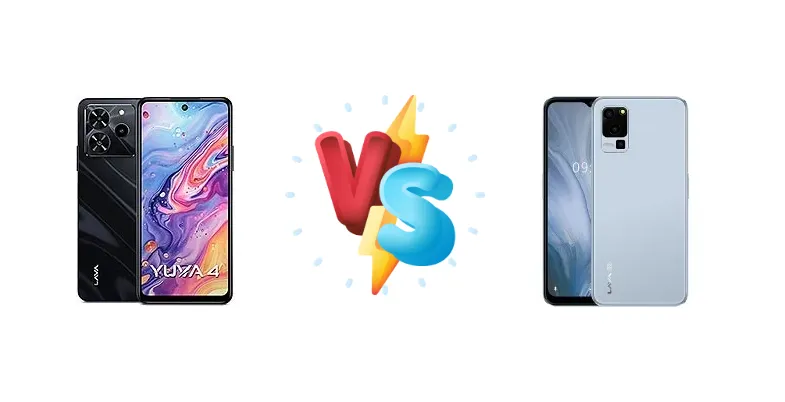
Lava is aggressively targeting the budget smartphone segment with the Yuva 4 and Blaze 5G. While both aim to deliver affordability, they diverge significantly in their core processing power. This comparison dissects the key differences between the Unisoc T606-powered Yuva 4 and the MediaTek Dimensity 700-equipped Blaze 5G, helping you determine which best suits your needs.
🏆 Quick Verdict
For most users, the Lava Blaze 5G is the superior choice. Its MediaTek Dimensity 700 chipset, built on a more efficient 7nm process, provides a noticeable performance uplift over the Yuva 4’s Unisoc T606, especially in demanding tasks and 5G connectivity. Both share the same slow 10W charging, but the Blaze 5G’s processing advantage justifies the potential price difference.
| Network |
|---|
| 2G bands | GSM 900 / 1800 | GSM 900 / 1800 |
| 3G bands | HSDPA 850 / 900 / 1900 / 2100 | HSDPA 900 / 2100 |
| 4G bands | 1, 3, 5, 7, 8, 20, 28, 38, 40, 41 | 1, 3, 5, 8, 40, 41 |
| 5G bands | - | SA/NSA |
| Speed | HSPA, LTE | HSPA, LTE, 5G |
| Technology | GSM / HSPA / LTE | GSM / HSPA / LTE / 5G |
| Launch |
|---|
| Announced | 2024, November 28 | 2022, October 3 |
| Status | Available. Released 2024, December | Available. Released 2022, October 24 |
| Body |
|---|
| Dimensions | 164.2 x 76 x 8.5 mm (6.46 x 2.99 x 0.33 in) | 165.3 x 76.4 x 8.9 mm (6.51 x 3.01 x 0.35 in) |
| SIM | Nano-SIM + Nano-SIM | Nano-SIM + Nano-SIM |
| Weight | 200 g (7.05 oz) | 207 g (7.30 oz) |
| Display |
|---|
| Resolution | 720 x 1612 pixels, 20:9 ratio (~269 ppi density) | 720 x 1600 pixels, 20:9 ratio (~269 ppi density) |
| Size | 6.56 inches, 103.4 cm2 (~82.8% screen-to-body ratio) | 6.52 inches, 102.6 cm2 (~81.3% screen-to-body ratio) |
| Type | IPS LCD, 90Hz | IPS LCD, 90Hz |
| Platform |
|---|
| CPU | Octa-core (2x1.6 GHz Cortex-A75 & 6x1.6 GHz Cortex-A55) | Octa-core (2x2.2 GHz Cortex-A76 & 6x2.0 GHz Cortex-A55) |
| Chipset | Unisoc T606 (12 nm) | Mediatek Dimensity 700 (7 nm) |
| GPU | Mali-G57 MP1 | Mali-G57 MC2 |
| OS | Android 14 | Android 12 |
| Memory |
|---|
| Card slot | microSDXC (dedicated slot) | microSDXC (uses shared SIM slot) |
| Internal | 64GB 4GB RAM, 128GB 4GB RAM | 128GB 4GB RAM, 128GB 6GB RAM |
| | - | eMMC 5.1 |
| Main Camera |
|---|
| Dual | 50 MP, (wide), AF
VGA
Auxiliary lens | - |
| Features | LED flash, HDR, panorama | LED flash, HDR, panorama |
| Single | - | 8 MP, f/2.0, (wide) |
| Triple | - | 50 MP, (wide), 0.64µm, AF
2 MP (macro)
0.3 MP |
| Video | 1080p@30fps | 1080p@30fps |
| Selfie camera |
|---|
| Single | 8 MP | 8 MP, f/2.0, (wide) |
| Video | Yes | Yes |
| Sound |
|---|
| 3.5mm jack | - | Yes |
| 35mm jack | Yes | Yes |
| Loudspeaker | Yes | Yes |
| Comms |
|---|
| Bluetooth | 4.2, A2DP | 5.0, A2DP, LE |
| NFC | No | No |
| Positioning | GPS, GLONASS | GPS |
| Radio | FM radio | FM radio |
| USB | USB Type-C 2.0, OTG | USB Type-C 2.0, OTG |
| WLAN | Wi-Fi 802.11 b/g/n/ac | Wi-Fi 802.11 b/g/n/ac |
| Features |
|---|
| Sensors | Fingerprint (side-mounted), accelerometer, proximity | Fingerprint (side-mounted), accelerometer, proximity |
| Battery |
|---|
| Charging | 10W wired | 10W wired |
| Type | Li-Ion 5000 mAh | Li-Po 5000 mAh |
| Misc |
|---|
| Colors | Glossy White, Glossy Purple, Glossy Black | Green, Blue |
| Models | - | LXX503 |
| Price | About 80 EUR | About 130 EUR |
Lava Yuva 4
- Most affordable option
- Sufficient for basic tasks
- Decent build quality for the price
- Underpowered chipset
- Slow charging speed
- Limited 5G capabilities
Lava Blaze 5G
- Faster and more efficient processor
- Integrated 5G modem
- Better multitasking performance
- Slow charging speed
- Potentially higher price
- May still exhibit some throttling under heavy load
Display Comparison
Neither Lava provides display specifications beyond resolution. However, given the price points, both likely utilize LCD panels. The key difference lies in the processing power driving them. A faster chipset like the Dimensity 700 in the Blaze 5G will translate to smoother animations and faster app loading times on the display, regardless of panel quality.
Camera Comparison
Without detailed camera specs, a direct comparison is difficult. However, the processing power of the Dimensity 700 in the Blaze 5G will likely result in better image processing, including noise reduction and dynamic range. The chipset’s ISP (Image Signal Processor) is more capable than the one found in the Unisoc T606, leading to superior image quality, particularly in low-light conditions. Expect any differences in sensor quality to be less impactful than the processing capabilities.
Performance
The core differentiator is the chipset. The Lava Blaze 5G’s MediaTek Dimensity 700 (7nm) boasts significantly higher CPU clock speeds (2.2 GHz Cortex-A76 vs 1.6 GHz Cortex-A75 in the Yuva 4) and a more advanced manufacturing process. This 7nm process is crucial; it allows for greater transistor density and improved thermal efficiency, meaning the Blaze 5G can sustain peak performance for longer without throttling. The Yuva 4’s Unisoc T606 (12nm) is adequate for basic tasks, but will struggle with demanding applications and multitasking. The Dimensity 700’s integrated 5G modem is also a major advantage, providing faster and more reliable 5G connectivity.
Battery Life
Both devices are limited to 10W wired charging, a significant drawback in today’s market. This means both will take a considerable amount of time to fully charge. While battery capacity isn’t specified, the more efficient 7nm Dimensity 700 in the Blaze 5G will likely result in slightly better battery life, as it consumes less power during operation. The difference won’t be dramatic, but it’s a factor to consider.
Buying Guide
Buy the Lava Yuva 4 if you prioritize extreme affordability and your usage is limited to basic tasks like calls, messaging, and light social media. It’s a solid option for first-time smartphone users or those on a very tight budget. Buy the Lava Blaze 5G if you want a smoother, more responsive experience, especially when utilizing 5G networks, and anticipate occasional gaming or multitasking. The Dimensity 700 offers a future-proofed experience for a minimal price premium.
Frequently Asked Questions
❓ Will the Dimensity 700 in the Blaze 5G handle demanding games like PUBG Mobile?
The Dimensity 700 is capable of running PUBG Mobile, but expect to play at medium settings for a smooth experience. While it’s not a gaming powerhouse, it offers a significant improvement over the Yuva 4’s Unisoc T606, which would likely struggle even at the lowest settings.
❓ Is the 10W charging on both phones a dealbreaker?
Yes, the 10W charging is a significant drawback on both devices. Expect a full charge to take well over two hours. If fast charging is a priority, you’ll need to consider other options outside of these two models.
❓ How much of a real-world performance difference will I notice between the Unisoc T606 and the Dimensity 700?
You’ll notice a substantial difference in app loading times, multitasking, and overall responsiveness with the Blaze 5G. The Dimensity 700’s faster CPU and GPU, combined with its more efficient architecture, will make everyday tasks feel snappier and more fluid.
❓ Does the Lava Blaze 5G support all 5G bands available in [Country/Region]?
Lava does not explicitly list 5G band support on their website. It's crucial to check with your carrier to confirm compatibility with the Blaze 5G before purchasing, as 5G band support varies by region.