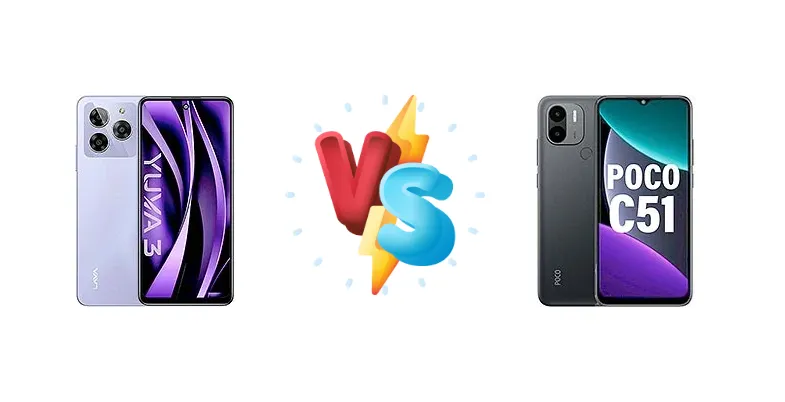
The sub-$150 smartphone market is fiercely competitive. Both the Lava Yuva 3 and Xiaomi Poco C51 aim to deliver essential smartphone functionality at an incredibly accessible price point. However, they take different approaches to achieving this, primarily through their chipset choices. This comparison dissects those differences and determines which device offers the best value for your money.
🏆 Quick Verdict
For the average user prioritizing responsiveness and overall performance, the Lava Yuva 3 is the better choice. Its Unisoc T606 chipset, featuring Cortex-A75 cores, provides a noticeable performance advantage over the Poco C51’s Helio G36. While the Poco C51 is cheaper, the Yuva 3’s faster charging and more capable processor justify the slight price premium.
| Network |
|---|
| 2G bands | GSM 900 / 1800 | GSM 850 / 900 / 1800 / 1900 |
| 3G bands | HSDPA 900 / 2100 | HSDPA 850 / 900 / 2100 |
| 4G bands | 1, 3, 5, 8, 40, 41 | 1, 3, 5, 8, 40, 41 |
| Speed | HSPA, LTE | HSPA, LTE |
| Technology | GSM / HSPA / LTE | GSM / HSPA / LTE |
| Launch |
|---|
| Announced | 2024, February 02 | 2023, April 07 |
| Status | Available. Released 2024, February 07 | Available. Released 2023, April 13 |
| Body |
|---|
| Dimensions | 164.2 x 76 x 8.5 mm (6.46 x 2.99 x 0.33 in) | 164.9 x 76.8 x 9.1 mm (6.49 x 3.02 x 0.36 in) |
| SIM | Nano-SIM + Nano-SIM | Nano-SIM + Nano-SIM |
| Weight | 192 g (6.77 oz) | 192 g (6.77 oz) |
| Display |
|---|
| Resolution | 720 x 1600 pixels, 20:9 ratio (~270 ppi density) | 720 x 1600 pixels, 20:9 ratio (~269 ppi density) |
| Size | 6.5 inches, 102.0 cm2 (~81.7% screen-to-body ratio) | 6.52 inches, 102.6 cm2 (~81.0% screen-to-body ratio) |
| Type | IPS LCD, 90Hz | IPS LCD, 400 nits (typ) |
| Platform |
|---|
| CPU | Octa-core (2x1.6 GHz Cortex-A75 & 6x1.6 GHz Cortex-A55) | Octa-core (4x2.2 GHz Cortex-A53 & 4x1.7 GHz Cortex-A53) |
| Chipset | Unisoc T606 (12 nm) | Mediatek Helio G36 (12 nm) |
| GPU | Mali-G57 MP1 | PowerVR GE8320 |
| OS | Android 13 | Android 13 (Go edition), MIUI |
| Memory |
|---|
| Card slot | microSDXC (dedicated slot) | microSDXC (dedicated slot) |
| Internal | 64GB 4GB RAM, 128GB 4GB RAM | 64GB 4GB RAM, 128GB 6GB RAM |
| | - | eMMC 5.1 |
| Main Camera |
|---|
| Dual | 13 MP, (wide), AF
VGA
Auxiliary lens | 8 MP, f/2.0, (wide)
0.08 MP (depth) |
| Features | LED flash, HDR, panorama | Dual-LED flash, HDR |
| Single | - | 8 MP, f/2.0, (wide)
Auxiliary lens |
| Video | 1080p@30fps | 1080p@30fps |
| Selfie camera |
|---|
| Single | 5 MP | 5 MP, f/2.2 |
| Video | Yes | 1080p@30fps |
| Sound |
|---|
| 3.5mm jack | - | Yes |
| 35mm jack | Yes | Yes |
| Loudspeaker | Yes | Yes |
| Comms |
|---|
| Bluetooth | 5.0, A2DP, LE | 5.0, A2DP, LE |
| NFC | No | No |
| Positioning | GPS, GLONASS | GPS, GLONASS, BDS |
| Radio | FM radio | FM radio, recording |
| USB | USB Type-C 2.0, OTG | microUSB 2.0, OTG |
| WLAN | Wi-Fi 802.11 b/g/n/ac | Wi-Fi 802.11 b/g/n |
| Features |
|---|
| Sensors | Fingerprint (side-mounted), accelerometer, proximity | Fingerprint (rear-mounted), accelerometer |
| Battery |
|---|
| Charging | 18W wired | 10W wired |
| Type | Li-Po 5000 mAh | Li-Po 5000 mAh |
| Misc |
|---|
| Colors | Eclipse Black, Cosmic Lavender, Galaxy White | Power Black, Royal Blue |
| Models | - | MZB0E6DIN, MZB0DXKIN, 2302EPCC4I, 2305EPCC4G, 2302EPCC4H |
| Price | About 80 EUR | About 100 EUR |
| SAR | - | 0.97 W/kg (head) 0.87 W/kg (body) |
Lava Yuva 3
- Faster processor with Cortex-A75 cores
- Faster 18W charging
- Potentially smoother multitasking
- May be slightly more expensive
- Camera performance likely similar to Poco C51
Xiaomi Poco C51
- Lower price point
- Decent battery life (estimated 5000mAh)
- Lightweight and compact
- Slower processor with older Cortex-A53 cores
- Slower 10W charging
- Potentially noticeable lag during multitasking
Display Comparison
Neither device boasts a standout display. Both likely utilize LCD panels, common in this price bracket. Specifics like resolution and peak brightness are not provided, but we can assume they are similar – around 720p+ and 400-500 nits respectively. The focus here isn't on visual fidelity, but on basic usability. Bezels are likely to be substantial on both, maximizing screen real estate within a compact form factor.
Camera Comparison
Camera performance is likely to be similar and unremarkable on both devices. Without sensor size or aperture information, it’s difficult to make definitive claims. Both will likely feature a primary camera and a depth sensor, with the Poco C51 potentially including a macro lens. Image processing will be basic, prioritizing speed over quality. Don't expect exceptional low-light performance or detailed images from either device. The focus should be on capturing memories, not creating professional-grade photographs.
Performance
This is where the Yuva 3 pulls ahead. The Unisoc T606 utilizes two Cortex-A75 cores clocked at 1.6 GHz alongside six Cortex-A55 cores. This architecture provides a significant boost in single-core performance compared to the Poco C51’s Helio G36, which relies on four Cortex-A53 cores clocked at 2.2 GHz and another four at 1.7 GHz. While the G36 has more cores, the older A53 architecture is less efficient and delivers lower performance per clock cycle. The Yuva 3 will handle multitasking and app switching more smoothly. The 12nm process node is shared by both, suggesting similar thermal characteristics, but the more efficient architecture of the T606 will likely result in slightly better sustained performance.
Battery Life
Battery capacity is not specified for either device, but both likely house around a 5000mAh battery, standard for this segment. However, the charging speeds differ significantly. The Lava Yuva 3 supports 18W wired charging, while the Poco C51 is limited to 10W. This translates to a considerably faster 0-100% charge time for the Yuva 3, potentially shaving off an hour or more. This is a crucial advantage for users who rely heavily on their phones throughout the day.
Buying Guide
Buy the Lava Yuva 3 if you need a phone that feels responsive for everyday tasks like browsing, social media, and light gaming. The faster processor and 18W charging will significantly improve your experience. Buy the Xiaomi Poco C51 if your primary concern is absolute affordability and you only need a phone for basic communication – calls, texts, and very light app usage. Be prepared for slower performance and longer charging times.
Frequently Asked Questions
❓ Will the Poco C51 struggle with popular apps like WhatsApp and Facebook?
While the Poco C51 can run these apps, the Helio G36 chipset and older Cortex-A53 cores may result in noticeable lag when switching between apps or loading heavier content within them. The Lava Yuva 3, with its more modern chipset, will provide a smoother experience.
❓ How long will it take to fully charge the Lava Yuva 3 with the included charger?
Given the 18W charging support, a full charge from 0% to 100% on the Lava Yuva 3 should take approximately 2-2.5 hours, assuming a compatible charger is used. This is significantly faster than the Poco C51’s estimated 3-4 hours with its 10W charging.
❓ Is the Unisoc T606 chipset in the Lava Yuva 3 capable of playing modern mobile games?
The Unisoc T606 can handle casual mobile games without issue. However, demanding titles like PUBG Mobile or Call of Duty: Mobile will likely require low graphics settings and may still experience occasional frame drops. The Poco C51 will struggle even more with these games.
❓ Does either phone support VoLTE or VoWiFi for improved call quality?
This information isn't provided in the specifications. However, given these phones are targeted at emerging markets, it's likely both support VoLTE, but VoWiFi support is less certain. Check with your carrier for compatibility.