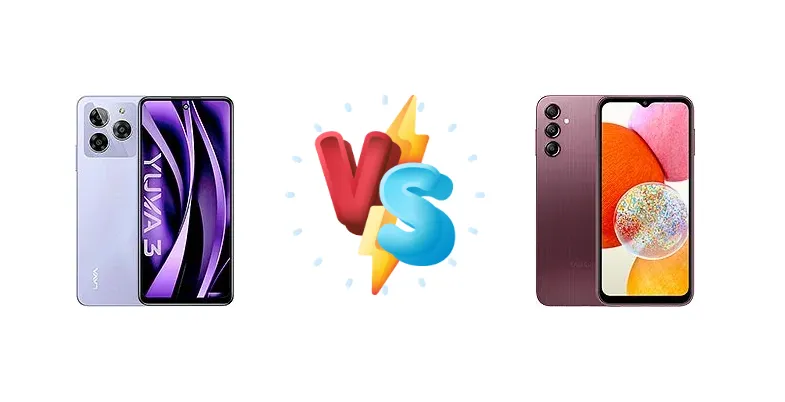
The sub-$150 smartphone market is fiercely competitive. The Lava Yuva 3 and Samsung Galaxy A14 both aim to deliver essential smartphone functionality at an accessible price point, but they take different approaches. The Yuva 3 focuses on a streamlined experience with a Unisoc chipset, while the Galaxy A14 offers a choice between a Mediatek Helio G80 and an Exynos 850, potentially catering to a wider range of user needs.
🏆 Quick Verdict
For most users, the Samsung Galaxy A14 (specifically the Exynos 850 variant) offers a more compelling package. While the Lava Yuva 3 provides a functional experience, the A14’s potentially more powerful chipset and established brand reputation provide a better long-term value proposition, despite slightly slower charging.
| Network |
|---|
| 2G bands | GSM 900 / 1800 | GSM 850 / 900 / 1800 / 1900 |
| 3G bands | HSDPA 900 / 2100 | HSDPA 850 / 900 / 2100 |
| 4G bands | 1, 3, 5, 8, 40, 41 | 1, 3, 5, 7, 8, 20, 28, 38, 40, 41 |
| Speed | HSPA, LTE | HSPA, LTE |
| Technology | GSM / HSPA / LTE | GSM / HSPA / LTE |
| Launch |
|---|
| Announced | 2024, February 02 | 2023, February 28 |
| Status | Available. Released 2024, February 07 | Available. Released 2023, March 27 |
| Body |
|---|
| Build | - | Glass front, plastic back, plastic frame |
| Dimensions | 164.2 x 76 x 8.5 mm (6.46 x 2.99 x 0.33 in) | 167.7 x 78 x 9.1 mm (6.60 x 3.07 x 0.36 in) |
| SIM | Nano-SIM + Nano-SIM | · Nano-SIM· Nano-SIM + Nano-SIM |
| Weight | 192 g (6.77 oz) | 201 g (7.09 oz) |
| Display |
|---|
| Resolution | 720 x 1600 pixels, 20:9 ratio (~270 ppi density) | 1080 x 2408 pixels, 20:9 ratio (~400 ppi density) |
| Size | 6.5 inches, 102.0 cm2 (~81.7% screen-to-body ratio) | 6.6 inches, 104.9 cm2 (~80.2% screen-to-body ratio) |
| Type | IPS LCD, 90Hz | PLS LCD |
| Platform |
|---|
| CPU | Octa-core (2x1.6 GHz Cortex-A75 & 6x1.6 GHz Cortex-A55) | Octa-core (2x2.0 GHz Cortex-A75 & 6x1.8 GHz Cortex-A55) - Version AOcta-core (4x2.0 GHz Cortex-A55 & 4x2.0 GHz Cortex-A55) - Version B |
| Chipset | Unisoc T606 (12 nm) | Mediatek MT6769 Helio G80 (12 nm) - Version AExynos 850 (8 nm) - Version B |
| GPU | Mali-G57 MP1 | Mali-G52 MC2 |
| OS | Android 13 | Android 13, upgradable to Android 15, One UI 7 |
| Memory |
|---|
| Card slot | microSDXC (dedicated slot) | microSDXC (dedicated slot) |
| Internal | 64GB 4GB RAM, 128GB 4GB RAM | 64GB 4GB RAM, 128GB 4GB RAM, 128GB 6GB RAM |
| Main Camera |
|---|
| Dual | 13 MP, (wide), AF
VGA
Auxiliary lens | - |
| Features | LED flash, HDR, panorama | LED flash, panorama, HDR |
| Single | - | 13 MP, f/2.0, (wide) |
| Triple | - | 50 MP, f/1.8, 26mm (wide), 1/2.75", 0.64µm, PDAF
5 MP, f/2.2, 17mm (ultrawide), 1/5.0", 1.12µm
2 MP (macro) |
| Video | 1080p@30fps | 1080p@30fps |
| Selfie camera |
|---|
| Single | 5 MP | 13 MP, f/2.0, 26mm (wide), 1/3.1", 1.12µm |
| Video | Yes | 1080p@30fps |
| Sound |
|---|
| 3.5mm jack | - | Yes |
| 35mm jack | Yes | Yes |
| Loudspeaker | Yes | Yes |
| Comms |
|---|
| Bluetooth | 5.0, A2DP, LE | 5.1 or 5.3, A2DP, LE |
| NFC | No | Yes (market/region dependent) |
| Positioning | GPS, GLONASS | GPS, GALILEO, GLONASS, BDS, QZSS |
| Radio | FM radio | Unspecified |
| USB | USB Type-C 2.0, OTG | USB Type-C 2.0 |
| WLAN | Wi-Fi 802.11 b/g/n/ac | Wi-Fi 802.11 a/b/g/n/ac, dual-band, Wi-Fi Direct |
| Features |
|---|
| Sensors | Fingerprint (side-mounted), accelerometer, proximity | Fingerprint (side-mounted), accelerometer, proximity, compass |
| Battery |
|---|
| Charging | 18W wired | 15W wired |
| Type | Li-Po 5000 mAh | Li-Po 5000 mAh |
| Misc |
|---|
| Colors | Eclipse Black, Cosmic Lavender, Galaxy White | Black, Dark Red, Silver, Green |
| Models | - | SM-A145F, SM-A145F/DSN, SM-A145M, SM-A145M/DS, SM-A145P, SM-A145R |
| Price | About 80 EUR | € 85.76 / $ 147.60 / £ 79.95 |
| SAR EU | - | 0.46 W/kg (head) 1.37 W/kg (body) |
Lava Yuva 3
- Faster charging (18W)
- Potentially lower price
- Simple, streamlined Android experience
- Less powerful chipset (Unisoc T606)
- Less established brand reputation
- Likely limited software updates
Samsung Galaxy A14
- More powerful chipset options (Helio G80/Exynos 850)
- Established brand and support
- Potentially better long-term software updates
- Slower charging (15W)
- Potentially higher price
- Bloatware common on Samsung devices
Display Comparison
Neither device boasts a standout display. Both are likely to utilize LCD panels, common in this price bracket. The key difference lies in processing power impacting UI smoothness. While specific display specs (resolution, brightness) are unavailable for the Yuva 3, the A14’s display is adequate for everyday use. The A14’s larger screen size will be preferable for media consumption, but both will likely struggle in direct sunlight.
Camera Comparison
Camera performance is likely to be similar across both devices, focusing on basic image capture. Both will likely feature a primary camera and depth/macro sensors. The A14’s potential for better image processing, thanks to the more powerful chipset, gives it a slight advantage. However, the presence of a 2MP macro camera on the A14 is largely a marketing gimmick and won’t deliver significant improvements in image quality. The larger sensor size (if any) on the A14’s main camera will be the key differentiator, but specific sensor details are unavailable.
Performance
This is where the biggest divergence occurs. The Lava Yuva 3’s Unisoc T606 (12nm) is a competent but entry-level chipset. Its octa-core configuration (2x1.6 GHz Cortex-A75 & 6x1.6 GHz Cortex-A55) provides adequate performance for basic tasks. The Samsung Galaxy A14 presents a split: the Helio G80 (12nm) version offers a slight performance edge over the T606, with faster Cortex-A75 cores (2x2.0 GHz). However, the Exynos 850 (8nm) variant is a significant step up. The 8nm process node translates to improved power efficiency and potentially better sustained performance, crucial for gaming and multitasking. The A75 cores in the A14 are clocked higher, and the Exynos version has a more balanced core configuration. This means the A14, particularly with the Exynos chip, will handle demanding apps and games more smoothly.
Battery Life
The Lava Yuva 3 features 18W wired charging, while the Samsung Galaxy A14 is limited to 15W. This suggests the Yuva 3 *could* charge slightly faster, but real-world charging times depend heavily on software optimization and battery capacity (which is currently unknown for both devices). The A14’s more efficient Exynos 850 chip (if equipped) could offset the slower charging with better overall battery life during usage. Without knowing the battery capacities, it’s difficult to definitively declare a winner, but the Yuva 3’s higher wattage is a point in its favor.
Buying Guide
Buy the Lava Yuva 3 if you prioritize simplicity and a no-frills Android experience, and are comfortable with a less-known brand. It’s a solid choice for basic communication and light tasks. Buy the Samsung Galaxy A14 if you value a more recognizable brand, potentially better performance (especially the Exynos version), and a wider ecosystem of support and accessories. It’s better suited for users who enjoy media consumption and occasional gaming.
Frequently Asked Questions
❓ Does the Exynos 850 chip in the Samsung Galaxy A14 tend to overheat during prolonged gaming sessions?
The Exynos 850's 8nm process node is relatively efficient, meaning it generates less heat compared to the 12nm Unisoc T606. While it may get warm during extended gaming, it's unlikely to experience significant throttling, providing a more consistent gaming experience than the Lava Yuva 3.
❓ Is the 2MP macro camera on the Samsung Galaxy A14 worth using, or is it just a marketing feature?
The 2MP macro camera on the A14 is largely a marketing feature. Its low resolution and fixed focus limit its usefulness. Images taken with it will likely lack detail and sharpness. It's best to rely on the main camera for most photography needs.
❓ Can the Lava Yuva 3 handle popular games like PUBG Mobile, and if so, at what settings?
The Lava Yuva 3 can likely run PUBG Mobile, but at the lowest graphics settings and frame rate. The Unisoc T606's limited processing power will struggle with higher settings, resulting in lag and stuttering. Expect a less-than-optimal gaming experience.
❓ How does Samsung's One UI affect the performance of the Galaxy A14 compared to a stock Android experience?
Samsung's One UI is feature-rich but can be resource-intensive. It adds animations and pre-installed apps that consume RAM and processing power. While the Exynos 850 (or Helio G80) can handle One UI, it may result in slightly slower app launch times and multitasking compared to a device running a cleaner, stock Android version like the Lava Yuva 3.