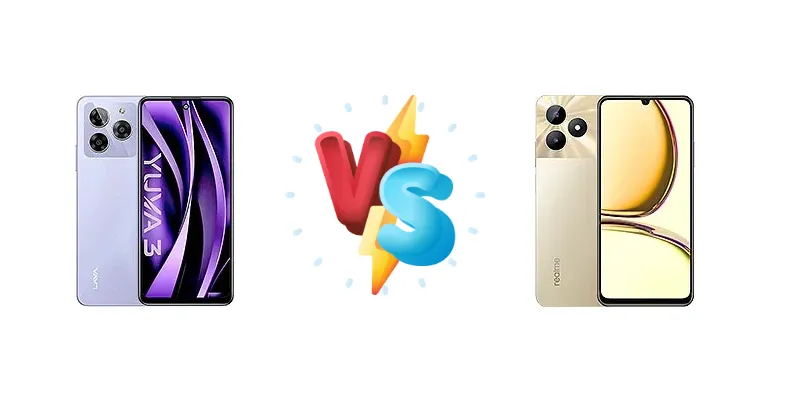
The sub-₹10,000 (approximately $120 USD) smartphone segment in India is fiercely competitive. Both the Lava Yuva 3 and the Realme C53 aim to deliver a compelling experience without breaking the bank. This comparison focuses on the core differences – specifically the Unisoc chipsets – and how they translate to everyday usage and performance.
🏆 Quick Verdict
For most users, the Realme C53 (India) offers a slight edge due to its marginally faster Unisoc Tiger T612 chipset. The higher clock speeds on the Cortex-A75 cores provide a more responsive experience in demanding apps. However, the Lava Yuva 3 remains a viable option for basic users prioritizing a reliable brand.
| Network |
|---|
| 2G bands | GSM 900 / 1800 | GSM 850 / 900 / 1800 / 1900 |
| 3G bands | HSDPA 900 / 2100 | HSDPA 850 / 900 / 2100 |
| 4G bands | 1, 3, 5, 8, 40, 41 | 1, 3, 5, 8, 38, 40, 41 |
| Speed | HSPA, LTE | HSPA, LTE |
| Technology | GSM / HSPA / LTE | GSM / HSPA / LTE |
| Launch |
|---|
| Announced | 2024, February 02 | 2023, July 19 |
| Status | Available. Released 2024, February 07 | Available. Released 2023, July 26 |
| Body |
|---|
| Build | - | Glass front, plastic frame, plastic back |
| Dimensions | 164.2 x 76 x 8.5 mm (6.46 x 2.99 x 0.33 in) | 167.2 x 76.7 x 8 mm (6.58 x 3.02 x 0.31 in) |
| SIM | Nano-SIM + Nano-SIM | Nano-SIM + Nano-SIM |
| Weight | 192 g (6.77 oz) | 186 g (6.56 oz) |
| Display |
|---|
| Resolution | 720 x 1600 pixels, 20:9 ratio (~270 ppi density) | 1080 x 2400 pixels, 20:9 ratio (~390 ppi density) |
| Size | 6.5 inches, 102.0 cm2 (~81.7% screen-to-body ratio) | 6.74 inches, 109.7 cm2 (~85.5% screen-to-body ratio) |
| Type | IPS LCD, 90Hz | IPS LCD, 90Hz, 560 nits (peak) |
| Platform |
|---|
| CPU | Octa-core (2x1.6 GHz Cortex-A75 & 6x1.6 GHz Cortex-A55) | Octa-core (2x1.8 GHz Cortex-A75 & 6x1.8 GHz Cortex-A55) |
| Chipset | Unisoc T606 (12 nm) | Unisoc Tiger T612 (12 nm) |
| GPU | Mali-G57 MP1 | Mali-G57 |
| OS | Android 13 | Android 13, Realme UI |
| Memory |
|---|
| Card slot | microSDXC (dedicated slot) | microSDXC (dedicated slot) |
| Internal | 64GB 4GB RAM, 128GB 4GB RAM | 64GB 6GB RAM, 128GB 4GB RAM, 128GB 6GB RAM |
| Main Camera |
|---|
| Dual | 13 MP, (wide), AF
VGA
Auxiliary lens | 108 MP, (wide), PDAF
Auxiliary lens |
| Features | LED flash, HDR, panorama | LED flash, HDR, panorama |
| Video | 1080p@30fps | 1080p@30fps |
| Selfie camera |
|---|
| Features | - | HDR |
| Single | 5 MP | 8 MP, (wide) |
| Video | Yes | 720p@30fps |
| Sound |
|---|
| 35mm jack | Yes | Yes |
| Loudspeaker | Yes | Yes |
| Comms |
|---|
| Bluetooth | 5.0, A2DP, LE | 5.0, A2DP, LE |
| NFC | No | No |
| Positioning | GPS, GLONASS | GPS, GLONASS, GALILEO |
| Radio | FM radio | Unspecified |
| USB | USB Type-C 2.0, OTG | USB Type-C 2.0 |
| WLAN | Wi-Fi 802.11 b/g/n/ac | Wi-Fi 802.11 a/b/g/n/ac, dual-band |
| Features |
|---|
| Sensors | Fingerprint (side-mounted), accelerometer, proximity | Fingerprint (side-mounted), accelerometer, gyro, proximity, compass |
| Battery |
|---|
| Charging | 18W wired | 18W wired |
| Type | Li-Po 5000 mAh | 5000 mAh |
| Misc |
|---|
| Colors | Eclipse Black, Cosmic Lavender, Galaxy White | Gold, Black |
| Models | - | RMX3762 |
| Price | About 80 EUR | About 110 EUR |
Lava Yuva 3
- Potentially more reliable brand reputation (Lava)
- Simple and user-friendly software experience
- Competitive pricing
- Slightly slower processor (Unisoc T606)
- May lack some software features found on Realme
Realme C53 (India)
- Faster processor (Unisoc Tiger T612)
- Potentially better multitasking performance
- Realme UI offers more customization options
- Realme UI can be bloated with pre-installed apps
- Brand perception may be less established than Lava in some regions
Display Comparison
Both devices are expected to feature LCD panels, typical for this price bracket. Specific details like resolution and peak brightness are not provided, but we can assume they are similar – likely 720p+ resolution. The absence of high refresh rates or advanced panel technologies like LTPO is standard. Bezels are likely to be comparable, focusing on maximizing screen real estate within the budget constraints. Color accuracy will likely be adequate for everyday use, but not geared towards content creation.
Camera Comparison
Without detailed sensor information, a direct camera comparison is difficult. However, it’s safe to assume both phones will feature a primary camera and potentially depth/macro sensors. The image processing algorithms will likely differ, with Realme often leaning towards more saturated and vibrant images, while Lava may aim for a more natural look. The aperture of the main sensor will be a key factor in low-light performance, but this information is unavailable. The presence of a 2MP macro camera on either device is largely a marketing feature with limited practical utility.
Performance
The core difference lies in the chipsets. The Realme C53 utilizes the Unisoc Tiger T612, featuring two Cortex-A75 cores clocked at 1.8 GHz and six Cortex-A55 cores at 1.8 GHz. The Lava Yuva 3, conversely, employs the Unisoc T606 with two Cortex-A75 cores at 1.6 GHz and six Cortex-A55 cores at 1.6 GHz. This 200 MHz clock speed difference on the A75 cores translates to a noticeable, though not dramatic, performance boost for the Realme C53 in CPU-intensive tasks. While both use 12nm fabrication, the T612’s slightly higher clock speeds will result in faster app loading times and smoother multitasking. Both devices likely feature similar RAM configurations, impacting overall responsiveness.
Battery Life
Both the Lava Yuva 3 and Realme C53 support 18W wired charging. While the battery capacity isn't specified, typical capacities for phones in this segment range from 5000mAh to 5080mAh. The 18W charging will likely take around 2-3 hours for a full charge. The actual battery life will depend heavily on usage patterns, but both devices should comfortably last a full day with moderate use. The efficiency of the Unisoc T612 might offer a slight advantage to the Realme C53 in terms of battery endurance.
Buying Guide
Buy the Lava Yuva 3 if you prioritize a locally manufactured phone with a focus on reliability and a simple, straightforward user experience. It's ideal for first-time smartphone users or those needing a secondary device for calls and basic tasks. Buy the Realme C53 (India) if you want a bit more performance for multitasking, light gaming, and a slightly smoother overall experience, especially if you frequently use social media or streaming apps.
Frequently Asked Questions
❓ Will the Realme C53's Unisoc T612 handle popular games like PUBG Mobile smoothly?
The Unisoc T612 can run PUBG Mobile, but expect to play at medium graphics settings and potentially with frame rate limitations to maintain a stable experience. It's not a gaming powerhouse, but it's capable of casual gaming.
❓ Is the Lava Yuva 3 a good choice for elderly users who primarily need a phone for calls and messaging?
Yes, the Lava Yuva 3 is an excellent choice for elderly users. Its simple interface, reliable brand reputation, and focus on core functionality make it easy to use for basic communication needs. The less demanding processor also contributes to better battery life for essential tasks.
❓ Does either phone support VoWiFi (WiFi Calling)?
Support for VoWiFi varies by carrier and region. Neither Lava nor Realme explicitly advertise VoWiFi support for these models. You'll need to check with your mobile carrier to confirm compatibility.
❓ How much storage do these phones typically come with, and is it expandable?
Both phones typically come with 64GB of internal storage, which is expandable via a microSD card slot. This allows you to add more storage for photos, videos, and other files.