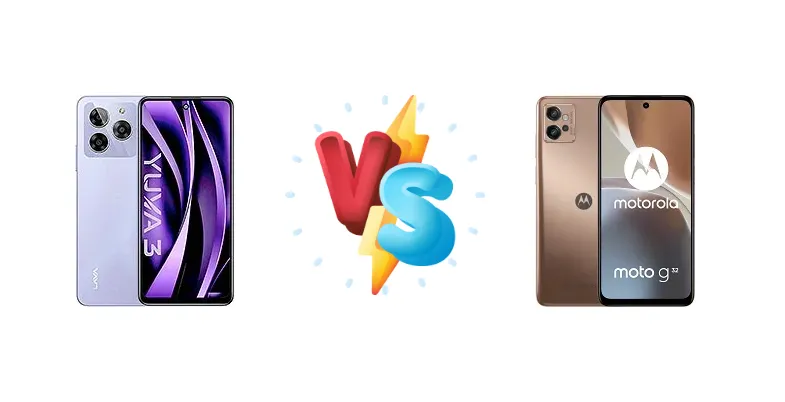
The sub-$150 smartphone market is fiercely competitive. The Lava Yuva 3 and Motorola Moto G32 both aim to deliver essential smartphone functionality at an accessible price point, but they take different approaches. The Yuva 3 relies on the efficiency of Unisoc’s T606, while the Moto G32 leverages Qualcomm’s Snapdragon 680. This comparison will dissect their key differences to determine which device offers the best overall experience.
🏆 Quick Verdict
For the average user prioritizing consistent performance and faster charging, the Motorola Moto G32 is the better choice. Its Snapdragon 680, built on a more efficient 6nm process, delivers a noticeable performance advantage over the Lava Yuva 3’s Unisoc T606, and the 30W charging significantly reduces downtime.
| Network |
|---|
| 2G bands | GSM 900 / 1800 | GSM 850 / 900 / 1800 / 1900 |
| 3G bands | HSDPA 900 / 2100 | HSDPA 850 / 900 / 1900 / 2100 |
| 4G bands | 1, 3, 5, 8, 40, 41 | 1, 3, 5, 7, 8, 20, 28, 38, 40, 41 |
| Speed | HSPA, LTE | HSPA, LTE |
| Technology | GSM / HSPA / LTE | GSM / HSPA / LTE |
| Launch |
|---|
| Announced | 2024, February 02 | 2022, July 28 |
| Status | Available. Released 2024, February 07 | Available. Released 2022, August 16 |
| Body |
|---|
| Build | - | Glass front, plastic frame, plastic back |
| Dimensions | 164.2 x 76 x 8.5 mm (6.46 x 2.99 x 0.33 in) | 161.8 x 73.8 x 8.5 mm (6.37 x 2.91 x 0.33 in) |
| SIM | Nano-SIM + Nano-SIM | · Nano-SIM· Nano-SIM + Nano-SIM |
| Weight | 192 g (6.77 oz) | 184 g (6.49 oz) |
| | - | Water-repellent design |
| Display |
|---|
| Resolution | 720 x 1600 pixels, 20:9 ratio (~270 ppi density) | 1080 x 2400 pixels, 20:9 ratio (~405 ppi density) |
| Size | 6.5 inches, 102.0 cm2 (~81.7% screen-to-body ratio) | 6.5 inches, 102.0 cm2 (~85.4% screen-to-body ratio) |
| Type | IPS LCD, 90Hz | IPS LCD, 90Hz |
| Platform |
|---|
| CPU | Octa-core (2x1.6 GHz Cortex-A75 & 6x1.6 GHz Cortex-A55) | Octa-core (4x2.4 GHz Kryo 265 Gold & 4x1.9 GHz Kryo 265 Silver) |
| Chipset | Unisoc T606 (12 nm) | Qualcomm SM6225 Snapdragon 680 4G (6 nm) |
| GPU | Mali-G57 MP1 | Adreno 610 |
| OS | Android 13 | Android 12, upgradable to Android 13 |
| Memory |
|---|
| Card slot | microSDXC (dedicated slot) | microSDXC (dedicated slot) |
| Internal | 64GB 4GB RAM, 128GB 4GB RAM | 64GB 4GB RAM, 128GB 4GB RAM, 128GB 6GB RAM, 128GB 8GB RAM, 256GB 8GB RAM |
| Main Camera |
|---|
| Dual | 13 MP, (wide), AF
VGA
Auxiliary lens | - |
| Features | LED flash, HDR, panorama | LED flash, HDR, panorama |
| Triple | - | 50 MP, f/1.8 (wide), 1/2.76", 0.64µm, PDAF
8 MP, f/2.2, 118˚ (ultrawide), 1/4.0", 1.12µm
2 MP, f/2.4, (macro/depth) |
| Video | 1080p@30fps | 1080p@30fps |
| Selfie camera |
|---|
| Single | 5 MP | 16 MP, f/2.4, (wide), 1.0µm |
| Video | Yes | 1080p@30fps |
| Sound |
|---|
| 3.5mm jack | - | Yes |
| 35mm jack | Yes | Yes |
| Loudspeaker | Yes | Yes, with stereo speakers |
| Comms |
|---|
| Bluetooth | 5.0, A2DP, LE | 5.2, A2DP, LE |
| NFC | No | Yes (market/region dependent) |
| Positioning | GPS, GLONASS | GPS, GLONASS, GALILEO |
| Radio | FM radio | FM radio |
| USB | USB Type-C 2.0, OTG | USB Type-C 2.0 |
| WLAN | Wi-Fi 802.11 b/g/n/ac | Wi-Fi 802.11 a/b/g/n/ac, dual-band, Wi-Fi Direct |
| Features |
|---|
| Sensors | Fingerprint (side-mounted), accelerometer, proximity | Fingerprint (side-mounted), accelerometer, gyro, proximity, compass |
| Battery |
|---|
| Charging | 18W wired | 30W wired |
| Type | Li-Po 5000 mAh | Li-Po 5000 mAh |
| Misc |
|---|
| Colors | Eclipse Black, Cosmic Lavender, Galaxy White | Mineral Grey, Satin Silver, Rose Gold |
| Models | - | XT2235-2, XT2235-3 |
| Price | About 80 EUR | ₹ 8,990 |
Lava Yuva 3
- More affordable price point
- Potentially longer battery life (depending on capacity)
- Acceptable for basic smartphone tasks
- Slower processor and less responsive performance
- Slower charging speed
- Less efficient chipset
Motorola Moto G32
- Faster and more efficient Snapdragon 680 processor
- Significantly faster 30W charging
- Better image processing capabilities
- Slightly higher price
- Battery life may be comparable to Yuva 3 (depending on capacity)
- May still exhibit some throttling under heavy load
Display Comparison
Neither Lava nor Motorola provide detailed display specifications beyond resolution. However, the display is likely a key area where cost-cutting occurs. Without knowing panel type (IPS vs. AMOLED) or peak brightness, it’s difficult to make a definitive statement. The Moto G32 likely benefits from Motorola’s generally better display calibration, but this is speculative. Bezels are expected to be similar on both devices, reflecting their budget positioning.
Camera Comparison
Without detailed camera sensor information, a direct comparison is challenging. Both phones likely feature a primary camera and multiple secondary sensors (depth, macro). However, the image signal processor (ISP) within the Snapdragon 680 is generally more advanced than the one found in the Unisoc T606, leading to better image processing, noise reduction, and dynamic range in the Moto G32. The 2MP macro cameras commonly found in this segment are unlikely to provide significant photographic value on either device.
Performance
The core difference lies in the chipsets. The Motorola Moto G32’s Snapdragon 680 (6nm) boasts a significant architectural advantage over the Lava Yuva 3’s Unisoc T606 (12nm). The 6nm process allows for higher transistor density and improved power efficiency, translating to better sustained performance and less thermal throttling. The Snapdragon 680’s CPU configuration – 4x2.4 GHz Kryo 265 Gold & 4x1.9 GHz Kryo 265 Silver – also offers a higher peak clock speed compared to the Yuva 3’s 2x1.6 GHz Cortex-A75 & 6x1.6 GHz Cortex-A55. This means faster app launches and smoother multitasking on the Moto G32. While both phones likely feature similar RAM configurations, the Snapdragon 680’s superior processing power will be the limiting factor for demanding tasks.
Battery Life
The battery capacity is not specified for either device, but both likely fall in the 5000mAh range, typical for this price bracket. The key differentiator is charging speed. The Motorola Moto G32’s 30W wired charging is a substantial upgrade over the Lava Yuva 3’s 18W charging. This translates to significantly faster 0-100% charging times, reducing downtime and improving usability. While a larger battery capacity on the Yuva 3 could partially offset the slower charging, the Moto G32’s faster charging is a more impactful benefit for most users.
Buying Guide
Buy the Lava Yuva 3 if you need a highly affordable device for basic tasks like calls, messaging, and light social media use, and are willing to compromise on performance and charging speed. Buy the Motorola Moto G32 if you prefer a smoother user experience, faster app loading times, and quicker charging, even if it means spending slightly more. The Moto G32 is better suited for users who occasionally play mobile games or multitask.
Frequently Asked Questions
❓ Will the Unisoc T606 in the Lava Yuva 3 struggle with popular apps like WhatsApp and Facebook?
While the Unisoc T606 can handle basic apps like WhatsApp and Facebook, you may experience occasional lag or slowdowns when multitasking or using more demanding features within those apps. The Snapdragon 680 in the Moto G32 offers a smoother experience for these everyday tasks.
❓ How long does it realistically take to fully charge the Motorola Moto G32 with the 30W charger?
The Motorola Moto G32, with its 30W charging, should be able to charge from 0% to 100% in approximately 60-75 minutes, depending on usage during charging. This is significantly faster than the Lava Yuva 3’s 18W charging, which could take over 2 hours.
❓ Is the Motorola Moto G32 a good option for playing casual mobile games like Candy Crush or Subway Surfers?
Yes, the Motorola Moto G32 is well-suited for casual mobile games. The Snapdragon 680 provides enough processing power for smooth gameplay in less demanding titles. However, for graphically intensive games, you may need to lower the graphics settings.
❓ Does the Lava Yuva 3 support VoLTE and VoWiFi for improved call quality?
While not explicitly stated, Lava typically includes VoLTE (Voice over LTE) support in its smartphones. VoWiFi (Voice over Wi-Fi) support is less common in this price range, and its availability on the Yuva 3 is uncertain. Check with your carrier for compatibility.