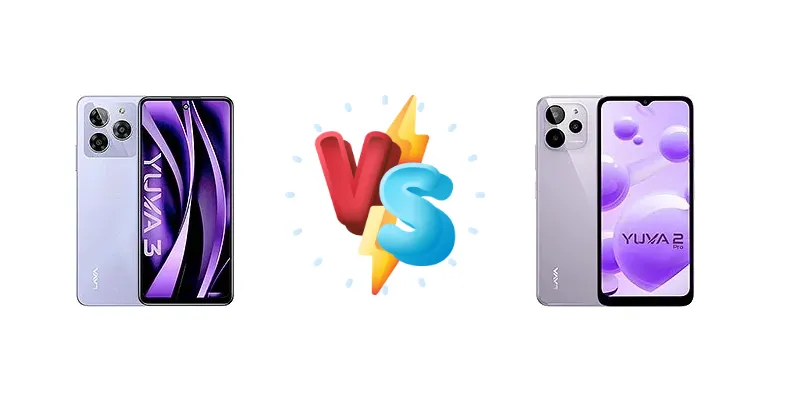
Lava's Yuva series aims to deliver essential smartphone features at incredibly competitive prices. The Yuva 3 represents a recent iteration, while the Yuva 2 Pro offered a compelling package upon its release. This comparison dissects the key differences between these two devices, focusing on their core performance and charging capabilities to determine which offers the best value.
🏆 Quick Verdict
For the average user prioritizing responsiveness and future-proofing, the Lava Yuva 3 is the better choice. Its Unisoc T606 chipset, featuring newer Cortex-A75 cores, provides a noticeable performance advantage over the Yuva 2 Pro’s Helio G37, despite the latter’s higher clock speeds on paper. The 18W charging is also a welcome upgrade.
| Network |
|---|
| 2G bands | GSM 900 / 1800 | GSM 900 / 1800 |
| 3G bands | HSDPA 900 / 2100 | HSDPA 900 / 2100 |
| 4G bands | 1, 3, 5, 8, 40, 41 | 1, 3, 5, 8, 40, 41 |
| Speed | HSPA, LTE | HSPA, LTE |
| Technology | GSM / HSPA / LTE | GSM / HSPA / LTE |
| Launch |
|---|
| Announced | 2024, February 02 | 2023, February 22 |
| Status | Available. Released 2024, February 07 | Available. Released 2023, February 22 |
| Body |
|---|
| Dimensions | 164.2 x 76 x 8.5 mm (6.46 x 2.99 x 0.33 in) | 164.5 x 76 x 9 mm (6.48 x 2.99 x 0.35 in) |
| SIM | Nano-SIM + Nano-SIM | Nano-SIM + Nano-SIM |
| Weight | 192 g (6.77 oz) | 204 g (7.20 oz) |
| Display |
|---|
| Resolution | 720 x 1600 pixels, 20:9 ratio (~270 ppi density) | 720 x 1600 pixels, 20:9 ratio (~269 ppi density) |
| Size | 6.5 inches, 102.0 cm2 (~81.7% screen-to-body ratio) | 6.52 inches, 102.6 cm2 (~82.1% screen-to-body ratio) |
| Type | IPS LCD, 90Hz | IPS LCD |
| Platform |
|---|
| CPU | Octa-core (2x1.6 GHz Cortex-A75 & 6x1.6 GHz Cortex-A55) | Octa-core (4x2.3 GHz Cortex-A53 & 4x1.8 GHz Cortex-A53) |
| Chipset | Unisoc T606 (12 nm) | Mediatek MT6765 Helio G37 (12 nm) |
| GPU | Mali-G57 MP1 | PowerVR GE8320 |
| OS | Android 13 | Android 12 |
| Memory |
|---|
| Card slot | microSDXC (dedicated slot) | microSDXC (dedicated slot) |
| Internal | 64GB 4GB RAM, 128GB 4GB RAM | 64GB 4GB RAM |
| | - | eMMC 5.1 |
| Main Camera |
|---|
| Dual | 13 MP, (wide), AF
VGA
Auxiliary lens | - |
| Features | LED flash, HDR, panorama | LED flash |
| Single | - | 5 MP |
| Triple | - | 13 MP, (wide), AF
VGA
VGA |
| Video | 1080p@30fps | 1080p@30fps |
| Selfie camera |
|---|
| Single | 5 MP | 5 MP |
| Video | Yes | Yes |
| Sound |
|---|
| 3.5mm jack | - | Yes |
| 35mm jack | Yes | Yes |
| Loudspeaker | Yes | Yes |
| Comms |
|---|
| Bluetooth | 5.0, A2DP, LE | 5.1, A2DP, LE |
| NFC | No | No |
| Positioning | GPS, GLONASS | GPS |
| Radio | FM radio | FM radio |
| USB | USB Type-C 2.0, OTG | USB Type-C 2.0, OTG |
| WLAN | Wi-Fi 802.11 b/g/n/ac | Wi-Fi 802.11 b/g/n/ac |
| Features |
|---|
| Sensors | Fingerprint (side-mounted), accelerometer, proximity | Fingerprint (side-mounted), accelerometer, proximity |
| Battery |
|---|
| Charging | 18W wired | 10W wired |
| Type | Li-Po 5000 mAh | Li-Po 5000 mAh |
| Misc |
|---|
| Colors | Eclipse Black, Cosmic Lavender, Galaxy White | Glass Lavender, Glass Green, Glass White |
| Models | - | LZX408 |
| Price | About 80 EUR | About 90 EUR |
Lava Yuva 3
- More modern CPU architecture (Cortex-A75)
- Faster 18W charging
- Potentially better thermal management
- Detailed display specs unknown
- Camera specs not specified
Lava Yuva 2 Pro
- Potentially lower price point
- Higher CPU clock speeds (on paper)
- Acceptable for basic smartphone tasks
- Older CPU architecture (Cortex-A53)
- Slower 10W charging
- Likely less responsive performance
Display Comparison
Both devices utilize 12nm process technology, suggesting similar power efficiency in display operation. However, detailed display specifications (resolution, panel type, brightness) are absent. Given the price bracket, we can assume both employ LCD panels. The lack of information prevents a detailed comparison of color accuracy or viewing angles. Bezels are likely comparable, focusing on maximizing screen real estate within the budget constraints.
Camera Comparison
Without detailed camera specifications beyond the chipsets, a direct comparison is limited. Both phones likely feature a multi-camera setup geared towards social media sharing. The absence of information regarding sensor sizes, apertures, or image processing algorithms makes it difficult to assess image quality. It's reasonable to assume both phones will struggle in low-light conditions, and the 2MP macro cameras commonly found in this segment offer limited practical benefit.
Performance
The core difference lies in the chipsets. The Lava Yuva 3’s Unisoc T606 features a dual-cluster configuration with 2x 1.6 GHz Cortex-A75 cores and 6x 1.6 GHz Cortex-A55 cores. This architecture provides a significant advantage in sustained performance compared to the Lava Yuva 2 Pro’s MediaTek Helio G37, which uses 4x 2.3 GHz Cortex-A53 cores and 4x 1.8 GHz Cortex-A53 cores. While the Helio G37 boasts higher clock speeds, the older Cortex-A53 architecture is less efficient and offers lower IPC (Instructions Per Clock) than the A75. This translates to smoother app launches and better multitasking on the Yuva 3. The Unisoc T606’s newer architecture also suggests improved thermal management, potentially leading to less throttling during prolonged use.
Battery Life
Battery capacity is not specified for either device. However, the Lava Yuva 3’s 18W wired charging is a clear advantage over the Yuva 2 Pro’s 10W charging. This faster charging speed will significantly reduce the time required to replenish the battery, offering greater convenience for users. Even with a similar battery capacity, the Yuva 3 will likely offer a quicker top-up, mitigating any potential battery life concerns.
Buying Guide
Buy the Lava Yuva 3 if you need a phone that feels snappier in everyday tasks, handles multitasking more efficiently, and benefits from faster charging. This phone is ideal for users who frequently switch between apps or enjoy light gaming. Buy the Lava Yuva 2 Pro if you prioritize a slightly lower initial cost and are primarily focused on basic smartphone functions like calling, texting, and social media browsing, and aren't concerned with demanding performance.
Frequently Asked Questions
❓ Will the Unisoc T606 in the Yuva 3 handle popular games like PUBG Mobile?
While the Unisoc T606 isn't a high-end gaming chip, it should be capable of running PUBG Mobile at medium settings with reasonable frame rates. The newer CPU architecture provides a more stable experience compared to the Helio G37, reducing the likelihood of significant frame drops during gameplay. However, don't expect to max out the graphics settings.
❓ How much faster is the 18W charging on the Yuva 3 compared to the 10W charging on the Yuva 2 Pro?
The 18W charging on the Yuva 3 will significantly reduce charging times. While exact 0-100% times are unavailable, expect a difference of at least 30-60 minutes, potentially more depending on battery capacity. This means less time tethered to a charger and more time using your phone.
❓ Is the difference in CPU architecture (A75 vs A53) noticeable in everyday use?
Yes, the difference is noticeable. The Cortex-A75 cores in the Yuva 3 are significantly more efficient and powerful than the Cortex-A53 cores in the Yuva 2 Pro. This translates to faster app launches, smoother multitasking, and a more responsive overall user experience. You'll feel the difference when switching between apps or browsing the web.