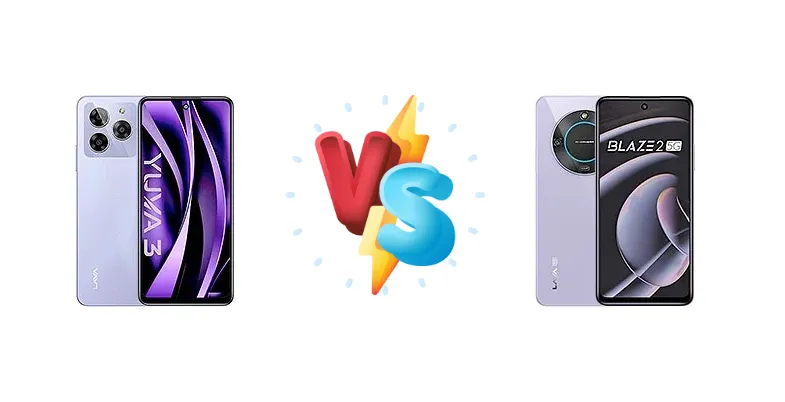
Lava is aggressively targeting the budget smartphone segment with the Yuva 3 and Blaze 2 5G. While both aim to deliver value, they take different approaches to achieving it. The Yuva 3 focuses on affordability, while the Blaze 2 5G adds 5G connectivity and a more powerful chipset. This comparison dissects the key differences to determine which phone offers the best experience for your money.
🏆 Quick Verdict
For most users, the Lava Blaze 2 5G is the superior choice. Its Mediatek Dimensity 6020 chipset, built on a more efficient 7nm process, provides a noticeable performance uplift over the Yuva 3’s Unisoc T606. While both share the same 18W charging, the Blaze 2 5G’s improved processing power justifies the slight price premium.
| Network |
|---|
| 2G bands | GSM 900 / 1800 | GSM 850 / 900 / 1800 / 1900 |
| 3G bands | HSDPA 900 / 2100 | HSDPA 900 / 2100 |
| 4G bands | 1, 3, 5, 8, 40, 41 | 1, 3, 5, 8, 40, 41 |
| 5G bands | - | 1, 3, 5, 8, 28, 41, 77, 88 SA/NSA |
| Speed | HSPA, LTE | HSPA, LTE, 5G |
| Technology | GSM / HSPA / LTE | GSM / HSPA / LTE / 5G |
| Launch |
|---|
| Announced | 2024, February 02 | 2023, November 02 |
| Status | Available. Released 2024, February 07 | Available. Released 2023, November 09 |
| Body |
|---|
| Dimensions | 164.2 x 76 x 8.5 mm (6.46 x 2.99 x 0.33 in) | 164.2 x 76 x 8.5 mm (6.46 x 2.99 x 0.33 in) |
| SIM | Nano-SIM + Nano-SIM | Nano-SIM + Nano-SIM |
| Weight | 192 g (6.77 oz) | 203 g (7.16 oz) |
| Display |
|---|
| Resolution | 720 x 1600 pixels, 20:9 ratio (~270 ppi density) | 720 x 1600 pixels, 20:9 ratio (~267 ppi density) |
| Size | 6.5 inches, 102.0 cm2 (~81.7% screen-to-body ratio) | 6.56 inches, 103.9 cm2 (~83.3% screen-to-body ratio) |
| Type | IPS LCD, 90Hz | IPS LCD, 90Hz |
| Platform |
|---|
| CPU | Octa-core (2x1.6 GHz Cortex-A75 & 6x1.6 GHz Cortex-A55) | Octa-core (2x2.2 GHz Cortex-A76 & 6x2.0 GHz Cortex-A55) |
| Chipset | Unisoc T606 (12 nm) | Mediatek Dimensity 6020 (7 nm) |
| GPU | Mali-G57 MP1 | Mali-G57 MC2 |
| OS | Android 13 | Android 13 |
| Memory |
|---|
| Card slot | microSDXC (dedicated slot) | microSDXC (dedicated slot) |
| Internal | 64GB 4GB RAM, 128GB 4GB RAM | 64GB 4GB RAM, 128GB 6GB RAM |
| Main Camera |
|---|
| Dual | 13 MP, (wide), AF
VGA
Auxiliary lens | - |
| Features | LED flash, HDR, panorama | LED flash, HDR, panorama |
| Single | - | 50 MP, (wide), AF
Auxiliary lens |
| Video | 1080p@30fps | 1440p@30fps, 1080p@30fps |
| Selfie camera |
|---|
| Single | 5 MP | 8 MP, (wide) |
| Video | Yes | Yes |
| Sound |
|---|
| 35mm jack | Yes | Yes |
| Loudspeaker | Yes | Yes |
| Comms |
|---|
| Bluetooth | 5.0, A2DP, LE | 5.0, A2DP, LE |
| NFC | No | No |
| Positioning | GPS, GLONASS | GPS, GLONASS |
| Radio | FM radio | FM radio |
| USB | USB Type-C 2.0, OTG | USB Type-C 2.0, OTG |
| WLAN | Wi-Fi 802.11 b/g/n/ac | Wi-Fi 802.11 b/g/n/ac |
| Features |
|---|
| Sensors | Fingerprint (side-mounted), accelerometer, proximity | Fingerprint (side-mounted), accelerometer, proximity, compass |
| Battery |
|---|
| Charging | 18W wired | 18W wired |
| Type | Li-Po 5000 mAh | Li-Po 5000 mAh |
| Misc |
|---|
| Colors | Eclipse Black, Cosmic Lavender, Galaxy White | Glass Blue, Glass Black, Glass Lavender |
| Price | About 80 EUR | About 110 EUR |
Lava Yuva 3
- Most affordable option
- Sufficient for basic tasks
- Decent build quality for the price
- Significantly slower performance
- Less efficient chipset
- Limited future-proofing
Lava Blaze 2 5G
- Faster and more efficient processor
- 5G connectivity
- Improved gaming performance
- Slightly higher price
- May still struggle with very demanding games
- 18W charging isn't the fastest
Display Comparison
Neither Lava provides display specifications beyond size, so a detailed comparison is limited. However, the chipset difference suggests the Blaze 2 5G likely benefits from a more capable display driver, potentially resulting in slightly better color reproduction and responsiveness. Both are likely using IPS LCD panels given the price point, and neither is expected to feature high refresh rates or advanced features like LTPO.
Camera Comparison
Without detailed camera specs, it’s difficult to make a definitive judgment. However, the chipset’s image signal processor (ISP) plays a crucial role in image quality. The Dimensity 6020’s ISP is likely more advanced than the Unisoc T606’s, resulting in better noise reduction, dynamic range, and overall image processing. Both phones likely feature a primary camera and depth/macro sensors, but the Blaze 2 5G’s processing power will likely yield superior results, especially in low-light conditions. We can assume both will have similar limitations in terms of optical image stabilization (OIS) – unlikely at this price point.
Performance
The core difference lies in the chipsets. The Lava Blaze 2 5G’s Mediatek Dimensity 6020 (7nm) is a significant upgrade over the Yuva 3’s Unisoc T606 (12nm). The 7nm process inherently offers better power efficiency and thermal performance. The Dimensity 6020’s CPU configuration – 2x2.2 GHz Cortex-A76 & 6x2.0 GHz Cortex-A55 – is faster than the Yuva 3’s 2x1.6 GHz Cortex-A75 & 6x1.6 GHz Cortex-A55. This translates to quicker app launches, smoother multitasking, and improved gaming performance. The A76 cores in the Dimensity 6020 are architecturally superior to the A75 cores in the Unisoc chip, offering better instructions per clock (IPC).
Battery Life
Both devices feature 18W wired charging, suggesting similar charging speeds. While battery capacity isn’t specified, the Dimensity 6020’s superior power efficiency in the Blaze 2 5G could translate to slightly longer battery life despite potentially having a similar capacity. The 7nm process allows the Blaze 2 5G to accomplish more per watt, meaning less energy is wasted during operation. Expect both phones to take around 2-2.5 hours for a full charge.
Buying Guide
Buy the Lava Yuva 3 if you prioritize absolute affordability and your usage is limited to basic tasks like calling, texting, and light social media. You'll be sacrificing performance and future-proofing. Buy the Lava Blaze 2 5G if you want a smoother, more responsive experience, 5G connectivity for faster data speeds, and the ability to handle more demanding apps and games without significant lag. It’s a small investment for a substantial improvement in usability.
Frequently Asked Questions
❓ Will the Mediatek Dimensity 6020 in the Blaze 2 5G overheat during prolonged gaming sessions?
The Dimensity 6020 is built on a 7nm process, which inherently generates less heat than the 12nm Unisoc T606 in the Yuva 3. While it may experience some throttling during extended, graphically intensive gaming, it’s less likely to overheat significantly compared to the Yuva 3, offering a more sustained level of performance.
❓ Is the 5G connectivity on the Blaze 2 5G actually useful, or is it just a marketing gimmick?
The usefulness of 5G depends on your location and carrier coverage. However, even in areas with limited 5G availability, the Blaze 2 5G will fall back to 4G LTE. The inclusion of 5G future-proofs the device and provides significantly faster download and upload speeds where available, making it beneficial for streaming, online gaming, and large file transfers.
❓ Can the Lava Blaze 2 5G handle popular games like PUBG Mobile and Call of Duty Mobile?
The Blaze 2 5G can run PUBG Mobile and Call of Duty Mobile, but you’ll likely need to use medium or low graphics settings for a smooth experience. The Dimensity 6020 provides a noticeable improvement over the Yuva 3’s chipset, allowing for playable frame rates, but don’t expect to max out the settings.