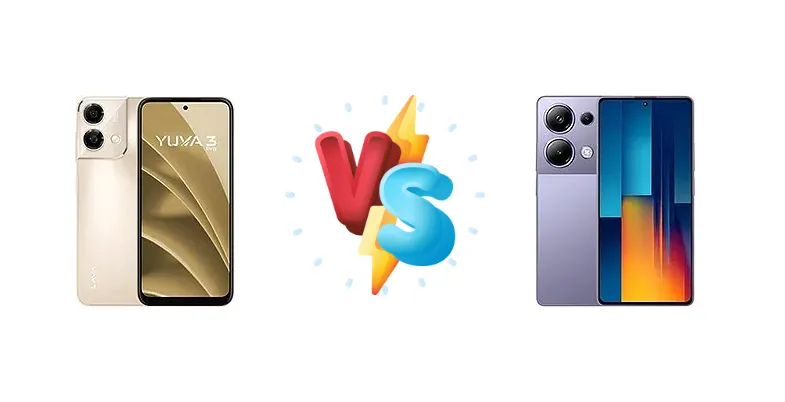
The sub-$200 smartphone market is fiercely competitive, and the Lava Yuva 3 Pro and Xiaomi Poco M6 Pro 4G are two contenders vying for your attention. While both aim to deliver value, they take distinctly different approaches – the Lava focuses on a balanced experience, while the Poco prioritizes performance and rapid charging. This comparison dissects their key differences to determine which phone best suits your needs.
🏆 Quick Verdict
For most users, the Xiaomi Poco M6 Pro 4G is the superior choice. Its significantly faster MediaTek Helio G99 Ultra chipset and blazing-fast 67W charging offer a noticeably smoother experience and reduced downtime. While the Lava Yuva 3 Pro is a capable device, it can't match the Poco's raw power.
| Network |
|---|
| 2G bands | GSM 900 / 1800 | GSM 850 / 900 / 1800 / 1900 |
| 3G bands | HSDPA 900 / 2100 | HSDPA 800 / 850 / 900 / 1700(AWS) / 1900 / 2100 |
| 4G bands | 1, 3, 5, 8, 40, 41 | 1, 2, 3, 4, 5, 7, 8, 12, 13, 17, 18, 19, 20, 26, 28, 38, 40, 41, 66 |
| Speed | HSPA, LTE | HSPA, LTE |
| Technology | GSM / HSPA / LTE | GSM / HSPA / LTE |
| Launch |
|---|
| Announced | 2023, December 14 | 2024, January 11 |
| Status | Available. Released 2023, December 14 | Available. Released 2024, January 12 |
| Body |
|---|
| Build | - | Glass front (Gorilla Glass 5), plastic frame |
| Dimensions | 165 x 76.1 x 8.7 mm (6.50 x 3.00 x 0.34 in) | 161.1 x 75 x 8 mm (6.34 x 2.95 x 0.31 in) |
| SIM | Nano-SIM + Nano-SIM | Nano-SIM + Nano-SIM |
| Weight | 200 g (7.05 oz) | 179 g (6.31 oz) |
| Display |
|---|
| Protection | - | Corning Gorilla Glass 5 |
| Resolution | 720 x 1600 pixels, 20:9 ratio (~270 ppi density) | 1080 x 2400 pixels, 20:9 ratio (~395 ppi density) |
| Size | 6.5 inches, 102.0 cm2 (~81.2% screen-to-body ratio) | 6.67 inches, 107.4 cm2 (~88.9% screen-to-body ratio) |
| Type | IPS LCD, 90Hz | AMOLED, 120Hz, 1000 nits (HBM), 1300 nits (peak) |
| Platform |
|---|
| CPU | Octa-core (2x2.0 GHz Cortex-A75 & 6x1.8 GHz Cortex-A55) | Octa-core (2x2.2 GHz Cortex-A76 & 6x2.0 GHz Cortex-A55) |
| Chipset | Unisoc Tiger T616 (12 nm) | Mediatek Helio G99 Ultra |
| GPU | Mali-G57 MP1 | Mali-G57 MC2 |
| OS | Android 13 | Android 13, MIUI 14, planned upgrade to Android 14, HyperOS |
| Memory |
|---|
| Card slot | microSDXC (dedicated slot) | microSDXC (uses shared SIM slot) |
| Internal | 128GB 8GB RAM | 256GB 8GB RAM, 512GB 12GB RAM |
| Main Camera |
|---|
| Features | LED flash, HDR, panorama | LED flash, HDR, panorama |
| Single | 50 MP, (wide), AF
Auxiliary lens | - |
| Triple | - | 64 MP, f/1.8, 25mm (wide), 1/2.0", 0.7µm, PDAF, OIS
8 MP, f/2.2, (ultrawide)
2 MP (macro) |
| Video | 1080p@30fps | 1080p@30/60fps, gyro-EIS |
| Selfie camera |
|---|
| Single | 8 MP | 16 MP, f/2.5, (wide) |
| Video | 1080p@30fps | 1080p@30/60fps |
| Sound |
|---|
| 35mm jack | Yes | Yes |
| Loudspeaker | Yes | Yes, with dual speakers |
| Comms |
|---|
| Bluetooth | 5.0, A2DP, LE | 5.2, A2DP, LE |
| Infrared port | - | Yes |
| NFC | No | Yes (market/region dependent) |
| Positioning | GPS | GPS, GALILEO, GLONASS, BDS |
| Radio | FM radio | FM radio |
| USB | USB Type-C 2.0, OTG | USB Type-C 2.0, OTG |
| WLAN | Wi-Fi 802.11 b/g/n/ac | Wi-Fi 802.11 a/b/g/n/ac, dual-band |
| Features |
|---|
| Sensors | Fingerprint (side-mounted), accelerometer, proximity | Fingerprint (under display, optical), accelerometer, gyro, compass |
| Battery |
|---|
| Charging | 18W wired | 67W wired, 100% in 44 min |
| Type | Li-Po 5000 mAh | 5000 mAh |
| Misc |
|---|
| Colors | Desert Gold, Forest Viridian (Green), Meadow Purple | Black, Blue, Purple |
| Models | - | 2312FPCA6G |
| Price | About 100 EUR | $ 170.00 |
| SAR | - | 1.09 W/kg (head) 1.09 W/kg (body) |
| SAR EU | - | 0.99 W/kg (head) 0.99 W/kg (body) |
Lava Yuva 3 Pro
- Potentially more affordable price point.
- Reliable Unisoc chipset for basic tasks.
- Simple and user-friendly experience.
- Significantly slower charging speed.
- Less powerful processor for demanding apps.
- Likely lower display brightness.
Xiaomi Poco M6 Pro 4G
- Faster MediaTek Helio G99 Ultra processor.
- Blazing-fast 67W charging (0-100% in 44 mins).
- Brighter display for outdoor visibility.
- May be slightly more expensive.
- Xiaomi’s MIUI software can be resource-intensive.
- Camera details are limited.
Display Comparison
The Poco M6 Pro 4G boasts a significantly brighter display, reaching a measured peak of 1053 nits. This translates to excellent visibility outdoors, a clear advantage over the Lava Yuva 3 Pro, whose brightness remains unspecified. While both likely utilize IPS LCD panels (given the price point), the Poco’s higher brightness is a tangible benefit for users who frequently use their phones in sunlight. The absence of refresh rate information for both devices suggests a standard 60Hz panel, which is typical for this segment.
Camera Comparison
Detailed camera analysis is limited by the provided data. Both phones are expected to feature multi-camera setups, but the specifics are unknown beyond the 'Photo / Video' designation for the Poco. The absence of sensor size or aperture information makes a direct comparison difficult. However, given Xiaomi’s history, the Poco M6 Pro 4G likely benefits from more sophisticated image processing algorithms and potentially a larger main sensor, leading to better image quality in various lighting conditions. The Lava Yuva 3 Pro’s camera performance is likely to be more basic.
Performance
The core difference lies in the chipsets. The Poco M6 Pro 4G’s MediaTek Helio G99 Ultra, with its 2x2.2 GHz Cortex-A76 cores, demonstrably outperforms the Lava Yuva 3 Pro’s Unisoc Tiger T616 (2x2.0 GHz Cortex-A75). The Cortex-A76 architecture in the Helio G99 Ultra is a generation ahead, offering improved IPC (Instructions Per Clock) and overall processing power. This will be most noticeable in demanding tasks like gaming and video editing. While both are octa-core CPUs, the Helio G99 Ultra’s superior architecture and clock speeds provide a clear performance advantage. The Lava's Unisoc T616 is adequate for everyday tasks, but will struggle with more intensive workloads.
Battery Life
The Poco M6 Pro 4G’s 67W wired charging is a game-changer, achieving a full charge in just 44 minutes. This is a massive advantage over the Lava Yuva 3 Pro’s 18W charging, which will take considerably longer. While the Poco’s battery capacity isn’t specified, its active use score of 11:46h suggests excellent battery life. The faster charging speed mitigates any potential concerns about battery capacity, allowing users to quickly top up their phone throughout the day. The Lava Yuva 3 Pro’s slower charging will be a significant inconvenience for users who frequently need to recharge.
Buying Guide
Buy the Lava Yuva 3 Pro if you prioritize a simple, reliable smartphone experience and aren't heavily reliant on demanding apps or gaming. It's a solid option for basic communication, social media, and light tasks. Buy the Xiaomi Poco M6 Pro 4G if you value performance, fast charging, and a brighter display. This phone is ideal for gamers, content creators, and anyone who wants a responsive and feature-rich device without breaking the bank.
Frequently Asked Questions
❓ Is the Helio G99 Ultra in the Poco M6 Pro 4G capable of handling demanding games like PUBG Mobile?
Yes, the MediaTek Helio G99 Ultra is well-suited for PUBG Mobile. While it won't deliver flagship-level graphics settings, it can comfortably run the game at medium to high settings with stable frame rates. The processor's architecture and clock speeds provide sufficient power for a smooth gaming experience.
❓ How does the 18W charging on the Lava Yuva 3 Pro compare to the 67W charging on the Poco M6 Pro 4G in real-world usage?
The difference is substantial. 18W charging will take over 2 hours to fully charge the Lava Yuva 3 Pro, while the Poco M6 Pro 4G reaches 100% in just 44 minutes. This means you can quickly top up the Poco during short breaks, whereas the Lava requires a much longer charging period, impacting usability.
❓ Does the Poco M6 Pro 4G's MIUI software significantly impact performance or battery life?
MIUI is known to be a feature-rich but sometimes resource-intensive skin. While it offers customization options, it can consume more RAM and processing power than stock Android. However, the Helio G99 Ultra's processing power is sufficient to mitigate most of these effects, and the Poco M6 Pro 4G still delivers a smooth experience overall. Optimizing background app activity can further improve battery life.