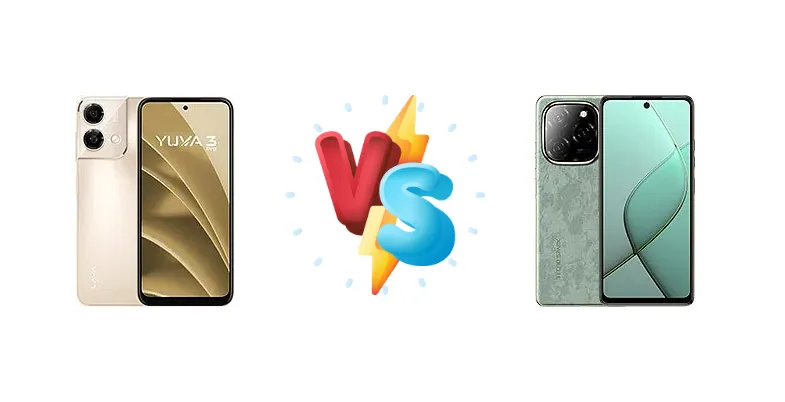
The sub-$200 5G smartphone market is heating up, with the Lava Yuva 3 Pro and Tecno Spark 20 Pro 5G vying for dominance. While both aim to deliver 5G connectivity at an accessible price, they take distinctly different approaches to achieving that goal, primarily through their chipset choices. This comparison dissects those differences and determines which phone offers the best overall experience.
🏆 Quick Verdict
For the average user prioritizing performance and faster charging, the Tecno Spark 20 Pro 5G is the clear winner. Its Mediatek Dimensity 6080, built on a more efficient 6nm process, provides a noticeable performance uplift over the Lava Yuva 3 Pro’s Unisoc Tiger T616, and the 33W charging significantly reduces downtime.
| Network |
|---|
| 2G bands | GSM 900 / 1800 | GSM 850 / 900 / 1800 / 1900 |
| 3G bands | HSDPA 900 / 2100 | HSDPA 850 / 900 / 1700(AWS) / 1900 / 2100 |
| 4G bands | 1, 3, 5, 8, 40, 41 | LTE |
| 5G bands | - | SA/NSA |
| Speed | HSPA, LTE | HSPA, LTE, 5G |
| Technology | GSM / HSPA / LTE | GSM / HSPA / LTE / 5G |
| Launch |
|---|
| Announced | 2023, December 14 | 2024, June 17 |
| Status | Available. Released 2023, December 14 | Available. Released 2024, June 20 |
| Body |
|---|
| Dimensions | 165 x 76.1 x 8.7 mm (6.50 x 3.00 x 0.34 in) | 168.5 x 76.2 x 8.3 mm or 8.5 mm |
| SIM | Nano-SIM + Nano-SIM | Nano-SIM + Nano-SIM |
| Weight | 200 g (7.05 oz) | 200 g or 201.5 g (7.05 oz) |
| Display |
|---|
| Resolution | 720 x 1600 pixels, 20:9 ratio (~270 ppi density) | 1080 x 2460 pixels (~396 ppi density) |
| Size | 6.5 inches, 102.0 cm2 (~81.2% screen-to-body ratio) | 6.78 inches, 109.2 cm2 (~85.0% screen-to-body ratio) |
| Type | IPS LCD, 90Hz | IPS LCD, 120Hz |
| Platform |
|---|
| CPU | Octa-core (2x2.0 GHz Cortex-A75 & 6x1.8 GHz Cortex-A55) | Octa-core (2x2.4 GHz Cortex-A76 & 6x2.0 GHz Cortex-A55) |
| Chipset | Unisoc Tiger T616 (12 nm) | Mediatek Dimensity 6080 (6 nm) |
| GPU | Mali-G57 MP1 | Mali-G57 MC2 |
| OS | Android 13 | Android 14 |
| Memory |
|---|
| Card slot | microSDXC (dedicated slot) | microSDXC (dedicated slot) |
| Internal | 128GB 8GB RAM | 128GB 8GB RAM, 256GB 8GB RAM |
| Main Camera |
|---|
| Dual | - | 108 MP, f/1.8, (wide), 1/1.67", 0.64µm, PDAF
2 MP (macro) |
| Features | LED flash, HDR, panorama | Quad-LED flash |
| Single | 50 MP, (wide), AF
Auxiliary lens | - |
| Video | 1080p@30fps | 1440p@30fps, 1080p@30fps |
| Selfie camera |
|---|
| Features | - | Dual-LED dual-tone flash |
| Single | 8 MP | 8 MP, (wide) |
| Video | 1080p@30fps | 1440p@30fps, 1080p@30fps |
| Sound |
|---|
| 35mm jack | Yes | No |
| Loudspeaker | Yes | Yes, with stereo speakers |
| Comms |
|---|
| Bluetooth | 5.0, A2DP, LE | 5.3, A2DP, LE |
| NFC | No | Yes |
| Positioning | GPS | GPS, GLONASS |
| Radio | FM radio | FM radio |
| USB | USB Type-C 2.0, OTG | USB Type-C |
| WLAN | Wi-Fi 802.11 b/g/n/ac | Wi-Fi 802.11 a/b/g/n/ac, dual-band |
| Features |
|---|
| Sensors | Fingerprint (side-mounted), accelerometer, proximity | Fingerprint (side-mounted), accelerometer, proximity, compass |
| Battery |
|---|
| Charging | 18W wired | 33W wired |
| Type | Li-Po 5000 mAh | 5000 mAh |
| Misc |
|---|
| Colors | Desert Gold, Forest Viridian (Green), Meadow Purple | Startrail Black, Glossy White, Neon Green |
| Models | - | KJ8 |
| Price | About 100 EUR | About 180 EUR |
Lava Yuva 3 Pro
- More affordable price point
- Reliable for basic smartphone tasks
- 5G connectivity
- Slower processor
- Slower charging speed
- Less efficient chipset
Tecno Spark 20 Pro 5G
- Faster and more efficient processor
- Significantly faster charging
- Improved multitasking capabilities
- Slightly higher price
- May not offer a dramatically better camera experience without further specs
- Potential for more software bloat (typical of Tecno)
Display Comparison
Neither device boasts a standout display. While specific panel details (like peak brightness or color gamut coverage) are unavailable, the core difference lies elsewhere. The focus here is on the underlying performance impacting the user experience, not display fidelity. Both likely utilize IPS LCD panels common in this price bracket, meaning viewing angles and color accuracy will be adequate but not exceptional.
Camera Comparison
Without detailed camera specs beyond the chipsets, a direct comparison is limited. However, the Dimensity 6080 generally offers superior image signal processing (ISP) capabilities, potentially leading to better image quality in various lighting conditions. The Lava Yuva 3 Pro will likely rely more heavily on software processing to compensate for a potentially less capable ISP. The presence of a more powerful chipset in the Tecno Spark 20 Pro 5G suggests a better ability to handle computational photography features.
Performance
The performance gap is the most significant differentiator. The Tecno Spark 20 Pro 5G’s Mediatek Dimensity 6080 (6nm) is a substantial upgrade over the Lava Yuva 3 Pro’s Unisoc Tiger T616 (12nm). The 6nm process inherently offers better power efficiency, translating to less heat generation and sustained performance. The Dimensity 6080’s CPU, featuring 2x2.4 GHz Cortex-A76 cores, also outpaces the Yuva 3 Pro’s 2x2.0 GHz Cortex-A75 cores. This means faster app loading times, smoother multitasking, and a more responsive user interface on the Tecno. While both are octa-core CPUs, the architectural improvements and process node give the Dimensity 6080 a clear advantage, particularly for demanding tasks.
Battery Life
The Lava Yuva 3 Pro’s 18W charging is noticeably slower than the Tecno Spark 20 Pro 5G’s 33W charging. While battery capacity isn’t specified, the faster charging speed of the Tecno is a significant advantage for users who frequently need to top up their phones. The Dimensity 6080’s 6nm efficiency also contributes to potentially better battery life, offsetting any capacity differences. Expect a full charge on the Tecno to be considerably quicker, reducing downtime and increasing usability.
Buying Guide
Buy the Lava Yuva 3 Pro if you need a reliable, basic 5G smartphone for everyday tasks like calling, messaging, and light social media use, and are comfortable with slower charging speeds. Buy the Tecno Spark 20 Pro 5G if you prioritize smoother multitasking, occasional gaming, and significantly faster charging, even if it means spending slightly more.
Frequently Asked Questions
❓ Will the Unisoc Tiger T616 in the Lava Yuva 3 Pro struggle with graphically intensive games like PUBG Mobile?
Yes, the Unisoc Tiger T616 is a budget chipset and will likely require significantly reduced graphics settings and frame rates to achieve playable performance in PUBG Mobile. Expect noticeable frame drops and potential stuttering, especially during intense firefights. The Tecno Spark 20 Pro 5G with the Dimensity 6080 will offer a much smoother gaming experience.
❓ How long does it realistically take to fully charge the Lava Yuva 3 Pro with the 18W charger?
Given the 18W charging speed and assuming a typical battery capacity for this segment (around 5000mAh), a full charge from 0% to 100% will likely take between 2.5 to 3.5 hours. This is considerably slower than the Tecno Spark 20 Pro 5G’s 33W charging, which can achieve a full charge in around 1.5 to 2 hours.
❓ Does the Tecno Spark 20 Pro 5G’s Dimensity 6080 support carrier aggregation for improved 5G speeds?
The Mediatek Dimensity 6080 does support carrier aggregation, which allows the phone to combine multiple 5G channels for faster and more stable data speeds. However, the actual speeds experienced will depend on your carrier’s network infrastructure and support for carrier aggregation in your area.