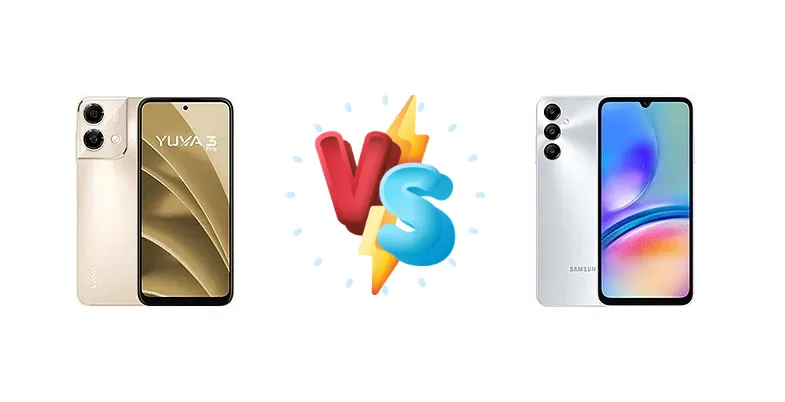
The sub-$150 smartphone market is fiercely competitive. The Lava Yuva 3 Pro and Samsung Galaxy A05s both aim to deliver essential smartphone functionality at an accessible price point. However, they take different approaches – the Lava prioritizes a newer chipset, while the Samsung focuses on established brand recognition and optimized battery performance. This comparison dissects their key differences to help you choose the right device.
🏆 Quick Verdict
For the average user prioritizing longevity and consistent performance, the Samsung Galaxy A05s is the better choice. Its Snapdragon 680 chipset, coupled with a measured 11:32h active use battery life, provides a smoother experience and less anxiety about daily charging. While the Lava Yuva 3 Pro offers a newer processor, the Samsung’s overall package is more refined.
| Network |
|---|
| 2G bands | GSM 900 / 1800 | GSM 850 / 900 / 1800 / 1900 |
| 3G bands | HSDPA 900 / 2100 | HSDPA 850 / 900 / 2100 |
| 4G bands | 1, 3, 5, 8, 40, 41 | 1, 3, 5, 7, 8, 20, 28, 38, 40, 41 |
| Speed | HSPA, LTE | HSPA, LTE |
| Technology | GSM / HSPA / LTE | GSM / HSPA / LTE |
| Launch |
|---|
| Announced | 2023, December 14 | 2023, September 25 |
| Status | Available. Released 2023, December 14 | Available. Released 2023, October 18 |
| Body |
|---|
| Build | - | Glass front, plastic back, plastic frame |
| Dimensions | 165 x 76.1 x 8.7 mm (6.50 x 3.00 x 0.34 in) | 168 x 77.8 x 8.8 mm (6.61 x 3.06 x 0.35 in) |
| SIM | Nano-SIM + Nano-SIM | · Nano-SIM· Nano-SIM + Nano-SIM |
| Weight | 200 g (7.05 oz) | 194 g (6.84 oz) |
| Display |
|---|
| Resolution | 720 x 1600 pixels, 20:9 ratio (~270 ppi density) | 1080 x 2400 pixels, 20:9 ratio (~393 ppi density) |
| Size | 6.5 inches, 102.0 cm2 (~81.2% screen-to-body ratio) | 6.7 inches, 108.4 cm2 (~82.9% screen-to-body ratio) |
| Type | IPS LCD, 90Hz | PLS LCD, 90Hz |
| Platform |
|---|
| CPU | Octa-core (2x2.0 GHz Cortex-A75 & 6x1.8 GHz Cortex-A55) | Octa-core (4x2.4 GHz Kryo 265 Gold & 4x1.9 GHz Kryo 265 Silver) |
| Chipset | Unisoc Tiger T616 (12 nm) | Qualcomm SM6225 Snapdragon 680 4G (6 nm) |
| GPU | Mali-G57 MP1 | Adreno 610 |
| OS | Android 13 | Android 13, up to 2 major Android upgrades, One UI 7 |
| Memory |
|---|
| Card slot | microSDXC (dedicated slot) | microSDXC (dedicated slot) |
| Internal | 128GB 8GB RAM | 64GB 4GB RAM, 128GB 4GB RAM, 128GB 6GB RAM |
| Main Camera |
|---|
| Features | LED flash, HDR, panorama | LED flash |
| Single | 50 MP, (wide), AF
Auxiliary lens | - |
| Triple | - | 50 MP, f/1.8, (wide), 1/2.8", 0.64µm, AF
2 MP (macro)
Auxiliary lens |
| Video | 1080p@30fps | 1080p@30/60fps |
| Selfie camera |
|---|
| Single | 8 MP | 13 MP, f/2.0, (wide), 1/3.X", 1.12µm |
| Video | 1080p@30fps | 1080p@30fps |
| Sound |
|---|
| 35mm jack | Yes | Yes |
| Loudspeaker | Yes | Yes |
| Comms |
|---|
| Bluetooth | 5.0, A2DP, LE | 5.1, A2DP, LE |
| NFC | No | Yes (market/region dependent) |
| Positioning | GPS | GPS, GLONASS, GALILEO, BDS, QZSS |
| Radio | FM radio | Unspecified |
| USB | USB Type-C 2.0, OTG | USB Type-C 2.0 |
| WLAN | Wi-Fi 802.11 b/g/n/ac | Wi-Fi 802.11 a/b/g/n/ac, dual-band, Wi-Fi Direct |
| Features |
|---|
| Sensors | Fingerprint (side-mounted), accelerometer, proximity | Fingerprint (side-mounted), accelerometer, proximity |
| Battery |
|---|
| Charging | 18W wired | 25W wired |
| Type | Li-Po 5000 mAh | Li-Po 5000 mAh |
| Misc |
|---|
| Colors | Desert Gold, Forest Viridian (Green), Meadow Purple | Black, Silver, Light Green, Violet |
| Models | - | SM-A057F, SM-A057F/DS, SM-A057M, SM-A057M/DS, SM-A057G/DSN, SM-A057G |
| Price | About 100 EUR | $ 134.00 / C$ 146.99 / £ 83.94 / € 100.99 |
| SAR EU | - | 0.58 W/kg (head) 1.31 W/kg (body) |
Lava Yuva 3 Pro
- Potentially more modern chipset (Unisoc T616)
- May offer a lower price point
- Fresh software experience (depending on updates)
- Less efficient 12nm process
- Uncertain display quality
- Potentially less refined software
Samsung Galaxy A05s
- Excellent battery life (11:32h active use)
- More efficient Snapdragon 680 chipset (6nm)
- Brighter and higher contrast display (468 nits, 1418:1)
- Faster 25W charging
- May be slightly more expensive
- Older chipset architecture compared to some competitors
Display Comparison
The Samsung Galaxy A05s boasts a measured peak brightness of 468 nits and a 1418:1 contrast ratio, indicating a more vibrant and visible display, especially outdoors. While the Lava Yuva 3 Pro’s display specifications are not provided, Samsung’s panel offers a tangible advantage in viewing quality. The contrast ratio suggests deeper blacks and more impactful colors, enhancing media consumption. The lack of detailed display specs for the Lava makes a direct comparison difficult, but the Samsung clearly leads in measured performance.
Camera Comparison
Both phones likely feature basic camera setups geared towards casual photography. The Samsung Galaxy A05s’ camera is described as capable of both Photo and Video, but details on sensor size and aperture are missing. It’s reasonable to assume a primary sensor around 13MP, typical for this price range. The Lava Yuva 3 Pro’s camera specifications are also absent. Without concrete details, it’s difficult to assess camera quality, but the Samsung’s brand reputation for image processing suggests a potentially more refined output. We can assume both phones will include lower-resolution auxiliary lenses (likely 2MP macro/depth sensors) that offer limited practical benefit.
Performance
The Samsung Galaxy A05s utilizes the Qualcomm Snapdragon 680 (6nm), featuring a Kryo CPU configuration with 4x2.4 GHz Gold cores and 4x1.9 GHz Silver cores. This 6nm process node is significantly more efficient than the 12nm Unisoc Tiger T616 in the Lava Yuva 3 Pro. The Snapdragon 680’s architecture, while not flagship-level, provides a noticeable performance boost in everyday tasks and light gaming. The Lava’s T616, with its 2x2.0 GHz Cortex-A75 and 6x1.8 GHz Cortex-A55 cores, will handle basic tasks, but will likely exhibit more lag and struggle with demanding applications. The 6nm process of the Snapdragon also translates to better thermal management, reducing the likelihood of performance throttling during sustained use.
Battery Life
The Samsung Galaxy A05s shines in battery life, achieving an impressive 11:32h of active use. This is a significant advantage over what we might expect from the Lava Yuva 3 Pro, given its 18W charging and lack of specified battery capacity. While the Lava’s 18W charging is adequate, the Samsung’s 25W charging allows for faster top-ups. The combination of a more efficient chipset (Snapdragon 680) and a likely optimized software experience allows the Samsung to extract significantly more runtime from its battery.
Buying Guide
Buy the Lava Yuva 3 Pro if you need a phone with a relatively modern chipset and are comfortable potentially troubleshooting software quirks. It’s a good option for tech enthusiasts who enjoy tinkering. Buy the Samsung Galaxy A05s if you prefer a reliable, long-lasting battery, a well-established brand, and a generally smoother, more predictable user experience. It’s ideal for first-time smartphone users or those who prioritize simplicity.
Frequently Asked Questions
❓ Is the Snapdragon 680 in the Samsung Galaxy A05s powerful enough for PUBG Mobile?
The Snapdragon 680 can run PUBG Mobile, but you’ll likely need to stick to medium graphics settings and moderate frame rates for a smooth experience. It’s not a gaming powerhouse, but it’s capable of handling the game at acceptable levels.
❓ How long will it take to fully charge the Samsung Galaxy A05s with the 25W charger?
While Samsung doesn't provide an exact 0-100% charging time, with the included 25W charger, you can expect a full charge in approximately 1 hour and 45 minutes to 2 hours, depending on usage during charging.
❓ Does the Lava Yuva 3 Pro support VoLTE and VoWiFi?
Given its target market and chipset, the Lava Yuva 3 Pro likely supports VoLTE (Voice over LTE) for improved call quality. VoWiFi (Voice over Wi-Fi) support is less certain and would depend on carrier compatibility and software implementation.
❓ What type of USB port do both phones use?
Both the Lava Yuva 3 Pro and Samsung Galaxy A05s utilize a USB-C port for charging and data transfer, which is standard for modern smartphones.