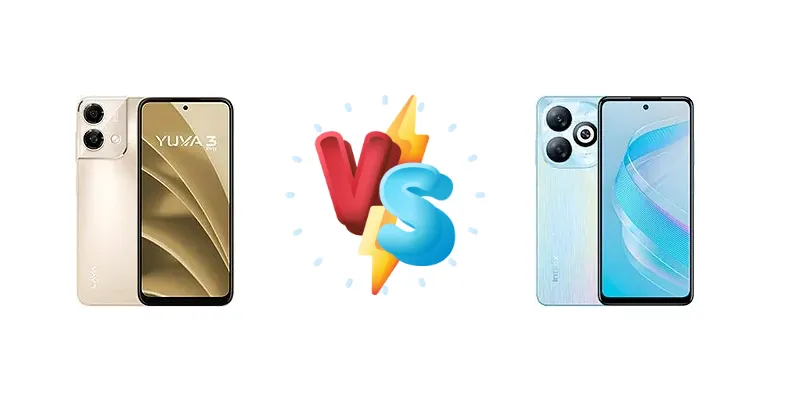
The sub-$150 smartphone market is fiercely competitive, and the Lava Yuva 3 Pro and Infinix Smart 8 Pro are two contenders vying for dominance. Both aim to deliver essential features at an accessible price, but they take different approaches to achieving this. The Yuva 3 Pro prioritizes processing power with its Unisoc Tiger T616, while the Smart 8 Pro focuses on features like reverse charging, despite utilizing a less powerful Mediatek Helio G36 chipset.
🏆 Quick Verdict
For the average user prioritizing responsiveness and smoother multitasking, the Lava Yuva 3 Pro emerges as the better choice. Its Unisoc Tiger T616 chipset, with its Cortex-A75 cores, offers a noticeable performance advantage over the Infinix Smart 8 Pro’s Helio G36, making it more suitable for everyday tasks and light gaming. However, the Smart 8 Pro’s reverse charging is a unique feature.
| Network |
|---|
| 2G bands | GSM 900 / 1800 | GSM 850 / 900 / 1800 / 1900 |
| 3G bands | HSDPA 900 / 2100 | HSDPA 850 / 900 / 1700(AWS) / 1900 / 2100 |
| 4G bands | 1, 3, 5, 8, 40, 41 | 1, 2, 3, 4, 5, 7, 8, 20, 28, 38, 41, 40 |
| Speed | HSPA, LTE | HSPA, LTE |
| Technology | GSM / HSPA / LTE | GSM / HSPA / LTE |
| Launch |
|---|
| Announced | 2023, December 14 | 2024, January 29 |
| Status | Available. Released 2023, December 14 | Available. Released 2024, February |
| Body |
|---|
| Build | - | Glass front, plastic back, plastic frame |
| Dimensions | 165 x 76.1 x 8.7 mm (6.50 x 3.00 x 0.34 in) | 163.6 x 75.6 x 8.5 mm (6.44 x 2.98 x 0.33 in) |
| SIM | Nano-SIM + Nano-SIM | Nano-SIM + Nano-SIM |
| Weight | 200 g (7.05 oz) | 189 g (6.67 oz) |
| Display |
|---|
| Resolution | 720 x 1600 pixels, 20:9 ratio (~270 ppi density) | 720 x 1612 pixels, 20:9 ratio (~267 ppi density) |
| Size | 6.5 inches, 102.0 cm2 (~81.2% screen-to-body ratio) | 6.6 inches, 104.6 cm2 (~84.6% screen-to-body ratio) |
| Type | IPS LCD, 90Hz | IPS LCD, 90Hz, 500 nits (peak) |
| Platform |
|---|
| CPU | Octa-core (2x2.0 GHz Cortex-A75 & 6x1.8 GHz Cortex-A55) | Octa-core (4x2.2 GHz Cortex-A53 & 4x1.6 GHz Cortex-A53) |
| Chipset | Unisoc Tiger T616 (12 nm) | Mediatek Helio G36 (12 nm) |
| GPU | Mali-G57 MP1 | PowerVR GE8320 |
| OS | Android 13 | Android 13 (Go edition), XOS 13 |
| Memory |
|---|
| Card slot | microSDXC (dedicated slot) | microSDXC (dedicated slot) |
| Internal | 128GB 8GB RAM | 64GB 4GB RAM, 128GB 8GB RAM, 256GB 4GB RAM |
| Main Camera |
|---|
| Features | LED flash, HDR, panorama | Ring-LED flash, HDR, panorama |
| Single | 50 MP, (wide), AF
Auxiliary lens | 50 MP, f/1.9, (wide), AF
Auxiliary lens |
| Video | 1080p@30fps | 1080p@30fps |
| Selfie camera |
|---|
| Single | 8 MP | 8 MP, f/2.0, (wide) |
| Video | 1080p@30fps | Yes |
| Sound |
|---|
| 35mm jack | Yes | Yes |
| Loudspeaker | Yes | Yes |
| Comms |
|---|
| Bluetooth | 5.0, A2DP, LE | 5.0, A2DP, LE |
| NFC | No | No |
| Positioning | GPS | GPS |
| Radio | FM radio | FM radio |
| USB | USB Type-C 2.0, OTG | USB Type-C 2.0, OTG |
| WLAN | Wi-Fi 802.11 b/g/n/ac | Wi-Fi 802.11 a/b/g/n/ac, dual-band |
| Features |
|---|
| Sensors | Fingerprint (side-mounted), accelerometer, proximity | Fingerprint (side-mounted), accelerometer, gyro, proximity, compass |
| Battery |
|---|
| Charging | 18W wired | 10W wired
Reverse wired |
| Type | Li-Po 5000 mAh | 5000 mAh |
| Misc |
|---|
| Colors | Desert Gold, Forest Viridian (Green), Meadow Purple | Rainbow Blue, Galaxy White, Shiny Gold, Timber Black |
| Models | - | X6525B |
| Price | About 100 EUR | About 100 EUR |
Lava Yuva 3 Pro
- More powerful Unisoc Tiger T616 chipset
- Faster 18W wired charging
- Potentially better image processing
- Lacks reverse charging functionality
- No detailed display specifications available
Infinix Smart 8 Pro
- Reverse wired charging for accessories
- Potentially lower price point
- Simple and straightforward user experience
- Less powerful Mediatek Helio G36 chipset
- Slower 10W wired charging
- Likely inferior image processing
Display Comparison
Neither Lava nor Infinix provide display specifications beyond the basic panel type. Given the price point, both likely utilize IPS LCD panels. However, the real difference lies elsewhere. The focus here is on the overall user experience, and a more powerful processor (Yuva 3 Pro) will contribute to smoother animations and transitions, indirectly improving perceived display quality. Without specific brightness or color accuracy data, it's difficult to declare a clear winner, but the Yuva 3 Pro’s processing power suggests a potentially more fluid visual experience.
Camera Comparison
Both phones likely feature basic camera setups geared towards casual photography. Without detailed sensor information, it’s difficult to make a definitive judgment. However, the emphasis should be on image processing capabilities, which are tied to the chipset. The Unisoc T616 in the Lava Yuva 3 Pro has a more powerful ISP (Image Signal Processor) than the Helio G36, potentially leading to better image quality, especially in challenging lighting conditions. The inclusion of a 2MP macro lens on either device is largely a marketing tactic, offering minimal practical benefit.
Performance
The core difference between these two phones is their chipsets. The Lava Yuva 3 Pro’s Unisoc Tiger T616 features two Cortex-A75 cores clocked at 2.0 GHz, paired with six Cortex-A55 cores at 1.8 GHz. This architecture is significantly more capable than the Infinix Smart 8 Pro’s Mediatek Helio G36, which uses four Cortex-A53 cores at 2.2 GHz and four more at 1.6 GHz. While the Helio G36 has a higher clock speed on its primary cores, the A75 cores in the T616 offer superior single-core performance, translating to faster app launches and smoother multitasking. The T616’s architecture is better suited for handling demanding applications. This means the Yuva 3 Pro will likely exhibit less lag and stuttering during everyday use.
Battery Life
The Infinix Smart 8 Pro’s 10W charging is a significant drawback compared to the Lava Yuva 3 Pro’s 18W charging. While battery capacity isn’t specified, 18W charging will substantially reduce charging times, offering a more convenient user experience. The Smart 8 Pro’s inclusion of reverse wired charging is a unique feature, allowing it to act as a power bank for other devices, but this comes at the cost of slower overall charging speeds. The faster charging of the Yuva 3 Pro is a clear advantage for users who prioritize minimizing downtime.
Buying Guide
Buy the Lava Yuva 3 Pro if you need a phone that feels snappy and responsive for daily use, and if you occasionally play mobile games. The more powerful processor will handle multitasking and app loading times more efficiently. Buy the Infinix Smart 8 Pro if you value the convenience of reverse charging to top up accessories like earbuds or smartwatches, and if your usage is primarily limited to basic communication and social media.
Frequently Asked Questions
❓ Will the Lava Yuva 3 Pro handle demanding games like PUBG Mobile?
While the Unisoc Tiger T616 can run PUBG Mobile, expect to play at lower graphics settings and frame rates for a smooth experience. It's not a dedicated gaming chipset, but it's significantly more capable than the Helio G36 for gaming.
❓ How useful is the reverse charging feature on the Infinix Smart 8 Pro?
The reverse charging feature is most useful for topping up small accessories like Bluetooth earbuds, smartwatches, or portable speakers. Don't expect to fully charge a smartphone with it, as the 10W output is relatively slow. It's a niche feature, but valuable for those who frequently use such accessories.
❓ Does the Infinix Smart 8 Pro experience noticeable lag during everyday tasks?
The Mediatek Helio G36 is a basic chipset, and users may experience some lag when opening multiple apps or switching between them quickly. It's suitable for light usage, but may struggle with heavier multitasking.
❓ What type of storage and RAM does the Lava Yuva 3 Pro use?
Unfortunately, the specific storage type (eMMC or UFS) and RAM speed (LPDDR4x or LPDDR5) are not specified. However, given the price point, it's likely to be eMMC storage and LPDDR4x RAM. This will impact app loading times and overall system responsiveness compared to faster storage and RAM technologies.