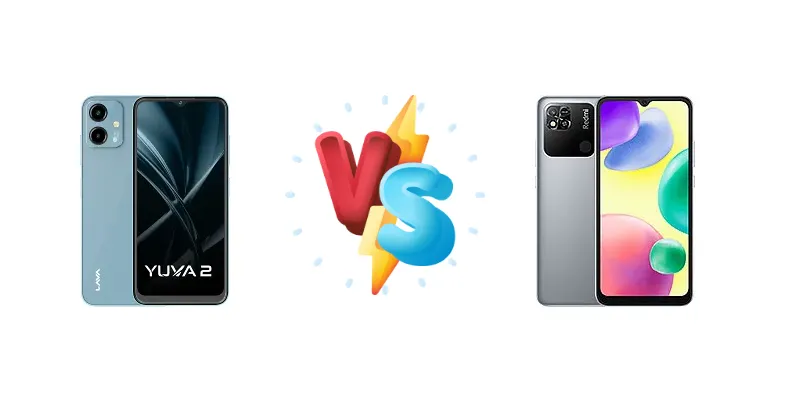
The sub-$150 smartphone market is fiercely competitive. Both the Lava Yuva 2 and Xiaomi Redmi 10A aim to deliver essential smartphone functionality at an incredibly accessible price point. However, they take different approaches to achieving this, primarily through their choice of chipset. This comparison dissects the key differences to determine which device offers the best value for your money.
🏆 Quick Verdict
For the average user prioritizing consistent performance in everyday tasks, the Lava Yuva 2 emerges as the slightly better choice. Its Unisoc T606 chipset, with its Cortex-A75 cores, provides a noticeable edge in responsiveness compared to the Redmi 10A's Helio G25, despite both being 12nm chips. However, the Redmi 10A remains a viable option for basic usage.
| Network |
|---|
| 2G bands | GSM 900 / 1800 | GSM 850 / 900 / 1800 / 1900 |
| 3G bands | HSDPA 900 / 2100 | HSDPA 850 / 900 / 2100 |
| 4G bands | 1, 3, 5, 8, 40, 41 | 1, 3, 5, 8, 40, 41 - International |
| Speed | HSPA, LTE | HSPA, LTE |
| Technology | GSM / HSPA / LTE | GSM / HSPA / CDMA2000 / LTE |
| | - | 1, 3, 5, 8, 34, 38, 39, 40, 41 - China |
| Launch |
|---|
| Announced | 2023, August 02 | 2022, March 29 |
| Status | Available. Released 2023, August 02 | Available. Released 2022, March 31 |
| Body |
|---|
| Build | Glass front, plastic frame, plastic back | - |
| Dimensions | 165 x 76.1 x 8.7 mm (6.50 x 3.00 x 0.34 in) | 164.9 x 77.1 x 9 mm (6.49 x 3.04 x 0.35 in) |
| SIM | Nano-SIM + Nano-SIM | Nano-SIM + Nano-SIM |
| Weight | 202 g (7.13 oz) | 194 g (6.84 oz) |
| Display |
|---|
| Resolution | 720 x 1600 pixels, 20:9 ratio (~270 ppi density) | 720 x 1600 pixels, 20:9 ratio (~269 ppi density) |
| Size | 6.5 inches, 102.0 cm2 (~81.2% screen-to-body ratio) | 6.53 inches, 102.9 cm2 (~81.0% screen-to-body ratio) |
| Type | IPS LCD, 90Hz | IPS LCD, 400 nits (typ) |
| Platform |
|---|
| CPU | Octa-core (2x1.6 GHz Cortex-A75 & 6x1.6 GHz Cortex-A55) | Octa-core (4x2.0 GHz Cortex-A53 & 4x1.5 GHz Cortex-A53) |
| Chipset | Unisoc T606 (12 nm) | Mediatek MT6762G Helio G25 (12 nm) |
| GPU | Mali-G57 MP1 | PowerVR GE8320 |
| OS | Android 12 | Android 11, MIUI 12.5 |
| Memory |
|---|
| Card slot | microSDXC (uses shared SIM slot) | microSDXC |
| Internal | 64GB 3GB RAM | 32GB 2GB RAM, 32GB 3GB RAM, 64GB 3GB RAM, 64GB 4GB RAM, 128GB 4GB RAM, 128GB 6GB RAM |
| Main Camera |
|---|
| Dual | 13 MP, (wide), AF
VGA | - |
| Features | LED flash, HDR, panorama | LED flash |
| Single | - | 13 MP, f/2.2, (wide), 1.0µm, AF |
| Video | 1080p@30fps | 1080p@30fps |
| Selfie camera |
|---|
| Features | - | HDR |
| Single | 5 MP | 5 MP |
| Video | 1080p@30fps | 1080p@30fps |
| Sound |
|---|
| 3.5mm jack | - | Yes |
| 35mm jack | Yes | Yes |
| Loudspeaker | Yes | Yes |
| Comms |
|---|
| Bluetooth | 5.0, A2DP, LE | 5.0, A2DP, LE |
| NFC | No | No |
| Positioning | GPS, GALILEO, GLONASS | GPS, GLONASS, BDS |
| Radio | FM radio | No |
| USB | USB Type-C 2.0, OTG | microUSB 2.0 |
| WLAN | Wi-Fi 802.11 b/g/n/ac | Wi-Fi 802.11 a/b/g/n, Wi-Fi Direct |
| Features |
|---|
| Sensors | Fingerprint (side-mounted), accelerometer, proximity | Fingerprint (rear-mounted), accelerometer, proximity |
| Battery |
|---|
| Charging | 10W wired | 10W wired |
| Type | Li-Po 5000 mAh | Li-Ion 5000 mAh |
| Misc |
|---|
| Colors | Glass Lavender, Glass Green, Glass Blue | Charcoal Black, Sea Blue, Slate Grey |
| Models | - | 220233L2C, 220233L2G, 220233L2I |
| Price | About 80 EUR | € 60.00 / $ 66.55 |
| SAR | - | 0.90 W/kg (head) 0.65 W/kg (body) |
| SAR EU | - | 0.40 W/kg (head) 0.99 W/kg (body) |
Lava Yuva 2
- More responsive performance due to Cortex-A75 cores
- Potentially better power efficiency with Unisoc T606
- Slightly more modern chipset architecture
- Lava brand recognition is lower than Xiaomi
- Display specs are unknown, potentially average quality
Xiaomi Redmi 10A
- Larger display size (6.53 inches)
- Stronger brand recognition and established ecosystem
- Potentially more refined camera software
- Less powerful chipset (Helio G25)
- Cortex-A53 cores are less efficient than A75
- May feel sluggish during multitasking
Display Comparison
Neither device boasts a standout display. Both are likely to feature LCD panels, typical for this price bracket. Without specific display specs (resolution, brightness), the comparison hinges on panel quality, which is difficult to ascertain without direct testing. However, the Redmi 10A's larger 6.53-inch display (versus the Yuva 2's 6.5-inch) offers a slightly more immersive viewing experience, though this comes at the cost of potentially lower pixel density. Bezels are expected to be substantial on both.
Camera Comparison
Camera performance is likely to be similar on both devices, with both likely featuring a primary sensor paired with basic auxiliary lenses (often 2MP depth or macro sensors). Without specific sensor details, it's difficult to make a definitive judgment. Image processing will play a significant role, and Xiaomi generally has a more refined software algorithm. However, the hardware limitations of both devices mean that image quality will be heavily dependent on good lighting conditions. The 2MP macro cameras on both are largely marketing features and offer limited practical benefit.
Performance
The core difference lies in the chipsets. The Lava Yuva 2’s Unisoc T606 utilizes a big.LITTLE architecture with 2x 1.6 GHz Cortex-A75 cores and 6x 1.6 GHz Cortex-A55 cores. This configuration provides a performance boost for demanding tasks compared to the Xiaomi Redmi 10A’s MediaTek Helio G25, which features 4x 2.0 GHz Cortex-A53 cores and 4x 1.5 GHz Cortex-A53 cores. While the Helio G25 has a higher clock speed on its primary cores, the Cortex-A75 cores in the T606 are architecturally superior, offering better instructions per clock (IPC). This translates to smoother multitasking and a more responsive user interface on the Lava Yuva 2. Both phones will likely struggle with graphically intensive games, but the Yuva 2 should offer a slightly more playable experience.
Battery Life
Both the Lava Yuva 2 and Xiaomi Redmi 10A feature 10W wired charging, indicating similar charging speeds (approximately 3-4 hours for a full charge). Battery capacity is not specified, but given the price point, both are likely to house around a 5000mAh battery. The slightly more efficient Unisoc T606 in the Lava Yuva 2 *may* translate to marginally better battery life, but real-world usage will be the deciding factor. The 10W charging is slow by modern standards, so overnight charging is recommended.
Buying Guide
Buy the Lava Yuva 2 if you need a phone that feels more responsive during multitasking, app switching, and light gaming. The Cortex-A75 cores offer a tangible benefit for users who don't want a sluggish experience. Buy the Xiaomi Redmi 10A if your primary needs are limited to calls, messaging, and very light social media browsing, and you prioritize brand recognition within the Xiaomi ecosystem.
Frequently Asked Questions
❓ Will the Helio G25 in the Redmi 10A struggle with popular apps like Facebook and WhatsApp?
While the Helio G25 can handle basic apps like Facebook and WhatsApp, you may experience occasional lag or slowdowns when multitasking or using these apps alongside other background processes. The Lava Yuva 2's Unisoc T606 is better equipped to handle these scenarios smoothly.
❓ Is the Lava Yuva 2 a good option for playing PUBG Mobile or other demanding games?
Neither the Lava Yuva 2 nor the Redmi 10A are ideal for playing PUBG Mobile or other graphically intensive games. You'll likely need to play at the lowest settings with significant frame rate drops. The Yuva 2's slightly more powerful chipset may offer a marginally better experience, but don't expect a fluid gaming experience.
❓ How long will it take to fully charge both phones from 0%?
With both phones utilizing 10W charging, a full charge from 0% is expected to take approximately 3 to 4 hours. This is a relatively slow charging speed compared to modern smartphones, so it's best to charge them overnight.
❓ Does either phone support fast charging?
No, neither the Lava Yuva 2 nor the Xiaomi Redmi 10A supports fast charging. Both are limited to 10W wired charging, which is standard for phones in this price range.