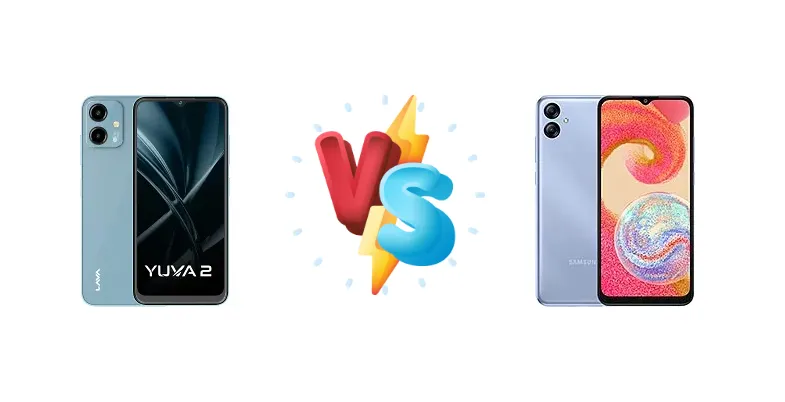
The Lava Yuva 2 and Samsung Galaxy A04e represent the extreme end of the smartphone price spectrum, targeting first-time buyers or those needing a reliable secondary device. Both phones aim to deliver essential functionality at an incredibly low cost, but significant differences in their core hardware – specifically the chipset – dictate their real-world performance and suitability for different users.
🏆 Quick Verdict
For the average user prioritizing responsiveness and future-proofing, the Lava Yuva 2 is the better choice. Its Unisoc T606 chipset, featuring newer Cortex-A75 cores, provides a noticeable performance advantage over the Samsung Galaxy A04e’s aging Helio P35. While both offer basic functionality, the Yuva 2 offers a smoother experience for everyday tasks.
| Network |
|---|
| 2G bands | GSM 900 / 1800 | GSM 850 / 900 / 1800 / 1900 |
| 3G bands | HSDPA 900 / 2100 | HSDPA 850 / 900 / 2100 |
| 4G bands | 1, 3, 5, 8, 40, 41 | 1, 3, 5, 7, 8, 20, 28, 38, 40, 41 |
| Speed | HSPA, LTE | HSPA, LTE |
| Technology | GSM / HSPA / LTE | GSM / HSPA / LTE |
| Launch |
|---|
| Announced | 2023, August 02 | 2022, October 21 |
| Status | Available. Released 2023, August 02 | Available. Released 2022, November 07 |
| Body |
|---|
| Build | Glass front, plastic frame, plastic back | Glass front, plastic back, plastic frame |
| Dimensions | 165 x 76.1 x 8.7 mm (6.50 x 3.00 x 0.34 in) | 164.2 x 75.9 x 9.1 mm (6.46 x 2.99 x 0.36 in) |
| SIM | Nano-SIM + Nano-SIM | · Nano-SIM· Nano-SIM + Nano-SIM |
| Weight | 202 g (7.13 oz) | 188 g (6.63 oz) |
| Display |
|---|
| Resolution | 720 x 1600 pixels, 20:9 ratio (~270 ppi density) | 720 x 1600 pixels, 20:9 ratio (~270 ppi density) |
| Size | 6.5 inches, 102.0 cm2 (~81.2% screen-to-body ratio) | 6.5 inches, 102.0 cm2 (~81.8% screen-to-body ratio) |
| Type | IPS LCD, 90Hz | PLS LCD |
| Platform |
|---|
| CPU | Octa-core (2x1.6 GHz Cortex-A75 & 6x1.6 GHz Cortex-A55) | Octa-core (4x2.3 GHz Cortex-A53 & 4x1.8 GHz Cortex-A53) |
| Chipset | Unisoc T606 (12 nm) | Mediatek MT6765 Helio P35 (12 nm) |
| GPU | Mali-G57 MP1 | PowerVR GE8320 |
| OS | Android 12 | Android 12, One UI Core 4.1 |
| Memory |
|---|
| Card slot | microSDXC (uses shared SIM slot) | microSDXC (dedicated slot) |
| Internal | 64GB 3GB RAM | 32GB 2GB RAM, 32GB 3GB RAM, 32GB 4GB RAM, 64GB 2GB RAM, 64GB 3GB RAM, 64GB 4GB RAM, 128GB 4GB RAM |
| Main Camera |
|---|
| Dual | 13 MP, (wide), AF
VGA | 13 MP, f/2.2, (wide), AF
Auxiliary lens |
| Features | LED flash, HDR, panorama | LED flash |
| Single | - | 5 MP, f/2.2 |
| Video | 1080p@30fps | 1080p@30fps |
| Selfie camera |
|---|
| Single | 5 MP | 5 MP, f/2.2 |
| Video | 1080p@30fps | Yes |
| Sound |
|---|
| 3.5mm jack | - | Yes |
| 35mm jack | Yes | Yes |
| Loudspeaker | Yes | Yes |
| Comms |
|---|
| Bluetooth | 5.0, A2DP, LE | 5.0, A2DP, LE |
| NFC | No | No |
| Positioning | GPS, GALILEO, GLONASS | GPS, GLONASS, GALILEO, BDS |
| Radio | FM radio | Unspecified |
| USB | USB Type-C 2.0, OTG | USB Type-C 2.0, OTG |
| WLAN | Wi-Fi 802.11 b/g/n/ac | Wi-Fi 802.11 b/g/n, Wi-Fi Direct |
| Features |
|---|
| Sensors | Fingerprint (side-mounted), accelerometer, proximity | Accelerometer, proximity |
| Battery |
|---|
| Charging | 10W wired | - |
| Type | Li-Po 5000 mAh | Li-Po 5000 mAh |
| Misc |
|---|
| Colors | Glass Lavender, Glass Green, Glass Blue | Black, Copper, Light Blue |
| Models | - | SM-A042F, SM-A042F/DS, SM-A042M, SM-A042M/DS |
| Price | About 80 EUR | ₹ 7,999 |
| SAR EU | - | 0.29 W/kg (head) 1.11 W/kg (body) |
Lava Yuva 2
- More modern CPU architecture (Unisoc T606)
- Potentially smoother multitasking
- Better long-term performance
- Slower 10W charging
- Less established brand recognition
Samsung Galaxy A04e
- Established Samsung brand
- Potential for longer software support (though not guaranteed)
- Wider availability in some markets
- Older, less efficient CPU (Helio P35)
- Slower overall performance
- Limited RAM likely exacerbates performance issues
Display Comparison
Neither device boasts a standout display. Both are likely utilizing LCD panels, a common cost-saving measure in this segment. While specific details like peak brightness and color gamut coverage are unavailable, the focus here is on functionality over fidelity. Bezels are expected to be substantial on both, maximizing screen real estate within a compact form factor. Color accuracy will likely be standard for the price point, prioritizing power efficiency over precise color reproduction.
Camera Comparison
Camera performance will be limited on both devices. Details regarding sensor size and aperture are unavailable, but it’s safe to assume both feature basic sensors. The presence of a 2MP macro camera on the A04e is largely a marketing gimmick, offering minimal practical benefit due to the low resolution and lack of optical image stabilization (OIS). Image processing will likely be heavily reliant on software algorithms to enhance detail and reduce noise, but the limitations of the hardware will be apparent. Expect acceptable results in well-lit conditions, but significant degradation in low-light scenarios.
Performance
The core difference lies in the chipsets. The Lava Yuva 2’s Unisoc T606 (12nm) utilizes a more modern CPU configuration: two Cortex-A75 cores clocked at 1.6 GHz paired with six Cortex-A55 cores, also at 1.6 GHz. This architecture provides a significant uplift in single-core and multi-core performance compared to the Samsung Galaxy A04e’s MediaTek Helio P35 (12nm). The Helio P35 relies on four Cortex-A53 cores at 2.3 GHz and another four at 1.8 GHz. While the higher clock speeds *seem* advantageous, the older A53 architecture is less efficient and delivers lower Instructions Per Clock (IPC) than the A75. This translates to a snappier experience on the Yuva 2, especially when multitasking or running slightly more demanding apps. The RAM configuration is not specified, but both will likely feature limited RAM, further emphasizing the importance of the more efficient CPU in the Yuva 2.
Battery Life
Both devices feature 12nm chipsets, suggesting similar power efficiency profiles. The Lava Yuva 2’s 10W charging is comparatively slow, but the battery capacity is not specified. The Samsung Galaxy A04e’s battery capacity is also unknown. Given the target market, both phones are likely optimized for all-day battery life with moderate usage. The slower charging speed on the Yuva 2 means longer periods plugged into the wall, but the more efficient processor may offset this with lower overall power consumption.
Buying Guide
Buy the Lava Yuva 2 if you need a phone that feels reasonably snappy for basic tasks like browsing, social media, and messaging, and you value a more modern processor architecture. Buy the Samsung Galaxy A04e if brand recognition and access to Samsung’s ecosystem are paramount, and your usage is extremely light – primarily calls, texts, and occasional light browsing. The A04e’s strength lies in its established brand and potential for software updates, though these are not guaranteed.
Frequently Asked Questions
❓ Will the Unisoc T606 in the Lava Yuva 2 handle popular apps like WhatsApp and Facebook smoothly?
Yes, the Unisoc T606’s Cortex-A75 cores are more than capable of handling everyday apps like WhatsApp, Facebook, and web browsing without significant lag. The improved architecture provides a noticeable boost in responsiveness compared to the Helio P35 in the A04e, making for a smoother user experience.
❓ Is the Samsung Galaxy A04e likely to receive regular software updates?
While Samsung is generally good with software support, the A04e is an entry-level device. While it may receive security patches for a period, major Android version updates are less likely compared to Samsung’s higher-end models. Don't expect the same level of long-term support as a flagship device.
❓ Can either of these phones handle basic mobile gaming?
Both phones can handle *very* basic mobile gaming, but don't expect high frame rates or detailed graphics. The Helio P35 in the A04e will struggle with more demanding titles, while the Yuva 2’s Unisoc T606 will offer a slightly better experience, but still requires lowered graphics settings for smoother gameplay.