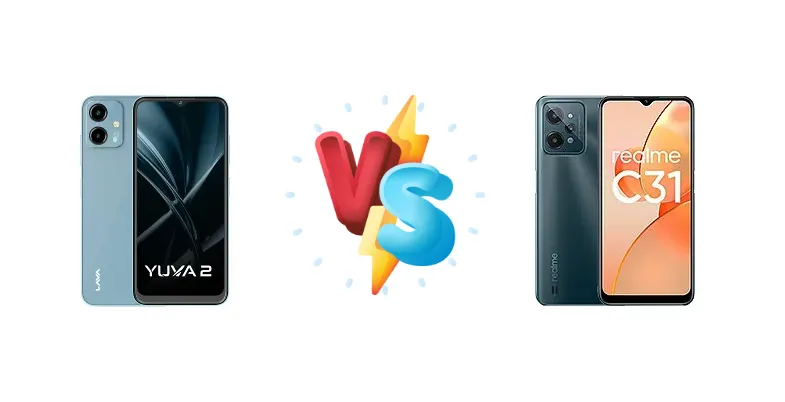
The sub-$100 smartphone market is fiercely competitive, and the Lava Yuva 2 and Realme C31 are two contenders vying for your attention. Both devices leverage Unisoc chipsets to deliver affordable Android experiences, but subtle differences in processing power and potential optimizations could make one a better fit for your needs. This comparison dissects their specifications to reveal which phone offers the best value.
🏆 Quick Verdict
For most users, the Realme C31 emerges as the slightly better choice due to its marginally faster Unisoc Tiger T612 chipset. The higher clock speeds translate to a snappier experience in everyday tasks. However, the Lava Yuva 2 may offer a more competitive price point, making it a viable option for extremely budget-conscious buyers.
| Network |
|---|
| 2G bands | GSM 900 / 1800 | GSM 850 / 900 / 1800 / 1900 |
| 3G bands | HSDPA 900 / 2100 | HSDPA 850 / 900 / 2100 |
| 4G bands | 1, 3, 5, 8, 40, 41 | 1, 3, 5, 8, 38, 40, 41 |
| Speed | HSPA, LTE | HSPA, LTE |
| Technology | GSM / HSPA / LTE | GSM / HSPA / LTE |
| Launch |
|---|
| Announced | 2023, August 02 | 2022, March 25 |
| Status | Available. Released 2023, August 02 | Available. Released 2022, March 31 |
| Body |
|---|
| Build | Glass front, plastic frame, plastic back | Glass front, plastic frame, plastic back |
| Dimensions | 165 x 76.1 x 8.7 mm (6.50 x 3.00 x 0.34 in) | 164.7 x 76.1 x 8.4 mm (6.48 x 3.00 x 0.33 in) |
| SIM | Nano-SIM + Nano-SIM | Nano-SIM + Nano-SIM |
| Weight | 202 g (7.13 oz) | 197 g (6.95 oz) |
| Display |
|---|
| Protection | - | Panda Glass |
| Resolution | 720 x 1600 pixels, 20:9 ratio (~270 ppi density) | 720 x 1600 pixels, 20:9 ratio (~270 ppi density) |
| Size | 6.5 inches, 102.0 cm2 (~81.2% screen-to-body ratio) | 6.5 inches, 102.0 cm2 (~81.4% screen-to-body ratio) |
| Type | IPS LCD, 90Hz | IPS LCD, 400 nits |
| Platform |
|---|
| CPU | Octa-core (2x1.6 GHz Cortex-A75 & 6x1.6 GHz Cortex-A55) | Octa-core (2x1.8 GHz Cortex-A75 & 6x1.8 GHz Cortex-A55) |
| Chipset | Unisoc T606 (12 nm) | Unisoc Tiger T612 (12 nm) |
| GPU | Mali-G57 MP1 | Mali-G57 |
| OS | Android 12 | Android 11, Realme UI 2.0 |
| Memory |
|---|
| Card slot | microSDXC (uses shared SIM slot) | microSDXC (dedicated slot) |
| Internal | 64GB 3GB RAM | 32GB 3GB RAM, 64GB 4GB RAM |
| | - | UFS 2.2 |
| Main Camera |
|---|
| Dual | 13 MP, (wide), AF
VGA | - |
| Features | LED flash, HDR, panorama | LED flash, HDR, panorama |
| Single | - | 5 MP, f/2.2, 27mm (wide), 1/5.0", 1.12µm |
| Triple | - | 13 MP, f/2.2, 25mm (wide), 1/3.06", 1.12µm, AF
2 MP (macro)
Auxiliary lens |
| Video | 1080p@30fps | 1080p@30fps |
| Selfie camera |
|---|
| Features | - | HDR |
| Single | 5 MP | 5 MP, f/2.2, 27mm (wide), 1/5.0", 1.12µm |
| Video | 1080p@30fps | 720p@30fps |
| Sound |
|---|
| 3.5mm jack | - | Yes |
| 35mm jack | Yes | Yes |
| Loudspeaker | Yes | Yes |
| Comms |
|---|
| Bluetooth | 5.0, A2DP, LE | 5.0, A2DP, LE |
| NFC | No | No |
| Positioning | GPS, GALILEO, GLONASS | GPS, GLONASS, GALILEO, BDS |
| Radio | FM radio | No |
| USB | USB Type-C 2.0, OTG | microUSB 2.0 |
| WLAN | Wi-Fi 802.11 b/g/n/ac | Wi-Fi 802.11 b/g/n |
| Features |
|---|
| Sensors | Fingerprint (side-mounted), accelerometer, proximity | Fingerprint (side-mounted), accelerometer, gyro, proximity |
| Battery |
|---|
| Charging | 10W wired | 10W wired |
| Type | Li-Po 5000 mAh | 5000 mAh |
| Misc |
|---|
| Colors | Glass Lavender, Glass Green, Glass Blue | Light Silver, Dark Green |
| Models | - | RMX3501 |
| Price | About 80 EUR | About 150 EUR |
Lava Yuva 2
- Potentially lower price point
- Unisoc T606 is a proven chipset
- Likely similar battery life to C31
- Slightly slower CPU performance
- May have less optimized software
- Unknown display quality
Realme C31
- Faster Unisoc Tiger T612 chipset
- Potentially smoother multitasking
- Slightly better gaming performance
- May be slightly more expensive
- 10W charging is slow
- Unknown display quality
Display Comparison
Neither Lava nor Realme provide display specifications beyond size. Given the price bracket, both likely utilize LCD panels with 720p+ resolution. The absence of details like peak brightness or color gamut suggests neither phone excels in display quality. Bezels are expected to be noticeable on both, prioritizing affordability over an immersive viewing experience. Color accuracy will likely be standard for this segment.
Camera Comparison
Detailed camera specifications are unavailable. However, given the market segment, both phones likely feature a primary camera paired with depth and macro sensors. The quality of the primary sensor will be the most significant factor, but without knowing the sensor size or aperture, it’s difficult to assess. Image processing will likely be basic, focusing on contrast and saturation rather than advanced features like HDR or night mode. The 2MP macro sensors found on many phones in this price range offer limited practical utility.
Performance
The core difference lies in the chipsets. The Realme C31’s Unisoc Tiger T612, with its 2x1.8 GHz Cortex-A75 cores and 6x1.8 GHz Cortex-A55 cores, offers a clock speed advantage over the Lava Yuva 2’s Unisoc T606 (2x1.6 GHz Cortex-A75 & 6x1.6 GHz Cortex-A55). While both are 12nm chips, the 200MHz boost in core clock speeds on the T612 should result in a noticeable, albeit not dramatic, performance increase in CPU-bound tasks. Both phones will likely be paired with similar amounts of RAM, further emphasizing the chipset as the primary differentiator. Thermal management will be passive, relying on the chassis to dissipate heat, potentially leading to throttling under sustained load.
Battery Life
Both the Lava Yuva 2 and Realme C31 feature 10W wired charging. This translates to a relatively slow charging speed, requiring several hours to fully charge the battery. The actual battery capacity is not specified, but typical capacities for phones in this segment range from 5000mAh to 5500mAh. The slower charging speed means battery life will be a more critical factor. Users should expect a full charge to take over 3 hours, and efficient power management will be crucial for all-day usage.
Buying Guide
Buy the Lava Yuva 2 if you prioritize maximizing value and are willing to accept slightly slower performance for basic tasks like calling, texting, and light social media use. Buy the Realme C31 if you want a more responsive experience for multitasking, occasional gaming, and smoother app transitions, and are willing to spend a little extra.
Frequently Asked Questions
❓ Will the Realme C31 handle popular games like PUBG Mobile or Call of Duty?
The Unisoc Tiger T612 in the Realme C31 can run PUBG Mobile and Call of Duty, but expect to play at lower graphics settings and frame rates to maintain a stable experience. The chipset isn't designed for demanding gaming, so significant frame drops and lag may occur during intense battles. The Lava Yuva 2 will likely offer a slightly less smooth gaming experience due to its slower processor.
❓ How long will it take to fully charge the Lava Yuva 2 or Realme C31 with the 10W charger?
With the included 10W charger, expect a full charge to take approximately 3 to 4 hours for both the Lava Yuva 2 and Realme C31. The slow charging speed is typical for phones in this price range. It's recommended to charge the phones overnight to ensure they are fully powered for the day.
❓ Is the difference in processor speed between the Unisoc T606 and T612 noticeable in everyday use?
The 200MHz clock speed difference between the T606 and T612 is noticeable in everyday tasks like app launching and multitasking. The Realme C31 with the T612 will feel slightly snappier and more responsive, especially when switching between multiple apps. However, for basic tasks like calling and texting, the difference may be minimal.