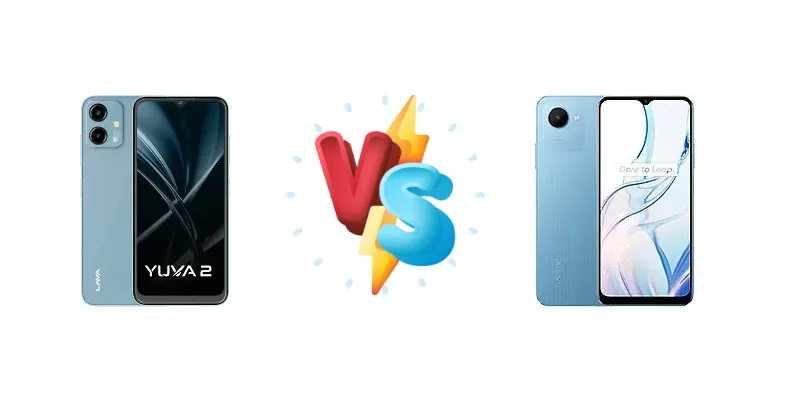
The Lava Yuva 2 and Realme C30s represent the fiercely competitive entry-level smartphone market. Both aim to deliver essential smartphone functionality at an incredibly affordable price point. However, beneath the similar price tags lie key differences in processing power that significantly impact the user experience, making a direct comparison crucial for budget-conscious buyers.
🏆 Quick Verdict
For the average user prioritizing responsiveness and multitasking, the Lava Yuva 2 is the better choice. Its Unisoc T606 chipset, featuring Cortex-A75 performance cores, offers a noticeable performance advantage over the Realme C30s’ all-Cortex-A55 CPU. While both offer identical 10W charging, the Yuva 2’s superior processing power justifies its slight price premium.
| Network |
|---|
| 2G bands | GSM 900 / 1800 | GSM 850 / 900 / 1800 / 1900 |
| 3G bands | HSDPA 900 / 2100 | HSDPA 850 / 900 / 2100 |
| 4G bands | 1, 3, 5, 8, 40, 41 | 1, 3, 5, 8, 38, 40, 41 |
| Speed | HSPA, LTE | HSPA, LTE |
| Technology | GSM / HSPA / LTE | GSM / HSPA / LTE |
| Launch |
|---|
| Announced | 2023, August 02 | 2022, September 14 |
| Status | Available. Released 2023, August 02 | Available. Released 2022, September 23 |
| Body |
|---|
| Build | Glass front, plastic frame, plastic back | Glass front, plastic frame, plastic back |
| Dimensions | 165 x 76.1 x 8.7 mm (6.50 x 3.00 x 0.34 in) | 164.2 x 75.7 x 8.5 mm (6.46 x 2.98 x 0.33 in) |
| SIM | Nano-SIM + Nano-SIM | Nano-SIM + Nano-SIM |
| Weight | 202 g (7.13 oz) | 186 g (6.56 oz) |
| Display |
|---|
| Resolution | 720 x 1600 pixels, 20:9 ratio (~270 ppi density) | 720 x 1600 pixels, 20:9 ratio (~270 ppi density) |
| Size | 6.5 inches, 102.0 cm2 (~81.2% screen-to-body ratio) | 6.5 inches, 102.0 cm2 (~82.1% screen-to-body ratio) |
| Type | IPS LCD, 90Hz | IPS LCD |
| Platform |
|---|
| CPU | Octa-core (2x1.6 GHz Cortex-A75 & 6x1.6 GHz Cortex-A55) | Octa-core 1.6 GHz Cortex-A55 |
| Chipset | Unisoc T606 (12 nm) | - |
| GPU | Mali-G57 MP1 | IMG8322 |
| OS | Android 12 | Android 12, Realme UI Go |
| Memory |
|---|
| Card slot | microSDXC (uses shared SIM slot) | microSDXC (dedicated slot) |
| Internal | 64GB 3GB RAM | 32GB 2GB RAM, 32GB 3GB RAM, 64GB 3GB RAM, 64GB 4GB RAM |
| Main Camera |
|---|
| Dual | 13 MP, (wide), AF
VGA | - |
| Features | LED flash, HDR, panorama | LED flash, HDR, panorama |
| Single | - | 8 MP, (wide), 1/4.0", 1.12µm |
| Video | 1080p@30fps | 1080p@30fps |
| Selfie camera |
|---|
| Features | - | HDR |
| Single | 5 MP | 5 MP, (wide), 1/5.0", 1.12µm |
| Video | 1080p@30fps | 720p@30fps |
| Sound |
|---|
| 3.5mm jack | - | Yes |
| 35mm jack | Yes | Yes |
| Loudspeaker | Yes | Yes |
| Comms |
|---|
| Bluetooth | 5.0, A2DP, LE | 4.2, A2DP |
| NFC | No | No |
| Positioning | GPS, GALILEO, GLONASS | GPS, GLONASS |
| Radio | FM radio | Unspecified |
| USB | USB Type-C 2.0, OTG | microUSB 2.0, OTG |
| WLAN | Wi-Fi 802.11 b/g/n/ac | Wi-Fi 802.11 b/g/n |
| Features |
|---|
| Sensors | Fingerprint (side-mounted), accelerometer, proximity | Fingerprint (side-mounted), accelerometer, proximity |
| Battery |
|---|
| Charging | 10W wired | 10W wired |
| Type | Li-Po 5000 mAh | 5000 mAh |
| Misc |
|---|
| Colors | Glass Lavender, Glass Green, Glass Blue | Stripe Blue, Stripe Black |
| Models | - | RMX3690 |
| Price | About 80 EUR | About 100 EUR |
Lava Yuva 2
- More powerful processor (Unisoc T606 with Cortex-A75 cores)
- Potentially smoother multitasking experience
- May offer slightly faster image processing
- May be slightly more expensive than the Realme C30s
- Limited information available on display specifications
Realme C30s
- Potentially lower price point
- Simple and straightforward user experience
- Compact form factor (6.5-inch display)
- Less powerful processor (all Cortex-A55 cores)
- Slower app launch times and multitasking
- Limited performance for gaming
Display Comparison
Neither Lava nor Realme provide display specifications beyond size. Given the price bracket, both likely utilize LCD panels with 720p+ resolution. The absence of details like peak brightness or color gamut makes a direct comparison impossible. However, the Realme C30s’ smaller screen size (6.5 inches vs. the Yuva 2’s 6.51 inches) *may* result in a slightly higher pixel density, though the difference is likely imperceptible to most users. Bezels are expected to be substantial on both devices.
Camera Comparison
Both phones are expected to feature basic camera setups, likely headlined by a single 8MP or 13MP main sensor. Details are scarce, but the Realme C30s often includes a secondary 2MP depth sensor, which offers minimal practical benefit. Image processing will likely be heavily reliant on software algorithms to enhance image quality. Without detailed sensor specifications or camera samples, it’s difficult to declare a clear winner; however, the Yuva 2’s more powerful processor *could* translate to slightly faster image processing times.
Performance
This is where the Yuva 2 pulls ahead. The Unisoc T606 in the Lava Yuva 2 boasts a dual-cluster CPU configuration: two Cortex-A75 cores clocked at 1.6 GHz and six Cortex-A55 cores, also at 1.6 GHz. This contrasts sharply with the Realme C30s’ octa-core CPU comprised entirely of Cortex-A55 cores at the same clock speed. The Cortex-A75 cores are significantly more powerful than the A55, resulting in faster app launch times and smoother multitasking on the Yuva 2. While both chipsets are 12nm, the architectural advantage of the A75 cores is substantial. The Realme C30s will handle basic tasks, but the Yuva 2 offers a more fluid experience.
Battery Life
Both the Lava Yuva 2 and Realme C30s are equipped with 10W wired charging. This is a slow charging standard by today’s standards, meaning a full 0-100% charge will take approximately 2.5 to 3 hours. Battery capacity is not specified for either device, but given the price point, both likely house batteries in the 5000mAh range. The slightly more efficient Unisoc T606 in the Yuva 2 *may* contribute to marginally better battery life, but the difference will likely be minimal in real-world usage.
Buying Guide
Buy the Lava Yuva 2 if you frequently switch between apps, enjoy light gaming, or need a phone that feels more responsive overall. The Unisoc T606 provides a tangible boost in performance for everyday tasks. Buy the Realme C30s if your primary needs are basic communication – calls, texts, and light social media – and you prioritize simplicity and potentially a slightly lower initial cost. It’s a functional device for minimal smartphone usage.
Frequently Asked Questions
❓ Will the Lava Yuva 2 handle popular games like PUBG Mobile or Call of Duty?
While the Lava Yuva 2 can *run* these games, expect to play them at the lowest graphics settings and potentially with frame rate drops. The Unisoc T606 isn't a gaming powerhouse, and these titles are demanding. The Realme C30s would struggle even more.
❓ Is the 10W charging speed acceptable for daily use on either phone?
10W charging is slow by modern standards. Both phones will require over 2.5 hours for a full charge. It's best to charge overnight. Neither device offers fast charging capabilities.
❓ How much storage do these phones typically come with, and is it expandable?
Both phones typically ship with 32GB or 64GB of internal storage. Crucially, both support microSD card expansion, allowing you to add up to 512GB or 1TB of additional storage for photos, videos, and apps.
❓ What version of Android do these phones run, and will they receive software updates?
Both devices likely run Android Go Edition, a lightweight version of Android designed for devices with limited RAM. Software update support is typically limited on phones in this price range; don't expect major Android version upgrades.