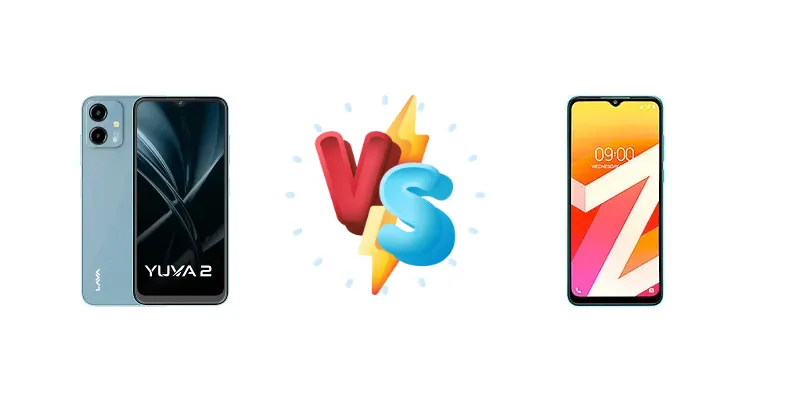
Lava is aggressively targeting the entry-level smartphone market with the Yuva 2 and Z6. Both devices aim to deliver essential features at incredibly competitive prices. However, they diverge significantly in their core processing power, making the choice less straightforward than it appears. This comparison dissects the key differences to determine which phone offers the best value for your money.
🏆 Quick Verdict
For the average user prioritizing consistent performance and a slightly more modern architecture, the Lava Yuva 2 emerges as the better choice. Its Unisoc T606 chipset, while not a powerhouse, offers a more balanced CPU configuration than the Lava Z6’s Helio G35, resulting in smoother multitasking and app loading.
| Network |
|---|
| 2G bands | GSM 900 / 1800 | GSM 900 / 1800 |
| 3G bands | HSDPA 900 / 2100 | HSDPA 900 / 2100 |
| 4G bands | 1, 3, 5, 8, 40, 41 | 1, 3, 5, 8, 40, 41 |
| Speed | HSPA, LTE | HSPA 42.2/5.76 Mbps, LTE Cat4 150/50 Mbps |
| Technology | GSM / HSPA / LTE | GSM / HSPA / LTE |
| Launch |
|---|
| Announced | 2023, August 02 | 2021, January 07 |
| Status | Available. Released 2023, August 02 | Available. Released 2021, January 11 |
| Body |
|---|
| Build | Glass front, plastic frame, plastic back | Glass front, plastic back, plastic frame |
| Dimensions | 165 x 76.1 x 8.7 mm (6.50 x 3.00 x 0.34 in) | 164.5 x 75.8 x 9 mm (6.48 x 2.98 x 0.35 in) |
| SIM | Nano-SIM + Nano-SIM | Nano-SIM + Nano-SIM |
| Weight | 202 g (7.13 oz) | 190 g (6.70 oz) |
| Display |
|---|
| Protection | - | Corning Gorilla Glass 3 |
| Resolution | 720 x 1600 pixels, 20:9 ratio (~270 ppi density) | 720 x 1600 pixels, 20:9 ratio (~270 ppi density) |
| Size | 6.5 inches, 102.0 cm2 (~81.2% screen-to-body ratio) | 6.51 inches, 102.3 cm2 (~82.1% screen-to-body ratio) |
| Type | IPS LCD, 90Hz | IPS LCD |
| Platform |
|---|
| CPU | Octa-core (2x1.6 GHz Cortex-A75 & 6x1.6 GHz Cortex-A55) | Octa-core (4x2.3 GHz Cortex-A53 & 4x1.8 GHz Cortex-A53) |
| Chipset | Unisoc T606 (12 nm) | Mediatek MT6765G Helio G35 (12 nm) |
| GPU | Mali-G57 MP1 | PowerVR GE8320 |
| OS | Android 12 | Android 10 |
| Memory |
|---|
| Card slot | microSDXC (uses shared SIM slot) | microSDXC (dedicated slot) |
| Internal | 64GB 3GB RAM | 64GB 6GB RAM |
| | - | eMMC 5.1 |
| Main Camera |
|---|
| Dual | 13 MP, (wide), AF
VGA | - |
| Features | LED flash, HDR, panorama | LED flash |
| Triple | - | 13 MP, f/1.9, (wide), 1/3.0", 1.12µm, AF
5 MP, (ultrawide)
Auxiliary lens |
| Video | 1080p@30fps | 1080p@30fps |
| Selfie camera |
|---|
| Features | - | LED flash |
| Single | 5 MP | 16 MP, f/2.0, (wide), 1/3.06" 1.0µm |
| Video | 1080p@30fps | 1080p@30fps |
| Sound |
|---|
| 3.5mm jack | - | Yes |
| 35mm jack | Yes | Yes |
| Loudspeaker | Yes | Yes |
| Comms |
|---|
| Bluetooth | 5.0, A2DP, LE | 5.0, A2DP, LE |
| NFC | No | No |
| Positioning | GPS, GALILEO, GLONASS | GPS |
| Radio | FM radio | FM radio |
| USB | USB Type-C 2.0, OTG | USB Type-C |
| WLAN | Wi-Fi 802.11 b/g/n/ac | Wi-Fi 802.11 b/g/n, Wi-Fi Direct |
| Features |
|---|
| Sensors | Fingerprint (side-mounted), accelerometer, proximity | Fingerprint (rear-mounted), accelerometer, proximity |
| Battery |
|---|
| Charging | 10W wired | - |
| Type | Li-Po 5000 mAh | Li-Po 5000 mAh |
| Misc |
|---|
| Colors | Glass Lavender, Glass Green, Glass Blue | Blue, Red |
| Models | - | LMX06 |
| Price | About 80 EUR | About 110 EUR |
Lava Yuva 2
- More modern CPU architecture (Cortex-A75)
- Potentially better power efficiency
- Smoother multitasking experience
- Lower peak CPU clock speeds
- 10W charging is slow
Lava Z6
- Higher CPU clock speeds (potentially better for some games)
- Aggressive pricing
- 10W charging is standard for the segment
- Older CPU architecture (Cortex-A53)
- Less efficient CPU
- May exhibit more lag during multitasking
Display Comparison
Neither Lava provides detailed display specifications beyond resolution. Given the price point, both likely utilize IPS LCD panels. The absence of information regarding peak brightness, color gamut coverage, or refresh rates suggests a focus on cost reduction. Bezels are expected to be substantial on both devices. Without further data, a clear winner cannot be determined; display quality will likely be similar and adequate for basic use.
Camera Comparison
Both phones likely feature basic camera setups geared towards casual photography. Without detailed sensor information, it’s difficult to make a definitive comparison. The presence of a 2MP macro camera on either device is largely a marketing tactic, offering limited practical benefit. Image quality will heavily rely on software processing, and neither phone is expected to excel in low-light conditions. The absence of OIS (Optical Image Stabilization) on both devices suggests reliance on digital stabilization, which can introduce artifacts.
Performance
The core difference lies in the chipsets. The Lava Yuva 2’s Unisoc T606 features a 12nm process and an octa-core configuration with 2x 1.6 GHz Cortex-A75 cores and 6x 1.6 GHz Cortex-A55 cores. This architecture provides a more modern and efficient foundation than the Lava Z6’s MediaTek Helio G35. The G35 utilizes a 12nm process but employs 4x 2.3 GHz Cortex-A53 cores and 4x 1.8 GHz Cortex-A53 cores. While the G35 boasts higher clock speeds on its cores, the older Cortex-A53 architecture is less efficient and offers lower IPC (Instructions Per Clock) than the A75 cores in the Yuva 2. This translates to better multitasking and app responsiveness on the Yuva 2, despite the lower clock speeds. The Yuva 2's CPU is better suited for sustained workloads.
Battery Life
Both devices feature 10W wired charging, indicating a similar charging experience. Battery capacity is not specified, but given the target market, both are likely in the 4000-5000 mAh range. The Unisoc T606 in the Yuva 2 is generally more power-efficient than the Helio G35 in the Z6. This efficiency advantage, combined with potentially optimized software, could translate to slightly longer battery life for the Yuva 2, despite any potential differences in battery capacity.
Buying Guide
Buy the Lava Yuva 2 if you need a phone for everyday tasks like calling, messaging, social media, and light web browsing, and value a more responsive user experience. Buy the Lava Z6 if your primary concern is maximizing gaming performance on a very tight budget, understanding that this may come at the cost of overall system smoothness and efficiency. The Z6's higher clocked Cortex-A53 cores *may* provide a slight edge in some gaming scenarios, but the Yuva 2's architecture is more efficient.
Frequently Asked Questions
❓ Will the Helio G35 in the Lava Z6 struggle with demanding games like PUBG Mobile?
While the Helio G35 can run PUBG Mobile, expect to play at lower graphics settings and potentially experience frame drops, especially during intense action. The older Cortex-A53 cores and limited GPU power are a bottleneck. The Yuva 2, while not a gaming phone, will likely offer a more consistent, albeit lower, frame rate due to its more efficient architecture.
❓ Is the 10W charging on either phone sufficient for daily use?
10W charging is slow by modern standards, and both the Lava Yuva 2 and Z6 will take several hours to fully charge. This is typical for phones in this price segment. Plan to charge overnight to ensure a full battery for the next day. Neither phone supports fast charging technologies.
❓ Which phone is better for running multiple apps simultaneously?
The Lava Yuva 2 is significantly better suited for multitasking. The Unisoc T606’s Cortex-A75 cores and more efficient architecture handle multiple apps more smoothly than the Lava Z6’s Helio G35. Expect less lag and app reloading on the Yuva 2.