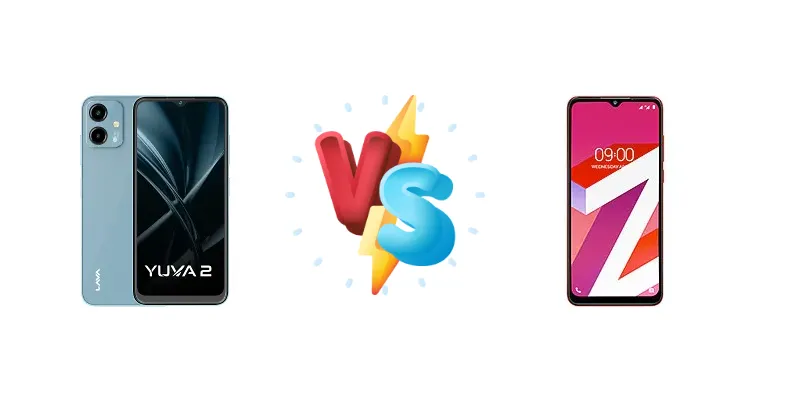
Lava is aggressively targeting the entry-level smartphone market with the Yuva 2 and Z4. Both devices aim to deliver essential features at incredibly competitive prices. However, they diverge significantly in their core processing power, making the choice less straightforward than it appears. This comparison dissects the key differences to determine which phone offers the best value for your money.
🏆 Quick Verdict
For the average user prioritizing consistent performance and a slightly more modern architecture, the Lava Yuva 2 emerges as the better choice. Its Unisoc T606 chipset, while not a powerhouse, offers a more balanced CPU configuration than the Z4’s Helio G35, resulting in smoother multitasking and app loading.
| Network |
|---|
| 2G bands | GSM 900 / 1800 | GSM 900 / 1800 |
| 3G bands | HSDPA 900 / 2100 | HSDPA 900 / 2100 |
| 4G bands | 1, 3, 5, 8, 40, 41 | 1, 3, 5, 8, 40, 41 |
| Speed | HSPA, LTE | HSPA 42.2/5.76 Mbps, LTE Cat4 150/50 Mbps |
| Technology | GSM / HSPA / LTE | GSM / HSPA / LTE |
| Launch |
|---|
| Announced | 2023, August 02 | 2021, January 07 |
| Status | Available. Released 2023, August 02 | Available. Released 2021, January 11 |
| Body |
|---|
| Build | Glass front, plastic frame, plastic back | Glass front, plastic back, plastic frame |
| Dimensions | 165 x 76.1 x 8.7 mm (6.50 x 3.00 x 0.34 in) | 164.5 x 75.8 x 9 mm (6.48 x 2.98 x 0.35 in) |
| SIM | Nano-SIM + Nano-SIM | Nano-SIM + Nano-SIM |
| Weight | 202 g (7.13 oz) | 190 g (6.70 oz) |
| Display |
|---|
| Protection | - | Corning Gorilla Glass 3 |
| Resolution | 720 x 1600 pixels, 20:9 ratio (~270 ppi density) | 720 x 1600 pixels, 20:9 ratio (~270 ppi density) |
| Size | 6.5 inches, 102.0 cm2 (~81.2% screen-to-body ratio) | 6.51 inches, 102.3 cm2 (~82.1% screen-to-body ratio) |
| Type | IPS LCD, 90Hz | IPS LCD |
| Platform |
|---|
| CPU | Octa-core (2x1.6 GHz Cortex-A75 & 6x1.6 GHz Cortex-A55) | Octa-core (4x2.3 GHz Cortex-A53 & 4x1.8 GHz Cortex-A53) |
| Chipset | Unisoc T606 (12 nm) | Mediatek MT6765G Helio G35 (12 nm) |
| GPU | Mali-G57 MP1 | PowerVR GE8320 |
| OS | Android 12 | Android 10 |
| Memory |
|---|
| Card slot | microSDXC (uses shared SIM slot) | microSDXC (dedicated slot) |
| Internal | 64GB 3GB RAM | 64GB 4GB RAM |
| | - | eMMC 5.1 |
| Main Camera |
|---|
| Dual | 13 MP, (wide), AF
VGA | - |
| Features | LED flash, HDR, panorama | LED flash |
| Single | - | 13 MP, f/2.0 AF |
| Triple | - | 13 MP, f/1.9, (wide), 1/3.0", 1.12µm, AF
5 MP, (ultrawide)
Auxiliary lens |
| Video | 1080p@30fps | 1080p@30fps |
| Selfie camera |
|---|
| Features | - | LED flash |
| Single | 5 MP | 16 MP, f/2.0, (wide), 1/3.06" 1.0µm |
| Video | 1080p@30fps | 1080p@30fps |
| Sound |
|---|
| 3.5mm jack | - | Yes |
| 35mm jack | Yes | Yes |
| Loudspeaker | Yes | Yes |
| Comms |
|---|
| Bluetooth | 5.0, A2DP, LE | 5.0, A2DP, LE |
| NFC | No | No |
| Positioning | GPS, GALILEO, GLONASS | GPS |
| Radio | FM radio | FM radio |
| USB | USB Type-C 2.0, OTG | USB Type-C |
| WLAN | Wi-Fi 802.11 b/g/n/ac | Wi-Fi 802.11 b/g/n, Wi-Fi Direct |
| Features |
|---|
| Sensors | Fingerprint (side-mounted), accelerometer, proximity | Fingerprint (rear-mounted), accelerometer, proximity |
| Battery |
|---|
| Charging | 10W wired | - |
| Stand-by | - | Up to 270 h |
| Talk time | - | Up to 24 h (2G) / Up to 15 h 30 min (3G) |
| Type | Li-Po 5000 mAh | Li-Po 5000 mAh |
| Misc |
|---|
| Colors | Glass Lavender, Glass Green, Glass Blue | Blue, Red |
| Models | - | S7 |
| Price | About 80 EUR | About 100 EUR |
| SAR | - | 0.52 W/kg (head) 0.64 W/kg (body) |
Lava Yuva 2
- More modern CPU architecture (Cortex-A75)
- Potentially smoother multitasking
- Likely better image processing
- 10W charging is slow
- Display specs are unknown
Lava Z4
- Potentially longer battery life during light use
- Lower price (likely)
- Simple and straightforward operation
- Older, less efficient CPU architecture (Cortex-A53)
- May struggle with demanding apps
- Potentially slower app loading times
Display Comparison
Neither Lava provides detailed display specifications beyond resolution. However, given the price point, both likely utilize IPS LCD panels. The real difference lies in the processing power driving the display. A smoother UI experience on the Yuva 2, thanks to the T606, will translate to more fluid animations and transitions, even if the panels themselves are similar in quality. Expect both to struggle in direct sunlight.
Camera Comparison
Both phones are expected to feature basic camera setups. Without detailed sensor information, it’s difficult to make a definitive judgment. However, the chipset’s image signal processor (ISP) plays a crucial role. The Unisoc T606 in the Yuva 2 likely has a more capable ISP than the Helio G35 in the Z4, potentially leading to better image processing, especially in low-light conditions. Expect both to struggle with dynamic range and detail in challenging lighting scenarios. The presence of a 2MP macro lens on either device is largely a marketing gimmick and should not be a deciding factor.
Performance
The core battleground is the chipset. The Lava Yuva 2’s Unisoc T606 features a 2x Cortex-A75 and 6x Cortex-A55 configuration, offering a more modern and efficient architecture than the Lava Z4’s MediaTek Helio G35. The G35 relies on 4x Cortex-A53 cores at a higher clock speed (2.3 GHz) alongside another 4x Cortex-A53 cores at 1.8 GHz. While the G35’s higher clock speed *appears* advantageous, the older A53 architecture is significantly less efficient per clock cycle. This means the Yuva 2 will likely handle multitasking and demanding apps more gracefully, despite the lower peak clock speeds. The T606’s architecture is better suited for sustained workloads.
Battery Life
Battery capacity isn’t specified, but both phones likely house batteries in the 4000-5000 mAh range, typical for this price segment. The Lava Z4, with its less power-hungry Helio G35, *could* potentially offer slightly longer battery life during very light usage. However, the Yuva 2’s more efficient chipset will minimize power drain during typical use. Both phones are limited to 10W charging, meaning a full charge will take a considerable amount of time – expect several hours from 0 to 100%.
Buying Guide
Buy the Lava Yuva 2 if you need a phone for everyday tasks like calling, messaging, social media, and light web browsing, and value a more responsive user experience. Buy the Lava Z4 if your primary concern is maximizing battery life during very basic usage, and you are willing to accept some performance compromises for potentially longer runtimes between charges. The Z4 is best suited for first-time smartphone users or those with extremely limited needs.
Frequently Asked Questions
❓ Will the Lava Yuva 2 handle popular games like PUBG Mobile or Call of Duty?
While the Unisoc T606 can run these games, expect to play at the lowest graphics settings and potentially with frame rate drops. The chipset isn't designed for intensive gaming, and sustained performance will likely be limited. The Lava Z4 will struggle even more with these titles.
❓ Is the 10W charging a significant drawback on both phones?
Yes, 10W charging is quite slow by modern standards. Expect a full charge to take 3-4 hours. This is a compromise made to keep the price low, and it's something to consider if you frequently need to top up your battery quickly.
❓ Which phone is better for someone who primarily uses WhatsApp and makes calls?
For basic communication, both phones are adequate. However, the Lava Yuva 2’s smoother performance will make the overall experience more pleasant, even for simple tasks like opening apps and scrolling through contacts.
❓ Does either phone support VoLTE or VoWiFi?
Given the target market, both phones likely support VoLTE (Voice over LTE) for improved call quality. VoWiFi (Voice over Wi-Fi) support is less certain and would depend on carrier compatibility. Check with your mobile provider for specific details.