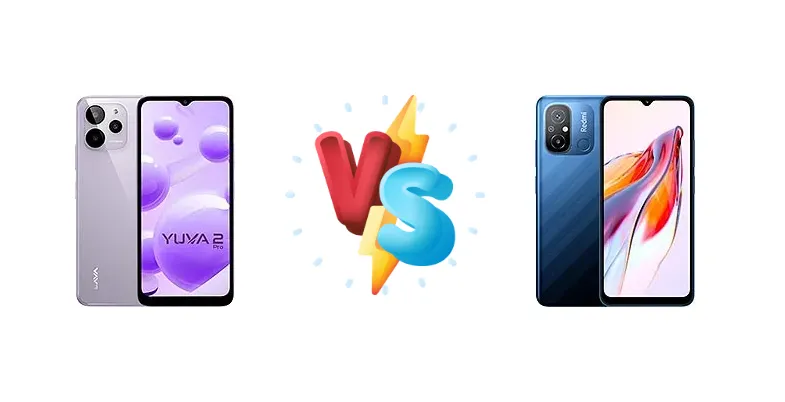
The budget smartphone market is fiercely competitive, offering incredible value for money. Two contenders vying for your attention are the Lava Yuva 2 Pro and the Xiaomi Redmi 12C. But which one delivers the best experience for your needs and budget? Let's dive in and find out.
🏆 Quick Verdict
The Xiaomi Redmi 12C edges out the Lava Yuva 2 Pro thanks to its significantly more powerful Helio G85 chipset, resulting in smoother performance and better gaming capabilities. Both offer decent battery life and basic features, but the Redmi 12C provides a more compelling overall package.
| Network |
|---|
| 2G bands | GSM 900 / 1800 | GSM 850 / 900 / 1800 / 1900 |
| 3G bands | HSDPA 900 / 2100 | HSDPA 850 / 900 / 2100 |
| 4G bands | 1, 3, 5, 8, 40, 41 | 1, 3, 5, 7, 8, 20, 28, 38, 40, 41 - International |
| Speed | HSPA, LTE | HSPA, LTE |
| Technology | GSM / HSPA / LTE | GSM / CDMA / HSPA / EVDO / LTE |
| | - | CDMA2000 1xEV-DO |
| Launch |
|---|
| Announced | 2023, February 22 | 2022, December 31 |
| Status | Available. Released 2023, February 22 | Available. Released 2023, January 01 |
| Body |
|---|
| Dimensions | 164.5 x 76 x 9 mm (6.48 x 2.99 x 0.35 in) | 168.8 x 76.4 x 8.8 mm (6.65 x 3.01 x 0.35 in) |
| SIM | Nano-SIM + Nano-SIM | Nano-SIM + Nano-SIM |
| Weight | 204 g (7.20 oz) | 192 g (6.77 oz) |
| Display |
|---|
| Resolution | 720 x 1600 pixels, 20:9 ratio (~269 ppi density) | 720 x 1650 pixels (~268 ppi density) |
| Size | 6.52 inches, 102.6 cm2 (~82.1% screen-to-body ratio) | 6.71 inches, 106.5 cm2 (~82.6% screen-to-body ratio) |
| Type | IPS LCD | IPS LCD, 500 nits (typ) |
| Platform |
|---|
| CPU | Octa-core (4x2.3 GHz Cortex-A53 & 4x1.8 GHz Cortex-A53) | Octa-core (2x2.0 GHz Cortex-A75 & 6x1.8 GHz Cortex-A55) |
| Chipset | Mediatek MT6765 Helio G37 (12 nm) | Mediatek MT6769Z Helio G85 (12 nm) |
| GPU | PowerVR GE8320 | Mali-G52 MC2 |
| OS | Android 12 | Android 12, MIUI 13 |
| Memory |
|---|
| Card slot | microSDXC (dedicated slot) | microSDXC (dedicated slot) |
| Internal | 64GB 4GB RAM | 32GB 2GB RAM, 32GB 3GB RAM, 32GB 4GB RAM, 64GB 3GB RAM, 64GB 4GB RAM, 128GB 3GB RAM, 128GB 4GB RAM, 128GB 6GB RAM |
| | eMMC 5.1 | eMMC 5.1 |
| Main Camera |
|---|
| Dual | - | 50 MP, (wide), PDAF
0.08 MP (depth) |
| Features | LED flash | LED flash, HDR |
| Single | 5 MP | 50 MP, f/1.8, (wide), 1/2.76", PDAF
Auxiliary lens |
| Triple | 13 MP, (wide), AF
VGA
VGA | - |
| Video | 1080p@30fps | 1080p@30fps |
| Selfie camera |
|---|
| Single | 5 MP | 5 MP, f/2.2, (wide) |
| Video | Yes | 1080p@30fps |
| Sound |
|---|
| 3.5mm jack | Yes | Yes |
| 35mm jack | Yes | Yes |
| Loudspeaker | Yes | Yes |
| Comms |
|---|
| Bluetooth | 5.1, A2DP, LE | 5.1, A2DP, LE |
| NFC | No | Yes (market/region dependent) |
| Positioning | GPS | GPS, GLONASS, BDS, GALILEO |
| Radio | FM radio | FM radio |
| USB | USB Type-C 2.0, OTG | microUSB 2.0 |
| WLAN | Wi-Fi 802.11 b/g/n/ac | Wi-Fi 802.11 a/b/g/n/ac, dual-band, Wi-Fi Direct |
| Features |
|---|
| Sensors | Fingerprint (side-mounted), accelerometer, proximity | Fingerprint (rear-mounted), accelerometer |
| | - | Virtual proximity sensing |
| Battery |
|---|
| Charging | 10W wired | 10W wired |
| Type | Li-Po 5000 mAh | Li-Po 5000 mAh |
| Misc |
|---|
| Colors | Glass Lavender, Glass Green, Glass White | Graphite Gray, Ocean Blue, Mint Green, Lavender Purple |
| Models | LZX408 | 22120RN86G, 22120RN86I, 22126RN91Y, 2212ARNC4L |
| Price | About 90 EUR | £ 132.99 / € 107.41 |
| SAR | - | 1.08 W/kg (head) 0.64 W/kg (body) |
| SAR EU | - | 0.98 W/kg (head) 0.99 W/kg (body) |
Lava Yuva 2 Pro
- Affordable
- Reliable for basic tasks
- Decent battery life
- Underpowered chipset
- Slow charging
- Basic camera performance
Xiaomi Redmi 12C
- Better performance (Helio G85)
- Slightly better camera processing
- More feature-rich software
- 10W charging is slow
- HD+ display isn't the sharpest
- Plastic build
Display Comparison
Both phones likely feature similar LCD displays, probably around 6.5 inches with an HD+ resolution. Expect decent viewing angles and color accuracy for everyday use, but don't anticipate flagship-level vibrancy or sharpness. The Redmi 12C might have a slightly better panel due to Xiaomi's generally higher display quality standards.
Camera Comparison
Camera specs are likely similar, with both phones probably featuring a 50MP main sensor and a depth sensor. Image quality will depend heavily on software processing. The Redmi 12C's superior processor might allow for slightly better image processing and potentially better low-light performance. Expect decent daytime shots from both.
Performance
This is where the Redmi 12C shines. The Helio G85 is a noticeable upgrade over the Helio G37. Expect smoother multitasking, faster app loading times, and a more enjoyable gaming experience on the Redmi 12C. The Yuva 2 Pro will handle basic tasks adequately, but may struggle with demanding apps or games.
Battery Life
Both phones are expected to have a 5000mAh battery, offering all-day battery life for moderate users. Charging speeds are identical at 10W, which is relatively slow by today's standards.
Buying Guide
The Lava Yuva 2 Pro is a good option for users prioritizing a simple, reliable phone for basic tasks like calling, texting, and light browsing. The Xiaomi Redmi 12C is ideal for those seeking a more responsive experience, better gaming performance, and a slightly more feature-rich device without breaking the bank.
Frequently Asked Questions
❓ Which phone is better for gaming?
The Xiaomi Redmi 12C is significantly better for gaming due to its more powerful Helio G85 chipset.
❓ Do both phones have a fingerprint sensor?
Generally, both phones are expected to have a rear-mounted fingerprint sensor, but confirm specific model details before purchasing.
❓ What is the storage capacity of each phone?
Storage options typically range from 32GB to 128GB, often with microSD card support. Check the specific variant you are considering.