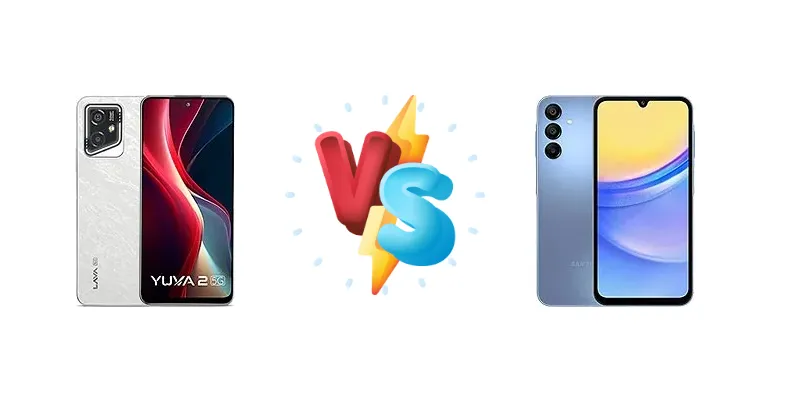
The sub-$200 5G smartphone market is heating up, with the Lava Yuva 2 5G and Samsung Galaxy A15 5G vying for dominance. Both aim to deliver 5G connectivity at an accessible price, but they take different approaches to achieve this. This comparison dives deep into their specifications to determine which device offers the best overall experience.
🏆 Quick Verdict
For the average user prioritizing display quality and sustained performance, the Samsung Galaxy A15 5G emerges as the better choice. Its brighter display and more efficient Dimensity 6100+ chipset provide a smoother, more enjoyable experience, despite the Lava Yuva 2 5G’s competitive pricing.
| Network |
|---|
| 2G bands | GSM 850 / 900 / 1800 / 1900 | GSM 850 / 900 / 1800 / 1900 |
| 3G bands | HSDPA 900 / 2100 | HSDPA 850 / 900 / 1700(AWS) / 1900 / 2100 |
| 4G bands | 1, 3, 5, 8, 28, 40, 41 | 1, 2, 3, 4, 5, 7, 8, 12, 17, 20, 26, 28, 38, 40, 41, 66 |
| 5G bands | 1, 3, 5, 8, 28, 40, 41, 77, 78 SA/NSA | 1, 3, 5, 7, 8, 26, 28, 40, 41, 66, 77, 78 SA/NSA/Sub6 |
| Speed | HSPA, LTE, 5G | HSPA, LTE, 5G |
| Technology | GSM / HSPA / LTE / 5G | GSM / HSPA / LTE / 5G |
| Launch |
|---|
| Announced | 2024, December 27 | 2023, December 11 |
| Status | Available. Released 2025, January | Available. Released 2023, December 16 |
| Body |
|---|
| Build | - | Glass front, plastic back, plastic frame |
| Dimensions | 165 x 75.8 x 8.7 mm (6.50 x 2.98 x 0.34 in) | 160.1 x 76.8 x 8.4 mm (6.30 x 3.02 x 0.33 in) |
| SIM | Nano-SIM + Nano-SIM | · Nano-SIM· Nano-SIM + Nano-SIM |
| Weight | 190 g (6.70 oz) | 200 g (7.05 oz) |
| Display |
|---|
| Resolution | 720 x 1612 pixels, 20:9 ratio (~265 ppi density) | 1080 x 2340 pixels, 19.5:9 ratio (~396 ppi density) |
| Size | 6.67 inches, 106.9 cm2 (~85.5% screen-to-body ratio) | 6.5 inches, 103.7 cm2 (~84.3% screen-to-body ratio) |
| Type | IPS LCD, 90Hz, 700 nits | Super AMOLED, 90Hz, 800 nits (HBM) |
| Platform |
|---|
| CPU | Octa-core (1x2.2 GHz Cortex-A76 & 3x Cortex-A76 & 4x Cortex-A55) | Octa-core (2x2.2 GHz Cortex-A76 & 6x2.0 GHz Cortex-A55) |
| Chipset | Unisoc T760 (6 nm) | Mediatek Dimensity 6100+ (6 nm) |
| GPU | Mali-G57 | Mali-G57 MC2 |
| OS | Android 14 | Android 14, upgradable to Android 16, One UI 8, up to 4 major Android upgrades |
| Memory |
|---|
| Card slot | microSDXC | microSDXC (uses shared SIM slot) |
| Internal | 128GB 4GB RAM | 64GB 4GB RAM, 128GB 4GB RAM, 128GB 6GB RAM, 128GB 8GB RAM, 256GB 8GB RAM |
| Main Camera |
|---|
| Dual | 50 MP, (wide), AF
2 MP (macro) | - |
| Features | LED flash, HDR, panorama | LED flash, panorama, HDR |
| Triple | - | 50 MP, f/1.8, (wide), AF
5 MP, f/2.2, (ultrawide)
2 MP (macro) |
| Video | 1080p@30fps | 1080p@30fps, gyro-EIS |
| Selfie camera |
|---|
| Single | 8 MP | 13 MP, f/2.0, (wide) |
| Video | 1080p@30fps | 1080p@30fps |
| Sound |
|---|
| 35mm jack | Yes | Yes |
| Loudspeaker | Yes, with stereo speakers | Yes |
| Comms |
|---|
| Bluetooth | 5.2, A2DP, LE | 5.3, A2DP, LE |
| NFC | No | Yes (market/region dependent) |
| Positioning | GPS | GPS, GALILEO, GLONASS, BDS, QZSS |
| Radio | FM radio | No |
| USB | USB Type-C 2.0, OTG | USB Type-C 2.0 |
| WLAN | Wi-Fi 802.11 a/b/g/n | Wi-Fi 802.11 a/b/g/n/ac, dual-band, Wi-Fi Direct |
| Features |
|---|
| Sensors | Fingerprint (side-mounted), accelerometer, proximity, compass | Fingerprint (side-mounted), accelerometer, gyro, compass |
| Battery |
|---|
| Charging | 18W wired | 25W wired |
| Type | Li-Po 5000 mAh | 5000 mAh |
| Misc |
|---|
| Colors | Marble Black, Marble White | Brave Black, Personality Yellow, Magical Blue, Optimistic Blue |
| Models | - | SM-A156B, SM-A156B/DS, SM-A156P, SM-A156P/DS, SM-A156U, SM-A156U1, SM-A156U1/DS, SM-A156W, SM-A156P/N, SM-A156P/DSN, SM-S156VL, SM-A156M, SM-A156E, SM-A156E/DSN |
| Price | About 110 EUR | € 167.00 / $ 79.97 / ₹ 17,490 |
| SAR EU | - | 0.80 W/kg (head) 1.46 W/kg (body) |
Lava Yuva 2 5G
- More affordable price point
- 5G connectivity
- Decent performance for basic tasks
- Lower display brightness
- Less powerful chipset
- Slower charging speed
Samsung Galaxy A15 5G
- Brighter, more vibrant display
- More powerful and efficient chipset
- Faster charging
- Longer battery life
- Higher price
- May still lack advanced features found in higher-end phones
Display Comparison
The Samsung Galaxy A15 5G boasts a significantly brighter display, reaching a measured 786 nits. This is crucial for outdoor visibility, a clear advantage over the Lava Yuva 2 5G, whose peak brightness is not specified but is likely lower given its price point. While both likely utilize LCD panels, the A15’s higher brightness translates to a more usable experience in direct sunlight. The A15’s larger screen size (6.6 inches vs. the Yuva 2’s 6.5 inches) also contributes to a more immersive viewing experience.
Camera Comparison
Detailed camera specs are limited for both devices. However, focusing on the core components, the Galaxy A15 5G likely benefits from Samsung’s superior image processing algorithms. While both phones likely feature a primary camera, the A15’s overall system is expected to deliver more consistent and detailed images. The presence of a 50MP main sensor on the A15 (based on typical Samsung A-series configurations) suggests a larger sensor size than the Yuva 2, improving low-light performance. The 2MP macro cameras on both devices are largely marketing features and offer limited practical value.
Performance
Both phones employ 6nm chipsets, but the Mediatek Dimensity 6100+ in the Galaxy A15 5G holds a performance edge. While both CPUs feature two Cortex-A76 cores clocked at 2.2 GHz, the A15’s configuration of 6x2.0 GHz Cortex-A55 cores versus the Yuva 2’s 4x Cortex-A55 cores provides a boost in multi-core performance. The Dimensity 6100+ also benefits from a more modern GPU architecture, resulting in smoother graphics rendering. The Yuva 2’s Unisoc T760, while capable, is geared towards efficiency rather than raw power. This difference will be noticeable in demanding games and multitasking scenarios.
Battery Life
The Samsung Galaxy A15 5G demonstrates a clear advantage in battery life, achieving 14:31 hours of active use. While the Lava Yuva 2 5G’s battery capacity isn’t specified, the A15’s combination of a more efficient chipset and optimized software results in significantly longer screen-on time. The A15 also supports 25W wired charging, considerably faster than the Yuva 2’s 18W charging, reducing downtime between charges. This faster charging is particularly beneficial given the A15’s higher screen brightness and more demanding processor.
Buying Guide
Buy the Lava Yuva 2 5G if you need a highly affordable 5G phone and are willing to compromise on display brightness and sustained performance. It’s ideal for basic tasks and occasional 5G use. Buy the Samsung Galaxy A15 5G if you prioritize a brighter, more vibrant display, longer battery life during active use, and a chipset capable of handling more demanding applications without significant throttling.
Frequently Asked Questions
❓ Is the Unisoc T760 in the Lava Yuva 2 5G sufficient for playing PUBG Mobile?
The Unisoc T760 can run PUBG Mobile, but expect to play at lower graphics settings to maintain a stable frame rate. The chipset prioritizes efficiency, and prolonged gaming sessions may result in noticeable thermal throttling. The Samsung Galaxy A15 5G with its Dimensity 6100+ will offer a smoother and more consistent gaming experience.
❓ Does the Samsung Galaxy A15 5G support VoWiFi (WiFi Calling)?
Samsung Galaxy A-series phones generally support VoWiFi, but compatibility depends on your carrier. Check with your mobile provider to confirm if VoWiFi is enabled on their network and supported on the Galaxy A15 5G. This feature allows you to make and receive calls over a WiFi connection when cellular signal is weak or unavailable.
❓ What type of storage does the Lava Yuva 2 5G use, and is it expandable?
While specific storage details aren't provided, budget phones like the Lava Yuva 2 5G typically use UFS 2.2 storage. It likely includes a dedicated microSD card slot for storage expansion, allowing you to add more space for photos, videos, and other files. Check the product specifications for the maximum supported microSD card capacity.