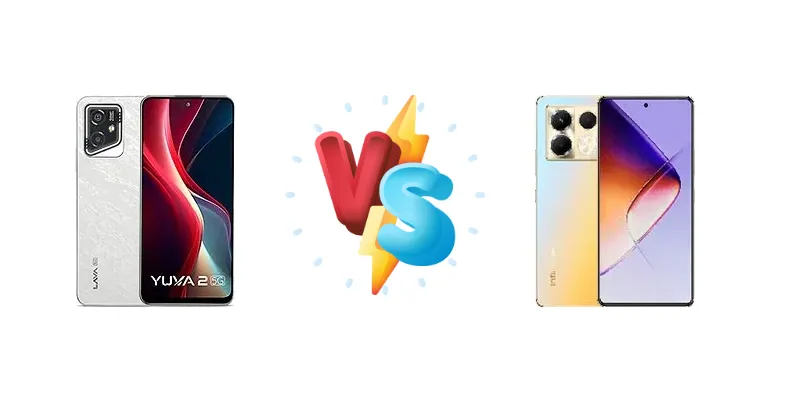
The sub-$15,000 5G smartphone segment is heating up. The Lava Yuva 2 5G offers a compelling entry point, while the Infinix Note 40 5G aims to deliver a more premium experience with faster charging and a more powerful chipset. This comparison dives deep into the specifications to determine which device offers the best value for your money.
🏆 Quick Verdict
For the average user prioritizing performance and future-proofing, the Infinix Note 40 5G is the clear winner. Its Mediatek Dimensity 7020 chipset provides a significant performance uplift over the Lava Yuva 2 5G’s Unisoc T760, coupled with significantly faster 33W charging and the added convenience of wireless charging.
| Network |
|---|
| 2G bands | GSM 850 / 900 / 1800 / 1900 | GSM 850 / 900 / 1800 / 1900 |
| 3G bands | HSDPA 900 / 2100 | HSDPA 850 / 900 / 1700(AWS) / 1900 / 2100 |
| 4G bands | 1, 3, 5, 8, 28, 40, 41 | 1, 2, 3, 4, 5, 7, 8, 12, 17, 20, 28, 38, 40, 41, 42, 66 |
| 5G bands | 1, 3, 5, 8, 28, 40, 41, 77, 78 SA/NSA | 1, 3, 5, 7, 8, 12, 20, 28, 38, 40, 41, 66, 77, 78 SA/NSA |
| Speed | HSPA, LTE, 5G | HSPA, LTE, 5G |
| Technology | GSM / HSPA / LTE / 5G | GSM / HSPA / LTE / 5G |
| Launch |
|---|
| Announced | 2024, December 27 | 2024, May 22 |
| Status | Available. Released 2025, January | Available. Released 2024, May 22 |
| Body |
|---|
| Dimensions | 165 x 75.8 x 8.7 mm (6.50 x 2.98 x 0.34 in) | 165.5 x 75.9 x 7.9 mm (6.52 x 2.99 x 0.31 in) |
| SIM | Nano-SIM + Nano-SIM | Nano-SIM + Nano-SIM |
| Weight | 190 g (6.70 oz) | 185 g (6.53 oz) |
| Display |
|---|
| Resolution | 720 x 1612 pixels, 20:9 ratio (~265 ppi density) | 1080 x 2436 pixels (~393 ppi density) |
| Size | 6.67 inches, 106.9 cm2 (~85.5% screen-to-body ratio) | 6.78 inches, 109.9 cm2 (~87.5% screen-to-body ratio) |
| Type | IPS LCD, 90Hz, 700 nits | AMOLED, 1B colors, 120Hz, 1300 nits (peak) |
| Platform |
|---|
| CPU | Octa-core (1x2.2 GHz Cortex-A76 & 3x Cortex-A76 & 4x Cortex-A55) | Octa-core (2x2.2 GHz Cortex-A78 & 6x2.0 GHz Cortex-A55) |
| Chipset | Unisoc T760 (6 nm) | Mediatek Dimensity 7020 (6 nm) |
| GPU | Mali-G57 | IMG BXM-8-256 |
| OS | Android 14 | Android 14, XOS 14 |
| Memory |
|---|
| Card slot | microSDXC | microSDXC (dedicated slot) |
| Internal | 128GB 4GB RAM | 256GB 8GB RAM, 512GB 12GB RAM |
| Main Camera |
|---|
| Dual | 50 MP, (wide), AF
2 MP (macro) | - |
| Features | LED flash, HDR, panorama | Quad-LED flash, HDR, panorama |
| Triple | - | 108 MP, f/1.8, 24mm (wide), PDAF
2 MP, f/2.4
2 MP, f/2.4 |
| Video | 1080p@30fps | 1440p@30fps, 1080p@30/60fps |
| Selfie camera |
|---|
| Features | - | Dual-LED flash |
| Single | 8 MP | 32 MP, f/2.2, (wide) |
| Video | 1080p@30fps | 1080p@30fps |
| Sound |
|---|
| 35mm jack | Yes | No |
| Loudspeaker | Yes, with stereo speakers | Yes, with stereo speakers |
| Comms |
|---|
| Bluetooth | 5.2, A2DP, LE | Yes |
| Infrared port | - | Yes |
| NFC | No | Yes (market/region dependent) |
| Positioning | GPS | GPS |
| Radio | FM radio | FM radio |
| USB | USB Type-C 2.0, OTG | USB Type-C 2.0, OTG |
| WLAN | Wi-Fi 802.11 a/b/g/n | Wi-Fi 802.11 a/b/g/n/ac |
| Features |
|---|
| Sensors | Fingerprint (side-mounted), accelerometer, proximity, compass | Fingerprint (under display, optical), accelerometer, gyro, proximity, compass |
| Battery |
|---|
| Charging | 18W wired | 33W wired, 50% in 31 min
15W wireless MagCharge
Reverse wired
Reverse wireless |
| Type | Li-Po 5000 mAh | 5000 mAh |
| Misc |
|---|
| Colors | Marble Black, Marble White | Obsidian Black, Titan Gold, Racing Edition |
| Models | - | X6852 |
| Price | About 110 EUR | About 220 EUR |
Lava Yuva 2 5G
- More affordable price point
- Reliable for basic smartphone tasks
- 5G connectivity
- Significantly slower charging
- Less powerful chipset for demanding tasks
- Lacks wireless charging
Infinix Note 40 5G
- Faster and more efficient Dimensity 7020 chipset
- 33W fast charging with 50% in 31 minutes
- 15W wireless MagCharge and reverse charging
- Higher price compared to Lava Yuva 2 5G
- May not be significantly better for extremely basic users
- Potential for slightly higher power consumption
Display Comparison
Neither device boasts a standout display. Both utilize 6nm chipsets, suggesting similar power efficiency needs, and therefore likely similar display panel choices to conserve battery. While specific display specs (resolution, panel type) are missing, the focus here is on performance. The absence of high refresh rates on either device suggests a cost-saving measure, prioritizing battery life over visual fluidity.
Camera Comparison
Without detailed camera specifications, a direct comparison is difficult. However, the market positioning suggests the Infinix Note 40 5G will likely feature a more capable camera system. The focus should be on the main sensor resolution and aperture. The presence of Optical Image Stabilization (OIS) – a feature often found in mid-range devices like the Note 40 5G – would be a significant advantage for capturing sharper images and videos, especially in low-light conditions. The 2MP macro cameras often found on both devices are largely marketing features and offer limited real-world benefit.
Performance
The core difference lies in the chipsets. The Infinix Note 40 5G’s Mediatek Dimensity 7020, featuring two Cortex-A78 cores clocked at 2.2 GHz, offers a substantial advantage over the Lava Yuva 2 5G’s Unisoc T760. The T760 utilizes a mix of Cortex-A76 and A55 cores, with a single A76 at 2.2 GHz. The A78 cores in the Dimensity 7020 represent a generational leap in performance and efficiency over the A76, translating to faster app loading times, smoother multitasking, and improved gaming performance. The Dimensity 7020’s integrated Mali-G68 GPU will also outperform the T760’s GPU, making it the better choice for mobile gamers. While both are 6nm chips, the architectural advantages of the Dimensity 7020 are significant.
Battery Life
The Infinix Note 40 5G’s 33W wired charging is a major advantage over the Lava Yuva 2 5G’s 18W charging. Infinix claims a 50% charge in 31 minutes, significantly reducing downtime. Furthermore, the Note 40 5G adds 15W wireless MagCharge and reverse charging capabilities, offering unparalleled convenience. While battery capacity isn’t specified, the faster charging and wireless options of the Infinix Note 40 5G offset any potential capacity differences.
Buying Guide
Buy the Lava Yuva 2 5G if you need a basic, reliable 5G smartphone for everyday tasks like calling, messaging, and light social media use, and are on a very tight budget. Buy the Infinix Note 40 5G if you prioritize smoother multitasking, occasional gaming, faster charging speeds, and the convenience of wireless charging, even if it means spending a bit more.
Frequently Asked Questions
❓ Is the Mediatek Dimensity 7020 in the Infinix Note 40 5G prone to overheating during extended gaming sessions?
The Dimensity 7020 is a relatively efficient chipset. While some heat generation is inevitable during gaming, the 6nm process and the chipset's thermal design should prevent significant throttling. However, sustained high-intensity gaming will likely result in some temperature increase, which is normal.
❓ Does the Infinix Note 40 5G's MagCharge work with all magnetic wireless chargers, or is it proprietary?
The Infinix Note 40 5G utilizes the MagCharge standard, which is based on the MagSafe technology popularized by Apple. While it's designed to be compatible with many MagSafe chargers, full compatibility isn't guaranteed. It's best to use chargers specifically marketed as MagCharge compatible for optimal performance and alignment.
❓ How does the Unisoc T760 in the Lava Yuva 2 5G handle multitasking compared to the Dimensity 7020?
The Unisoc T760 will struggle with heavy multitasking compared to the Dimensity 7020. The Dimensity 7020’s Cortex-A78 cores and more efficient architecture provide a significant advantage in handling multiple apps simultaneously without noticeable slowdowns. The Lava Yuva 2 5G is best suited for running one or two apps at a time.
❓ Is the 18W charging on the Lava Yuva 2 5G sufficient for daily use, or will I find myself frequently needing to top up the battery?
18W charging is relatively slow by today's standards. While it will charge the phone overnight, you'll likely need to top it up during the day if you're a heavy user. The slower charging speed is a significant drawback compared to the Infinix Note 40 5G’s 33W charging.