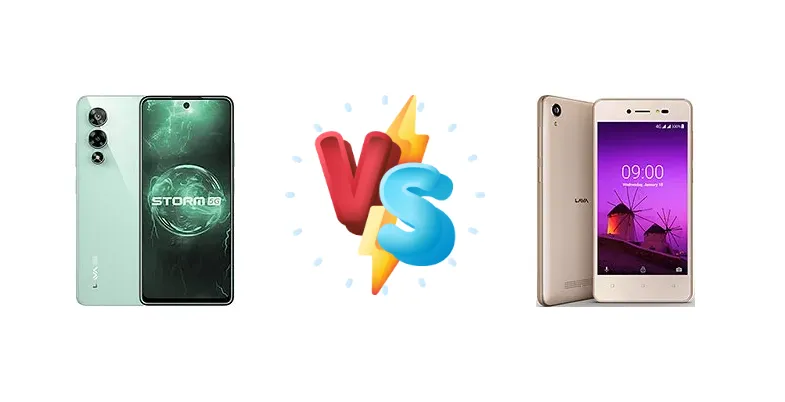
Lava's Storm and Z50 represent two distinct approaches to the budget smartphone market. The Z50 aims for ultimate affordability, while the Storm attempts to bridge the gap with a more modern chipset. This comparison dissects the core differences between these devices, focusing on how their hardware translates into real-world user experience.
🏆 Quick Verdict
For most users, the Lava Storm is the clear winner. Its Mediatek Dimensity 6080 chipset offers a significantly more responsive and future-proof experience than the Z50’s aging MT6737M. While the Z50 is cheaper, the performance gap is substantial enough to justify the Storm’s higher price for anyone beyond the most basic usage.
| Network |
|---|
| 2G bands | GSM 850 / 900 / 1800 / 1900 | GSM 900 / 1800 |
| 3G bands | HSDPA 900 / 2100 | HSDPA 900 / 2100 |
| 4G bands | 1, 3, 5, 8, 40, 41 | 1, 3, 5, 40, 41 |
| 5G bands | 1, 3, 5, 8, 28, 41, 77, 78 SA/NSA | - |
| Speed | HSPA, LTE, 5G | HSPA 21.1/5.76 Mbps, LTE Cat4 150/50 Mbps |
| Technology | GSM / HSPA / LTE / 5G | GSM / HSPA / LTE |
| Launch |
|---|
| Announced | 2023, December 21 | 2018, March. Released 2018, March |
| Status | Available. Released 2023, December 28 | Discontinued |
| Body |
|---|
| Dimensions | 168.7 x 76.7 x 9 mm (6.64 x 3.02 x 0.35 in) | 135 x 66.6 x 9.7 mm (5.31 x 2.62 x 0.38 in) |
| SIM | Nano-SIM + Nano-SIM | Dual SIM (Micro-SIM, dual stand-by) |
| Weight | 214 g (7.55 oz) | 140 g (4.94 oz) |
| Display |
|---|
| Protection | - | Corning Gorilla Glass 1 |
| Resolution | 1080 x 2460 pixels (~396 ppi density) | 480 x 854 pixels, 16:9 ratio (~218 ppi density) |
| Size | 6.78 inches, 109.2 cm2 (~84.4% screen-to-body ratio) | 4.5 inches, 55.8 cm2 (~62.1% screen-to-body ratio) |
| Type | IPS LCD, 120Hz | TN TFT |
| Platform |
|---|
| CPU | Octa-core (2x2.4 GHz Cortex-A76 & 6x2.0 GHz Cortex-A55) | Quad-core 1.1 GHz Cortex-A53 |
| Chipset | Mediatek Dimensity 6080 (6 nm) | Mediatek MT6737M (28 nm) |
| GPU | Mali-G57 MC2 | Mali-T720MP2 |
| OS | Android 13 | Android Oreo (Go edition) |
| Memory |
|---|
| Card slot | microSDXC | microSDXC |
| Internal | 128GB 8GB RAM | 8GB 1GB RAM |
| | - | eMMC 5.0 |
| Main Camera |
|---|
| Dual | 50 MP, (wide), PDAF
8 MP, (ultrawide) | - |
| Features | LED flash | LED flash, HDR |
| Single | - | 5 MP, AF |
| Video | 1080p@30fps | 720p@30fps |
| Selfie camera |
|---|
| Features | - | LED flash |
| Single | 16 MP | 5 MP |
| Video | 1080p@30fps | - |
| Sound |
|---|
| 3.5mm jack | - | Yes |
| 35mm jack | Yes | Yes |
| Loudspeaker | Yes | Yes |
| Comms |
|---|
| Bluetooth | 5.0, A2DP, LE | 4.0, A2DP |
| NFC | No | No |
| Positioning | GPS, GLONASS | GPS |
| Radio | FM radio | FM radio |
| USB | USB Type-C 2.0, OTG | microUSB 2.0 |
| WLAN | Wi-Fi 802.11 b/g/n/ac, dual-band | Wi-Fi 802.11 b/g/n, hotspot |
| Features |
|---|
| Sensors | Fingerprint (side-mounted), accelerometer, gyro, proximity, compass | Accelerometer, proximity |
| Battery |
|---|
| Charging | 33W wired | - |
| Type | Li-Po 5000 mAh | Li-Po 2000 mAh, removable |
| Misc |
|---|
| Colors | Black, Green | Gold, Black |
| Models | - | Z50 |
| Price | About 130 EUR | About 4400 INR |
Lava Storm
- Significantly faster processor for smoother performance
- More efficient chipset for better battery life
- Faster 33W wired charging
- Likely more expensive than the Lava Z50
- Specific display details are unknown
Lava Z50
- Lower price point for budget-conscious users
- Functional for basic communication tasks
- Simple and straightforward user experience
- Outdated processor resulting in slow performance
- Poor multitasking capabilities
- Likely limited software support
Display Comparison
Display specifications are not provided, so a direct comparison is limited. However, given the Z50’s older chipset, it’s likely to feature a lower resolution and less color accurate panel than the Storm. The Storm, benefiting from a more recent design cycle, likely has a more modern display with better viewing angles and potentially higher brightness. The absence of details prevents a deeper analysis of panel technology (IPS vs. AMOLED) or refresh rates.
Camera Comparison
Camera details are absent, making a detailed comparison impossible. However, given the Z50’s age, it’s reasonable to assume it features a lower resolution and less sophisticated camera system. The Storm, being a newer device, likely benefits from improved image processing algorithms and potentially larger sensor sizes. Without specific sensor information, it’s difficult to assess the quality of photos and videos from either device, but the Storm’s more modern chipset suggests a better overall camera experience.
Performance
The performance disparity is the most significant difference between these two phones. The Lava Storm’s Mediatek Dimensity 6080, built on a 6nm process, is a substantial upgrade over the Lava Z50’s Mediatek MT6737M (28nm). The Dimensity 6080’s octa-core configuration (2x2.4 GHz Cortex-A76 & 6x2.0 GHz Cortex-A55) provides significantly more processing power and efficiency compared to the Z50’s quad-core 1.1 GHz Cortex-A53. This translates to faster app loading times, smoother multitasking, and a more responsive user interface on the Storm. The 6nm process also means better thermal management, reducing the likelihood of performance throttling under sustained load. The Z50’s older chipset will struggle with demanding tasks and may exhibit noticeable lag even with everyday apps.
Battery Life
Battery capacity is not specified for either device. However, the Lava Storm’s 33W wired charging is a significant advantage over what the Z50 likely offers. Faster charging reduces downtime and allows for quicker top-ups. While a larger battery capacity on the Z50 could offset the slower charging, the Dimensity 6080’s superior power efficiency means the Storm is likely to achieve comparable or even better battery life despite potentially having a smaller battery.
Buying Guide
Buy the Lava Storm if you need a phone capable of handling modern apps, multitasking, and occasional gaming without significant lag. It’s ideal for users who value responsiveness and longevity. Buy the Lava Z50 if your primary needs are basic communication – calls, texts, and light web browsing – and you’re on a very tight budget. It’s a functional device for those prioritizing cost above all else.
Frequently Asked Questions
❓ Will the Lava Storm be able to run popular games like PUBG Mobile or Call of Duty?
The Mediatek Dimensity 6080 in the Lava Storm is capable of running PUBG Mobile and Call of Duty, but likely at medium settings to maintain a stable frame rate. The Z50’s MT6737M would struggle significantly with these titles, offering a poor gaming experience.
❓ How much of a difference will I notice in everyday tasks like browsing the web or using social media?
You’ll notice a substantial difference. The Lava Storm’s faster processor and more efficient architecture will result in snappier app loading times, smoother scrolling, and a more responsive overall experience when browsing the web or using social media apps. The Z50 will likely exhibit noticeable lag and delays.
❓ Is the Lava Z50 a good option for a first smartphone for someone who isn't tech-savvy?
The Lava Z50 could be suitable as a very basic first smartphone for someone with minimal tech experience, primarily for calls and texts. However, its limited performance may frustrate users who want to explore more advanced features or apps.
❓ What kind of software updates can I expect on the Lava Storm compared to the Z50?
The Lava Storm, being a newer device, is more likely to receive software updates and security patches from Lava. The Z50, with its older chipset, may have limited or no further software support, potentially leaving it vulnerable to security risks.