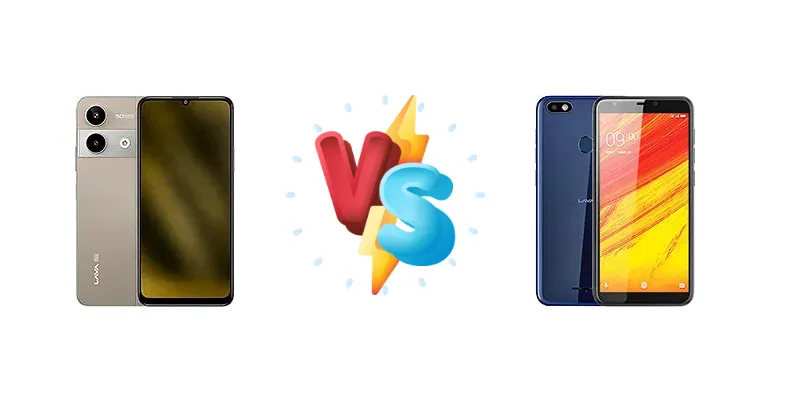
Lava's product line presents a clear dichotomy: the recently released Lava Storm Play, aiming for a balance of performance and affordability, and the older Lava Z91 (2GB), representing a more basic, budget-focused offering. This comparison dissects the core differences between these two devices, focusing on how their drastically different chipsets impact real-world usability.
🏆 Quick Verdict
For the vast majority of users, the Lava Storm Play is the clear winner. Its Mediatek Dimensity 7060 chipset delivers a significantly smoother and more responsive experience, making it suitable for multitasking, moderate gaming, and future-proofing. The Z91 remains viable only for those with extremely basic needs and a tight budget.
| Network |
|---|
| 2G bands | GSM 850 / 900 / 1800 / 1900 | GSM 900 / 1800 |
| 3G bands | HSDPA 850 / 900 / 1900 / 2100 | HSDPA 900 / 2100 |
| 4G bands | 1, 3, 5, 8, 28, 38, 40, 41 | 1, 3, 5, 40, 41 |
| 5G bands | 1, 2, 3, 5, 8, 28, 40, 41, 66, 77, 78 SA/NSA | - |
| Speed | HSPA, LTE, 5G | HSPA 42.2/5.76 Mbps, LTE Cat4 150/50 Mbps |
| Technology | GSM / HSPA / LTE / 5G | GSM / HSPA / LTE |
| Launch |
|---|
| Announced | 2025, June 13 | 2018, July. Released 2018, July |
| Status | Available. Released 2025, June 24 | Discontinued |
| Body |
|---|
| Dimensions | 168.8 x 78.1 x 8.3 mm (6.65 x 3.07 x 0.33 in) | 152 x 72.9 x 7.7 mm (5.98 x 2.87 x 0.30 in) |
| SIM | Nano-SIM + Nano-SIM | Nano-SIM + Nano-SIM |
| Weight | 196 g (6.91 oz) | 147 g (5.19 oz) |
| Display |
|---|
| Resolution | 720 x 1600 pixels, 20:9 ratio (~260 ppi density) | 720 x 1440 pixels, 18:9 ratio (~282 ppi density) |
| Size | 6.75 inches, 110.0 cm2 (~83.4% screen-to-body ratio) | 5.7 inches, 83.8 cm2 (~75.7% screen-to-body ratio) |
| Type | IPS LCD, 120Hz, 750 nits (HBM) | IPS LCD |
| Platform |
|---|
| CPU | Octa-core (2x2.6 GHz Cortex-A78 & 6x2.0 GHz Cortex-A55) | Quad-core 1.3 GHz Cortex-A53 |
| Chipset | Mediatek Dimensity 7060 (6 nm) | Mediatek MT6739 (28 nm) |
| GPU | IMG BXM-8-256 | PowerVR GE8100 |
| OS | Android 15, planned upgrade to Android 16 | Android 7.1 (Nougat) |
| Memory |
|---|
| Card slot | microSDXC (uses shared SIM slot) | microSDXC (dedicated slot) |
| Internal | 128GB 6GB RAM, 256GB 8GB RAM | 16GB 2GB RAM |
| | - | eMMC 5.1 |
| Main Camera |
|---|
| Dual | 50 MP, (wide), 1/2.8"
2 MP | - |
| Features | LED flash, HDR, panorama | LED flash |
| Single | - | 13 MP, f/2.0, 1/3.1", 1.12µm, AF |
| Video | 1440p@30fps, 1080p@30fps | 1080p@30fps |
| Selfie camera |
|---|
| Features | - | LED flash |
| Single | 8 MP | 8 MP, f/2.2 |
| Video | Yes | - |
| Sound |
|---|
| 3.5mm jack | - | Yes |
| 35mm jack | Yes | Yes |
| Loudspeaker | Yes | Yes |
| Comms |
|---|
| Bluetooth | 5.2, A2DP, LE | 4.0, A2DP |
| NFC | No | No |
| Positioning | GPS, GALILEO, GLONASS, BDS, QZSS | GPS |
| Radio | Unspecified | FM radio |
| USB | USB Type-C 2.0, OTG | microUSB 2.0, OTG |
| WLAN | Wi-Fi 802.11 a/b/g/n/ac, dual-band | Wi-Fi 802.11 a/b/g/n/ac, dual-band, Wi-Fi Direct |
| Features |
|---|
| Sensors | Fingerprint (side-mounted), accelerometer, gyro, proximity, compass | Fingerprint (rear-mounted), accelerometer, proximity |
| Battery |
|---|
| Charging | 18W wired | - |
| Type | Li-Po 5000 mAh | Li-Po 3000 mAh, non-removable |
| Misc |
|---|
| Colors | Frosty Blue, Dune Titanium | Blue |
| Price | ₹ 8,923 | About 9000 INR |
Lava Storm Play
- Significantly faster processor for smooth multitasking.
- More efficient chipset for longer battery life.
- Potential for a higher refresh rate display.
- Better camera performance due to improved ISP.
- Likely a higher price point than the Z91.
- May not include expandable storage (spec not provided).
Lava Z91 (2GB)
- Extremely affordable price point.
- Simple and easy-to-use interface.
- Lightweight and compact design (likely).
- Sufficient for basic communication tasks.
- Very slow processor leading to lag and frustration.
- Limited multitasking capabilities due to 2GB of RAM.
- Poor camera performance.
- Outdated chipset with limited software support.
Display Comparison
The context data doesn't provide display specifics, but given the price points, we can infer both devices likely utilize LCD panels. However, the Storm Play's more powerful chipset suggests a higher probability of a higher refresh rate display (potentially 90Hz) for smoother scrolling, a feature absent in the Z91. The Z91's display is likely limited to a standard 60Hz refresh rate. Bezels are also likely to be more substantial on the Z91 due to its older design.
Camera Comparison
Without specific camera specs, it's safe to assume the Lava Storm Play will offer a superior camera experience. The more powerful ISP (Image Signal Processor) within the Dimensity 7060 will enable better image processing, resulting in sharper, more detailed photos, especially in low-light conditions. While both phones likely feature a primary camera, the Storm Play's chipset allows for features like HDR and potentially even computational photography techniques absent in the Z91. Any secondary cameras on both devices are likely to be low-resolution sensors with limited utility.
Performance
The performance gap is the most significant differentiator. The Lava Storm Play's Mediatek Dimensity 7060, built on a 6nm process, is a substantial upgrade over the Z91's Mediatek MT6739 (28nm). The Dimensity 7060's octa-core configuration (2x2.6 GHz Cortex-A78 & 6x2.0 GHz Cortex-A55) provides significantly more processing power and efficiency compared to the Z91's quad-core 1.3 GHz Cortex-A53. The 6nm node translates to lower power consumption and less heat generation, meaning the Storm Play will sustain peak performance for longer periods. The Z91 will struggle with even moderately demanding apps, exhibiting noticeable lag and slowdowns. The 2GB of RAM in the Z91 further exacerbates these issues, limiting multitasking capabilities.
Battery Life
The context data only provides charging wattage (18W for the Storm Play). While battery capacity isn't specified, the Dimensity 7060's superior power efficiency will likely translate to longer battery life on the Storm Play, even if the Z91 has a slightly larger battery. The 18W charging on the Storm Play will also provide faster charging speeds compared to the Z91, which likely supports a slower charging standard.
Buying Guide
Buy the Lava Storm Play if you need a phone capable of handling modern apps, occasional gaming, and benefit from faster performance for everyday tasks. It's ideal for students, social media users, and anyone who wants a phone that won't feel sluggish after a few months. Buy the Lava Z91 (2GB) if you primarily need a device for calls, texts, and very light web browsing, and are prioritizing the absolute lowest possible price point over performance and longevity.
Frequently Asked Questions
❓ Will the Lava Storm Play be able to run popular games like PUBG Mobile or Call of Duty?
The Dimensity 7060 is capable of running PUBG Mobile and Call of Duty, but likely at medium settings to maintain a stable frame rate. Expect some frame drops during intense action sequences. The Z91 would struggle significantly with these titles, likely rendering them unplayable.
❓ Is the 2GB of RAM on the Lava Z91 sufficient for everyday use?
2GB of RAM is severely limited in 2024. While the Z91 can handle basic tasks like calls and texts, it will struggle with multitasking and running multiple apps simultaneously. Expect frequent app reloading and slowdowns.
❓ What kind of software updates can I expect on the Lava Z91?
Given the age of the MT6739 chipset and the Z91's position as a budget device, significant software updates are unlikely. Expect limited security patches and potentially no major Android version upgrades.
❓ Does the Lava Storm Play support 4G VoLTE for clear call quality?
The Dimensity 7060 chipset inherently supports 4G VoLTE, ensuring clear call quality and faster data speeds on compatible networks. The Z91's MT6739 also supports 4G, but its overall network performance will be slower.