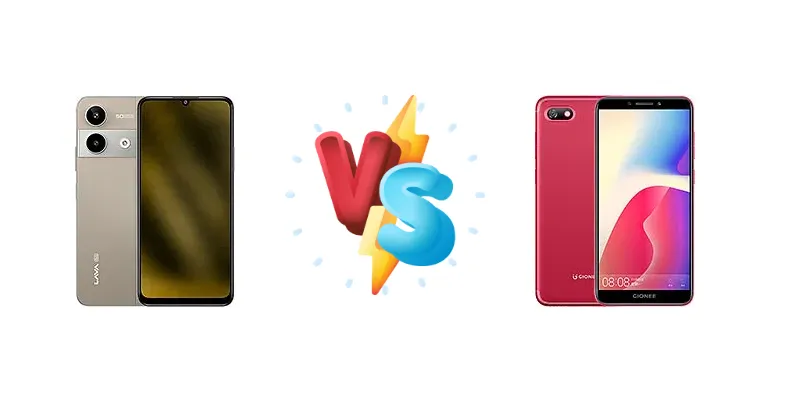
The Lava Storm Play and Gionee F205 represent opposite ends of the budget smartphone spectrum. The Gionee F205, likely a stock-clearing model, relies on older silicon, while the Lava Storm Play aims to deliver a modern experience at an accessible price point. This comparison dissects the core differences, focusing on how the chipset impacts real-world usability.
🏆 Quick Verdict
For the vast majority of users, the Lava Storm Play is the clear winner. Its Mediatek Dimensity 7060 chipset provides a substantial performance advantage over the Gionee F205’s MT6739, making it suitable for more demanding tasks and future-proofing. The Gionee F205 is only viable for extremely basic use cases.
| Network |
|---|
| 2G bands | GSM 850 / 900 / 1800 / 1900 | GSM 850 / 900 / 1800 / 1900 |
| 3G bands | HSDPA 850 / 900 / 1900 / 2100 | HSDPA 850 / 900 / 1900 / 2100 |
| 4G bands | 1, 3, 5, 8, 28, 38, 40, 41 | 1, 3, 5, 7, 8, 38, 39, 40, 41 |
| 5G bands | 1, 2, 3, 5, 8, 28, 40, 41, 66, 77, 78 SA/NSA | - |
| Speed | HSPA, LTE, 5G | HSPA, LTE |
| Technology | GSM / HSPA / LTE / 5G | GSM / CDMA / HSPA / LTE |
| | - | CDMA 800 & TD-SCDMA |
| Launch |
|---|
| Announced | 2025, June 13 | 2018, January. Released 2018, January |
| Status | Available. Released 2025, June 24 | Discontinued |
| Body |
|---|
| Build | - | Glass front, aluminum back, aluminum frame |
| Dimensions | 168.8 x 78.1 x 8.3 mm (6.65 x 3.07 x 0.33 in) | 148.4 x 70.7 x 8 mm (5.84 x 2.78 x 0.31 in) |
| SIM | Nano-SIM + Nano-SIM | Nano-SIM + Nano-SIM |
| Weight | 196 g (6.91 oz) | 135.6 g (4.80 oz) |
| Display |
|---|
| Resolution | 720 x 1600 pixels, 20:9 ratio (~260 ppi density) | 720 x 1440 pixels, 18:9 ratio (~295 ppi density) |
| Size | 6.75 inches, 110.0 cm2 (~83.4% screen-to-body ratio) | 5.45 inches, 76.7 cm2 (~73.1% screen-to-body ratio) |
| Type | IPS LCD, 120Hz, 750 nits (HBM) | IPS LCD |
| Platform |
|---|
| CPU | Octa-core (2x2.6 GHz Cortex-A78 & 6x2.0 GHz Cortex-A55) | Quad-core 1.3 GHz Cortex-A53 |
| Chipset | Mediatek Dimensity 7060 (6 nm) | Mediatek MT6739 (28 nm) |
| GPU | IMG BXM-8-256 | PowerVR GE8100 |
| OS | Android 15, planned upgrade to Android 16 | Android 7.1 (Nougat), Amigo 5 |
| Memory |
|---|
| Card slot | microSDXC (uses shared SIM slot) | microSDXC |
| Internal | 128GB 6GB RAM, 256GB 8GB RAM | 16GB 2GB RAM |
| | - | eMMC 5.1 |
| Main Camera |
|---|
| Dual | 50 MP, (wide), 1/2.8"
2 MP | - |
| Features | LED flash, HDR, panorama | LED flash, HDR, panorama |
| Single | - | 8 MP, AF |
| Video | 1440p@30fps, 1080p@30fps | 720p@30fps |
| Selfie camera |
|---|
| Single | 8 MP | 5 MP |
| Video | Yes | - |
| Sound |
|---|
| 3.5mm jack | - | Yes |
| 35mm jack | Yes | Yes |
| Loudspeaker | Yes | Yes |
| Comms |
|---|
| Bluetooth | 5.2, A2DP, LE | 4.2, A2DP, LE |
| NFC | No | No |
| Positioning | GPS, GALILEO, GLONASS, BDS, QZSS | GPS |
| Radio | Unspecified | FM radio |
| USB | USB Type-C 2.0, OTG | microUSB 2.0 |
| WLAN | Wi-Fi 802.11 a/b/g/n/ac, dual-band | Wi-Fi 802.11 b/g/n |
| Features |
|---|
| Sensors | Fingerprint (side-mounted), accelerometer, gyro, proximity, compass | Accelerometer, proximity, compass |
| Battery |
|---|
| Charging | 18W wired | - |
| Type | Li-Po 5000 mAh | Li-Ion 2670 mAh, non-removable |
| Misc |
|---|
| Colors | Frosty Blue, Dune Titanium | Gold, Red, Blue |
| Models | - | F205 |
| Price | ₹ 8,923 | About 130 EUR |
Lava Storm Play
- Significantly faster processor for smooth multitasking and gaming.
- More power-efficient chipset for longer battery life.
- Likely to receive more software updates and security patches.
- 18W charging is relatively slow.
- Display specifications are unknown, potentially lacking features like high refresh rate.
Gionee F205
- Extremely low price point.
- Simple and easy-to-use interface (likely).
- Acceptable for basic communication tasks.
- Very slow processor, struggles with modern apps.
- Poor battery life due to inefficient chipset.
- Limited software support and security updates.
Display Comparison
Neither device's display specifications are provided, so a direct comparison is limited. However, given the Gionee F205's older chipset and likely target market, it likely features a lower resolution and less color-accurate panel. The Lava Storm Play, benefiting from a more recent release, likely has a more modern display, though specifics like refresh rate and peak brightness remain unknown. Bezels are also likely to be more substantial on the Gionee F205.
Camera Comparison
Without detailed camera specifications, analysis is limited. However, given the Gionee F205’s age and price point, it likely features a basic camera setup with a small sensor and limited image processing capabilities. The Lava Storm Play, while not positioned as a camera-centric phone, likely benefits from the improved ISP (Image Signal Processor) integrated within the Dimensity 7060, resulting in better image quality, especially in low-light conditions. The presence of a more modern chipset allows for more sophisticated computational photography features.
Performance
The performance disparity is the defining characteristic of this comparison. The Lava Storm Play’s Mediatek Dimensity 7060, built on a 6nm process, features an octa-core configuration with two high-performance Cortex-A78 cores clocked at 2.6GHz, paired with six efficiency cores. This contrasts sharply with the Gionee F205’s Mediatek MT6739, a quad-core processor using the older Cortex-A53 architecture and a significantly less efficient 28nm process. The Dimensity 7060’s architecture and node shrink translate to substantially higher CPU and GPU performance, and improved power efficiency. Users will experience significantly faster app loading times, smoother multitasking, and the ability to play more demanding games on the Lava Storm Play.
Battery Life
Both devices feature 18W wired charging. While the battery capacities are unknown, the Lava Storm Play’s more efficient Dimensity 7060 chipset will likely result in longer battery life despite potentially having a similar or even smaller battery capacity. The 28nm MT6739 in the Gionee F205 is power-hungry, meaning it will drain the battery faster under similar usage scenarios. The 18W charging speed on both devices is relatively slow by modern standards, but the Lava Storm Play’s efficiency will minimize the impact of this limitation.
Buying Guide
Buy the Lava Storm Play if you need a phone capable of handling modern apps, occasional gaming, and future software updates. Its superior processing power and more efficient architecture will provide a smoother, more responsive experience. Buy the Gionee F205 if your needs are limited to calls, texts, and very light web browsing, and you prioritize the absolute lowest possible price point, accepting significant performance limitations.
Frequently Asked Questions
❓ Will the Gionee F205 struggle with popular apps like WhatsApp and Facebook?
Yes, the Gionee F205’s Mediatek MT6739 processor is significantly underpowered for modern applications. While it may run these apps, expect noticeable lag, slow loading times, and potential crashes, especially with multiple apps open.
❓ Can the Lava Storm Play handle mobile gaming?
The Lava Storm Play’s Dimensity 7060 is capable of handling many popular mobile games at medium settings. While it won’t deliver flagship-level performance, it provides a playable experience for titles like PUBG Mobile and Call of Duty Mobile, something the Gionee F205 simply cannot achieve.
❓ How long will software support last on the Gionee F205?
Given its age and Gionee’s historical software support track record, the Gionee F205 is unlikely to receive any further software updates or security patches. This poses a significant security risk and limits the phone’s longevity.
❓ Is the Lava Storm Play a good choice for someone upgrading from a very old phone?
Absolutely. The Lava Storm Play represents a substantial upgrade in performance and features compared to older devices. Its modern chipset and likely more recent software will provide a significantly improved user experience.