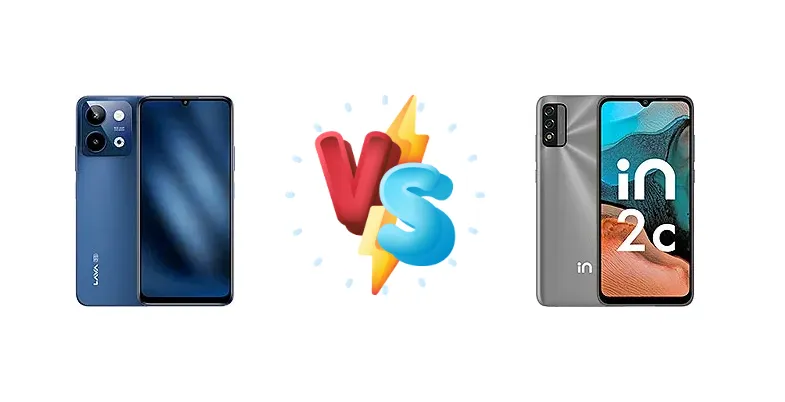
The sub-$150 smartphone market is fiercely competitive. The Lava Storm Lite and Micromax In 2c both aim to deliver essential smartphone functionality at an accessible price point, but they take different approaches to achieving this. The Lava Storm Lite leverages a newer, more efficient chipset, while the Micromax In 2c opts for a more established, albeit less powerful, processor. This comparison will dissect their key differences to help you choose the right device.
🏆 Quick Verdict
For most users, the Lava Storm Lite emerges as the better choice. Its Mediatek Dimensity 6400 chipset, built on a 6nm process, provides a significant performance advantage over the Micromax In 2c’s 12nm Unisoc T610, translating to smoother multitasking and a more responsive user experience. While charging is slightly slower, the overall efficiency gains make it the superior option.
| Network |
|---|
| 2G bands | GSM 850 / 900 / 1800 / 1900 | GSM 850 / 900 / 1800 / 1900 |
| 3G bands | HSDPA 900 / 2100 | HSDPA 850 / 2100 |
| 4G bands | 1, 3, 5, 8, 28, 40, 41 | 1, 3, 5, 8, 38, 40, 41 |
| 5G bands | 1, 3, 5, 8, 28, 40, 41, 77, 78 SA/NSA | - |
| Speed | HSPA, LTE, 5G | HSPA, LTE |
| Technology | GSM / HSPA / LTE / 5G | GSM / HSPA / LTE |
| Launch |
|---|
| Announced | 2025, June 13 | 2022, April 26 |
| Status | Available. Released 2025, June 19 | Available. Released 2022, May 01 |
| Body |
|---|
| Dimensions | 168.8 x 78.1 x 8.3 mm (6.65 x 3.07 x 0.33 in) | 164.3 x 75.7 x 8.6 mm (6.47 x 2.98 x 0.34 in) |
| SIM | Nano-SIM + Nano-SIM | Nano-SIM + Nano-SIM |
| Weight | 196 g (6.91 oz) | 198 g (6.98 oz) |
| Display |
|---|
| Resolution | 720 x 1600 pixels, 20:9 ratio (~260 ppi density) | 720 x 1600 pixels, 20:9 ratio (~269 ppi density) |
| Size | 6.75 inches, 110.0 cm2 (~83.4% screen-to-body ratio) | 6.52 inches, 102.6 cm2 (~82.5% screen-to-body ratio) |
| Type | IPS LCD, 120Hz | IPS LCD, 420 nits |
| Platform |
|---|
| CPU | Octa-core (2x2.5 GHz Cortex-A76 & 6x2.0 GHz Cortex-A55) | Octa-core (2x1.8 GHz Cortex-A75 & 6x1.8 GHz Cortex-A55) |
| Chipset | Mediatek Dimensity 6400 (6 nm) | Unisoc T610 (12 nm) |
| GPU | Mali-G57 MC2 | Mali-G52 MP2 |
| OS | Android 15 | Android 11 |
| Memory |
|---|
| Card slot | microSDXC | microSDXC (dedicated slot) |
| Internal | 64GB 4GB RAM, 128GB 4GB RAM | 32GB 3GB RAM |
| | - | eMMC 5.1 |
| Main Camera |
|---|
| Dual | - | 8 MP, (wide), AF
Auxiliary lens |
| Features | LED flash, HDR, panorama | LED flash, HDR, panorama |
| Single | 50 MP | 5 MP, AF |
| Video | 1440p@30fps, 1080p@30fps | 1080p@30fps |
| Selfie camera |
|---|
| Single | 5 MP | 5 MP, AF |
| Video | Yes | Unspecified |
| Sound |
|---|
| 3.5mm jack | - | Yes |
| 35mm jack | Yes | Yes |
| Loudspeaker | Yes | Yes |
| Comms |
|---|
| Bluetooth | 5.2, A2DP, LE | 5.0, A2DP, LE |
| NFC | No | No |
| Positioning | GPS, GLONASS | GPS |
| Radio | Unspecified | No |
| USB | USB Type-C 2.0, OTG | USB Type-C 2.0, OTG |
| WLAN | Wi-Fi 802.11 b/g/n/ac | Wi-Fi 802.11 a/b/g/n/ac, Wi-Fi Direct |
| Features |
|---|
| Sensors | Fingerprint (side-mounted), accelerometer, gyro, proximity, compass | Accelerometer, proximity |
| Battery |
|---|
| Charging | 15W wired | 10W wired |
| Type | Li-Po 5000 mAh | Li-Po 5000 mAh |
| Misc |
|---|
| Colors | Astral Blue, Cosmic Titanium | Brown, Silver |
| Models | - | E6533 |
| Price | ₹ 8,499 | About 100 EUR |
Lava Storm Lite
- Superior performance thanks to the Dimensity 6400 chipset.
- More efficient 6nm process for better battery life.
- Faster 15W charging.
- Potential for a better display panel.
- May be slightly more expensive than the Micromax In 2c.
- Limited information available on display specifications.
Micromax In 2c
- Lower price point.
- Simple and straightforward user experience.
- Adequate for basic smartphone tasks.
- Widely available.
- Significantly weaker performance compared to the Lava Storm Lite.
- Less efficient 12nm chipset.
- Slower 10W charging.
- Limited future-proofing.
Display Comparison
Neither Lava nor Micromax provide display specifications beyond resolution. However, the chipset differences hint at potential display capabilities. The Dimensity 6400 in the Lava Storm Lite supports higher resolution panels and faster refresh rates, suggesting a potentially sharper and smoother visual experience. The Unisoc T610 in the In 2c is more limited in this regard. Expect both to utilize LCD panels given the price bracket, but the Lava has headroom for a better quality panel.
Camera Comparison
Without detailed camera specs, it’s difficult to make a definitive judgment. However, the processing power of the Dimensity 6400 in the Lava Storm Lite will likely result in better image processing, particularly in low-light conditions. The In 2c’s Unisoc T610 will be limited in its ability to handle complex image algorithms. Expect both phones to feature basic camera setups, and image quality will likely be heavily reliant on software optimization. The Lava’s chipset gives it a clear advantage in this area.
Performance
The core difference lies in the chipsets. The Lava Storm Lite’s Mediatek Dimensity 6400 (6nm) boasts a more modern architecture – Cortex-A76 cores clocked at 2.5GHz alongside Cortex-A55 cores – compared to the Micromax In 2c’s Unisoc T610 (12nm) with its Cortex-A75 and A55 configuration. The 6nm process node of the Dimensity 6400 is significantly more efficient, leading to better thermal management and sustained performance. The A76 cores in the Lava offer a substantial uplift in single-core performance, crucial for app launch speeds and general responsiveness. The Unisoc T610, while capable, will struggle with demanding tasks and multitasking.
Battery Life
Both phones likely feature similar battery capacities, typical for this price range (around 5000mAh is expected). However, the Lava Storm Lite’s more efficient Dimensity 6400 chipset will translate to significantly better battery life. While the In 2c charges at 10W, the Lava Storm Lite supports 15W charging. This difference, while not massive, will result in faster top-ups, offsetting some of the efficiency gains of the Unisoc chip. The Lava’s efficiency will mean less time plugged in overall.
Buying Guide
Buy the Lava Storm Lite if you prioritize performance and future-proofing, even if it means slightly slower charging. This phone is ideal for users who enjoy casual gaming, stream videos, or frequently switch between apps. Buy the Micromax In 2c if your primary needs are basic communication – calls, texts, and light social media – and you value a lower initial price point above all else. It’s a suitable option for first-time smartphone users or those on a very tight budget.
Frequently Asked Questions
❓ Will the Lava Storm Lite handle popular games like PUBG Mobile or Call of Duty?
While not a dedicated gaming phone, the Mediatek Dimensity 6400 in the Lava Storm Lite is capable of running PUBG Mobile and Call of Duty at medium settings with reasonable frame rates. Expect some frame drops during intense action, but it will provide a playable experience. The Micromax In 2c will struggle with these titles.
❓ How much faster is the 15W charging on the Lava Storm Lite compared to the 10W charging on the Micromax In 2c?
The 15W charging on the Lava Storm Lite will reduce charging times by approximately 30-40% compared to the 10W charging on the Micromax In 2c. While not a dramatic difference, it will noticeably shorten the time it takes to fully charge the device.
❓ Is the difference in chipset performance noticeable in everyday tasks like browsing and social media?
Yes, the difference is quite noticeable. The Lava Storm Lite’s Dimensity 6400 provides a much smoother and more responsive experience when browsing the web, scrolling through social media feeds, and switching between apps. The Micromax In 2c may exhibit occasional lag or stuttering during these tasks.
❓ Which phone is better for someone who primarily uses their phone for calls and texts?
For basic communication, the Micromax In 2c is sufficient. Its Unisoc T610 chipset is adequate for calls and texts, and its lower price point makes it a viable option if those are your only needs. However, the Lava Storm Lite will still provide a more refined experience even for these basic tasks.