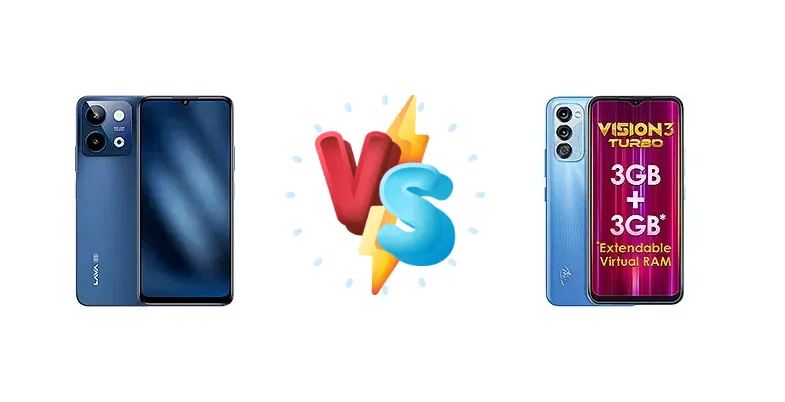
The sub-$150 smartphone market is fiercely competitive, and the Lava Storm Lite and itel Vision 3 Turbo are two contenders vying for dominance. The Lava Storm Lite arrives with a modern 6nm chipset, promising a performance boost, while the itel Vision 3 Turbo focuses on delivering a quick charging experience. This comparison dissects their key differences to help you choose the right device.
🏆 Quick Verdict
For the average user prioritizing performance and future-proofing, the Lava Storm Lite is the clear winner. Its Mediatek Dimensity 6400 chipset provides a substantial leap in processing power compared to the itel Vision 3 Turbo’s Unisoc SC9863A. However, the itel Vision 3 Turbo’s 18W charging is a notable advantage for those who value convenience.
| Network |
|---|
| 2G bands | GSM 850 / 900 / 1800 / 1900 | GSM 850 / 900 / 1800 / 1900 |
| 3G bands | HSDPA 900 / 2100 | HSDPA 850 / 900 / 2100 |
| 4G bands | 1, 3, 5, 8, 28, 40, 41 | LTE |
| 5G bands | 1, 3, 5, 8, 28, 40, 41, 77, 78 SA/NSA | - |
| Speed | HSPA, LTE, 5G | HSPA, LTE |
| Technology | GSM / HSPA / LTE / 5G | GSM / HSPA / LTE |
| Launch |
|---|
| Announced | 2025, June 13 | 2022 |
| Status | Available. Released 2025, June 19 | Available. Released 2022 |
| Body |
|---|
| Dimensions | 168.8 x 78.1 x 8.3 mm (6.65 x 3.07 x 0.33 in) | - |
| SIM | Nano-SIM + Nano-SIM | Dual SIM |
| Weight | 196 g (6.91 oz) | - |
| Display |
|---|
| Resolution | 720 x 1600 pixels, 20:9 ratio (~260 ppi density) | 720 x 1600 pixels, 20:9 ratio (~266 ppi density) |
| Size | 6.75 inches, 110.0 cm2 (~83.4% screen-to-body ratio) | 6.6 inches, 105.2 cm2 |
| Type | IPS LCD, 120Hz | IPS LCD |
| Platform |
|---|
| CPU | Octa-core (2x2.5 GHz Cortex-A76 & 6x2.0 GHz Cortex-A55) | Octa-core (4x1.6 GHz Cortex-A55 & 4x1.2 GHz Cortex-A55) |
| Chipset | Mediatek Dimensity 6400 (6 nm) | Unisoc SC9863A (28 nm) |
| GPU | Mali-G57 MC2 | IMG8322 |
| OS | Android 15 | Android 11 (Go edition) |
| Memory |
|---|
| Card slot | microSDXC | microSDXC |
| Internal | 64GB 4GB RAM, 128GB 4GB RAM | 64GB 3GB RAM |
| Main Camera |
|---|
| Features | LED flash, HDR, panorama | LED flash |
| Single | 50 MP | 8 MP (wide)
Auxiliary lens |
| Video | 1440p@30fps, 1080p@30fps | 1080p@30fps |
| Selfie camera |
|---|
| Single | 5 MP | 5 MP |
| Video | Yes | Yes |
| Sound |
|---|
| 35mm jack | Yes | Yes |
| Loudspeaker | Yes | Yes |
| Comms |
|---|
| Bluetooth | 5.2, A2DP, LE | Yes |
| NFC | No | No |
| Positioning | GPS, GLONASS | GPS |
| Radio | Unspecified | Unspecified |
| USB | USB Type-C 2.0, OTG | microUSB |
| WLAN | Wi-Fi 802.11 b/g/n/ac | Yes |
| Features |
|---|
| Sensors | Fingerprint (side-mounted), accelerometer, gyro, proximity, compass | Fingerprint (rear-mounted), accelerometer |
| Battery |
|---|
| Charging | 15W wired | 18W wired |
| Type | Li-Po 5000 mAh | 5000 mAh |
| Misc |
|---|
| Colors | Astral Blue, Cosmic Titanium | Blue |
| Price | ₹ 8,499 | - |
Lava Storm Lite
- Significantly faster processor for smoother performance
- More efficient 6nm chipset for better battery life
- Potential for better image processing due to stronger CPU
- Slower 15W charging
- Display specifications unknown, potentially average quality
itel Vision 3 Turbo
- Faster 18W wired charging for quick top-ups
- Potentially lower price point
- Suitable for basic smartphone tasks
- Significantly weaker processor for demanding tasks
- Less efficient 28nm chipset
- Likely limited gaming capabilities
Display Comparison
Neither device's display specifications are provided, so a direct comparison is limited. However, given the price bracket, both likely utilize LCD panels. The itel Vision 3 Turbo's focus on fast charging suggests potential compromises in display quality to reduce costs. Lava, with its more powerful processor, might have allocated more resources to a slightly better panel, but this remains speculative. Expect both to offer adequate, but not exceptional, viewing experiences.
Camera Comparison
Without detailed camera specifications, a precise comparison is difficult. However, the market segment suggests both phones will feature basic camera setups. The Lava Storm Lite’s more powerful processor could enable better image processing algorithms, potentially resulting in slightly improved photo quality, especially in low-light conditions. It's likely both devices will include a primary camera and potentially a depth or macro sensor, but image quality will be heavily reliant on software optimization rather than high-end hardware.
Performance
The Lava Storm Lite’s Mediatek Dimensity 6400 (6nm) is the clear performance champion. Its octa-core configuration, featuring 2x2.5 GHz Cortex-A76 and 6x2.0 GHz Cortex-A55 cores, significantly outperforms the itel Vision 3 Turbo’s Unisoc SC9863A (28nm). The Unisoc chip’s 4x1.6 GHz Cortex-A55 and 4x1.2 GHz Cortex-A55 cores are geared towards efficiency, not speed. The 6nm fabrication process of the Dimensity 6400 also translates to better thermal efficiency, reducing the likelihood of performance throttling during sustained tasks. Gamers and multitasking users will find the Lava Storm Lite a far more responsive and enjoyable experience.
Battery Life
The itel Vision 3 Turbo’s 18W wired charging is a key advantage over the Lava Storm Lite’s 15W charging. While battery capacity isn’t specified for either device, the faster charging speed will allow the itel Vision 3 Turbo to reach a full charge more quickly. This is particularly beneficial for users who need to quickly top up their phone throughout the day. However, the Lava Storm Lite’s more efficient Dimensity 6400 chipset may offset the slower charging with better overall battery life during typical usage.
Buying Guide
Buy the Lava Storm Lite if you need a phone capable of handling demanding apps, moderate gaming, and offer a smoother overall user experience. Its superior chipset will translate to longer software support and better longevity. Buy the itel Vision 3 Turbo if you prioritize quick top-ups and are primarily focused on basic smartphone tasks like calling, messaging, and light social media use. The faster charging is ideal for users who frequently find themselves with limited charging opportunities.
Frequently Asked Questions
❓ Will the Unisoc SC9863A in the itel Vision 3 Turbo struggle with popular apps like WhatsApp and Facebook?
While the Unisoc SC9863A can handle basic apps like WhatsApp and Facebook, it may exhibit noticeable lag or slowdowns when multitasking or using more demanding features within those apps. The Lava Storm Lite’s Dimensity 6400 offers a much smoother experience for everyday app usage.
❓ How long will it take to fully charge the itel Vision 3 Turbo with the 18W charger?
Without knowing the battery capacity, it's difficult to provide an exact time. However, with 18W charging, you can expect a full charge to take approximately 2 to 3 hours, depending on the initial battery level. This is faster than the Lava Storm Lite’s 15W charging.
❓ Can the Lava Storm Lite handle casual gaming like PUBG Mobile or Call of Duty Mobile?
The Lava Storm Lite’s Dimensity 6400 is capable of running PUBG Mobile and Call of Duty Mobile at medium settings with reasonable frame rates. However, don’t expect a high-end gaming experience. The itel Vision 3 Turbo would likely struggle to provide a playable experience with these titles.
❓ Is the difference in processor performance between the two phones noticeable in everyday use?
Yes, the difference is quite noticeable. The Lava Storm Lite will feel significantly snappier when opening apps, switching between tasks, and browsing the web. The itel Vision 3 Turbo may exhibit lag or delays in these scenarios.