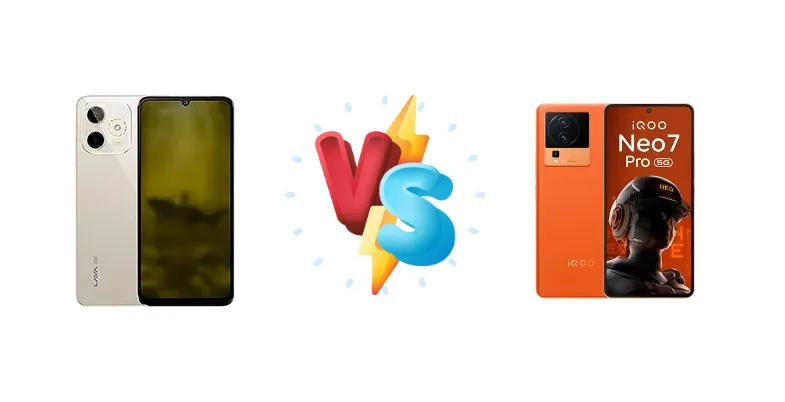
The Lava Shark and vivo iQOO Neo 7 Pro represent distinct approaches to the mid-range smartphone market. The Lava Shark aims for efficiency with a Unisoc chipset, while the iQOO Neo 7 Pro prioritizes raw power with the Snapdragon 8+ Gen 1. This comparison dissects their key differences to determine which device best suits your needs.
🏆 Quick Verdict
For most users, the vivo iQOO Neo 7 Pro is the clear winner. Its Snapdragon 8+ Gen 1 chipset offers a substantial performance advantage, coupled with blazing-fast 120W charging. While the Lava Shark provides a more economical option, the iQOO Neo 7 Pro delivers a significantly superior user experience.
| Network |
|---|
| 2G bands | GSM 850 / 900 / 1800 / 1900 | GSM 850 / 900 / 1800 / 1900 |
| 3G bands | HSDPA 850 / 900 / 2100 | HSDPA 800 / 850 / 900 / 1700(AWS) / 1900 / 2100 |
| 4G bands | LTE | 1, 2, 3, 4, 5, 8, 28, 34, 38, 39, 40, 41 |
| 5G bands | SA/NSA | 1, 3, 5, 8, 28, 40, 77, 78 SA/NSA |
| Speed | HSPA, LTE, 5G | HSPA, LTE, 5G |
| Technology | GSM / HSPA / LTE / 5G | GSM / HSPA / LTE / 5G |
| Launch |
|---|
| Announced | 2025, May 23 | 2023, July 04 |
| Status | Available. Released 2025, May 23 | Available. Released 2023, July 15 |
| Body |
|---|
| Build | - | Glass front, plastic frame, glass or leather back |
| Dimensions | - | 164.8 x 76.9 x 8.5 mm or 8.9 mm |
| SIM | Nano-SIM + Nano-SIM | Nano-SIM + Nano-SIM |
| Weight | - | 197 g or 202 g (6.95 oz) |
| Display |
|---|
| Resolution | 720 x 1612 pixels, 20:9 ratio (~262 ppi density) | 1080 x 2400 pixels, 20:9 ratio (~388 ppi density) |
| Size | 6.75 inches, 109.5 cm2 | 6.78 inches, 111.0 cm2 (~87.6% screen-to-body ratio) |
| Type | IPS LCD, 90Hz | AMOLED, 1B colors, 120Hz, HDR10+, 1300 nits (peak) |
| Platform |
|---|
| CPU | Octa-core (2x2.3 GHz Cortex-A76 & 6x2.1 GHz Cortex-A55) | Octa-core (1x3.19 GHz Cortex-X2 & 3x2.75 GHz Cortex-A710 & 4x2.0 GHz Cortex-A510) |
| Chipset | Unisoc T765 (6 nm) | Qualcomm SM8475 Snapdragon 8+ Gen 1 (4 nm) |
| GPU | Mali-G57 MC2 | Adreno 730 |
| OS | Android 15 | Android 13, Funtouch 13 |
| Memory |
|---|
| Card slot | microSDXC | No |
| Internal | 64GB 4GB RAM | 128GB 8GB RAM, 256GB 12GB RAM |
| Main Camera |
|---|
| Features | LED flash, HDR, panorama | LED flash, HDR, panorama |
| Single | 13 MP, (wide), AF | - |
| Triple | - | 50 MP, f/1.9, 24mm (wide), 1/1.57", 1.0µm, PDAF, OIS
8 MP, f/2.2, 16mm (ultrawide), 1/4.0", 1.12µm
2 MP (macro) |
| Video | 1080p@30fps | 4K@30fps, 1080p@30fps |
| Selfie camera |
|---|
| Features | - | HDR |
| Single | 5 MP | 16 MP, f/2.5, (wide), 1/3.1", 1.0µm |
| Video | Yes | 1080p@30fps |
| Sound |
|---|
| 35mm jack | Yes | No |
| Loudspeaker | Yes | Yes, with stereo speakers |
| Comms |
|---|
| Bluetooth | 5.0, A2DP, LE | 5.3, A2DP, LE, aptX HD, aptX Adaptive |
| Infrared port | - | Yes |
| NFC | No | No |
| Positioning | GPS, GLONASS | GPS, GLONASS, GALILEO, BDS, QZSS, NavIC |
| Radio | Unspecified | No |
| USB | USB Type-C, OTG | USB Type-C 2.0, OTG |
| WLAN | Wi-Fi 802.11 b/g/n/ac, dual-band | Wi-Fi 802.11 a/b/g/n/ac/6, dual-band, Wi-Fi Direct |
| Features |
|---|
| Sensors | Fingerprint (side-mounted); unspecified sensors | Fingerprint (under display, optical), accelerometer, gyro, proximity, compass |
| Battery |
|---|
| Charging | 18W wired | 120W wired, 50% in 8 min |
| Type | Li-Ion 5000 mAh | 5000 mAh |
| Misc |
|---|
| Colors | Stellar Gold, Stellar Blue | Fearless Flame, Dark Storm |
| Models | - | I2217 |
| Price | About 80 EUR | About 380 EUR |
Lava Shark
- More affordable price point
- Potentially better battery life during light usage due to efficient chipset
- Unisoc chipset offers a different experience for those seeking alternatives to Qualcomm/MediaTek
- Significantly lower performance compared to the iQOO Neo 7 Pro
- Slower charging speeds
- Likely inferior camera system
vivo iQOO Neo 7 Pro
- Exceptional performance with the Snapdragon 8+ Gen 1
- Ultra-fast 120W charging
- Likely superior camera system with advanced features
- Higher price tag
- Potentially more heat generation under sustained load (though mitigated by 4nm process)
- May not be the best choice for users prioritizing extreme battery life over performance
Display Comparison
Context data lacks display specifics for both devices. However, given the iQOO Neo 7 Pro's positioning, it likely features a higher refresh rate panel (120Hz or higher) compared to the Lava Shark, which may be limited to 60Hz. The iQOO Neo 7 Pro likely benefits from a brighter panel, enhancing outdoor visibility. The iQOO Neo 7 Pro's display is likely AMOLED, offering superior contrast and color accuracy compared to a potential LCD panel on the Lava Shark.
Camera Comparison
Without detailed camera specs, a direct comparison is limited. However, the iQOO Neo 7 Pro, being a higher-tier device, likely features a more sophisticated camera system with a larger sensor and optical image stabilization (OIS). The Lava Shark likely relies on smaller sensors and digital image stabilization. The iQOO Neo 7 Pro’s image processing capabilities, powered by the Snapdragon’s ISP, will likely deliver superior image quality, particularly in low-light conditions. Expect the iQOO Neo 7 Pro to offer more versatile shooting modes and better video recording capabilities.
Performance
The core difference lies in the chipsets. The Qualcomm Snapdragon 8+ Gen 1 (4nm) in the iQOO Neo 7 Pro is a flagship-level processor, boasting a Cortex-X2 prime core clocked at 3.19 GHz, significantly outperforming the Unisoc T765 (6nm) in the Lava Shark. The Snapdragon's architecture – 1x Cortex-X2, 3x Cortex-A710, and 4x Cortex-A510 – is designed for sustained performance, while the Unisoc T765’s 2x Cortex-A76 and 6x Cortex-A55 configuration is more focused on efficiency. This translates to a noticeable advantage for the iQOO Neo 7 Pro in gaming, video editing, and demanding multitasking. The 4nm process node of the Snapdragon also contributes to better thermal efficiency, reducing throttling under sustained load.
Battery Life
The iQOO Neo 7 Pro’s 120W wired charging is a game-changer, capable of charging the device to 50% in just 8 minutes. The Lava Shark’s 18W charging is considerably slower. While battery capacity isn’t specified, the iQOO Neo 7 Pro’s faster charging mitigates the impact of a potentially smaller battery. The Snapdragon 8+ Gen 1’s efficiency also contributes to better battery life under heavy use, despite the higher performance demands.
Buying Guide
Buy the Lava Shark if you prioritize affordability and basic smartphone functionality, and are comfortable with a more modest performance profile. It's ideal for users who primarily browse, communicate, and occasionally use light apps. Buy the vivo iQOO Neo 7 Pro if you demand high performance for gaming, multitasking, or demanding applications, and value incredibly fast charging speeds. This phone is geared towards power users and mobile gamers.
Frequently Asked Questions
❓ Will the Unisoc T765 in the Lava Shark struggle with graphically intensive games like Genshin Impact?
Yes, the Unisoc T765 is not designed for demanding games. While it can handle less intensive titles, you'll likely experience significant frame drops and reduced graphical settings in games like Genshin Impact. The iQOO Neo 7 Pro’s Snapdragon 8+ Gen 1 is far better equipped for a smooth gaming experience.
❓ How much faster is the 120W charging on the iQOO Neo 7 Pro compared to the 18W charging on the Lava Shark in real-world use?
The difference is substantial. The iQOO Neo 7 Pro can reach 50% charge in approximately 8 minutes, while the Lava Shark will take well over an hour to achieve the same level. This means you can quickly top up the iQOO Neo 7 Pro during short breaks, making it ideal for users on the go.
❓ Does the Snapdragon 8+ Gen 1 in the iQOO Neo 7 Pro get excessively hot during prolonged gaming sessions?
While the Snapdragon 8+ Gen 1 is a powerful chip, the 4nm manufacturing process helps to mitigate heat generation. The iQOO Neo 7 Pro likely incorporates thermal management solutions to prevent overheating, but some warmth is expected during extended gaming. It will still perform better than the Lava Shark under load due to its superior thermal design and efficiency.