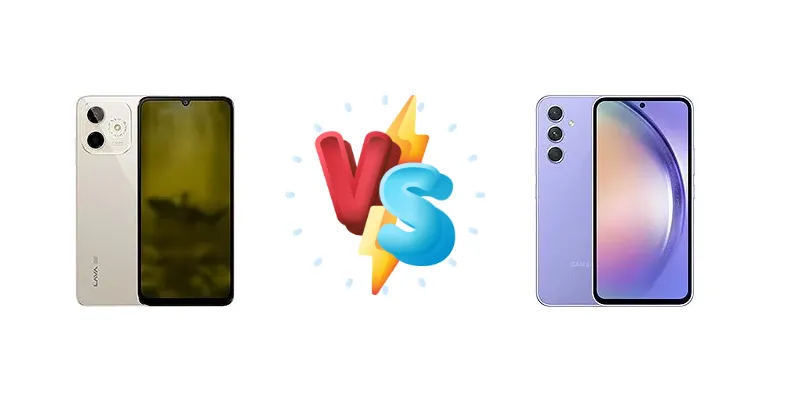
The Lava Shark and Samsung Galaxy A54 represent compelling options in the increasingly competitive mid-range smartphone market. The Lava Shark aims to undercut the competition with a focus on affordability, powered by a Unisoc chipset. Meanwhile, the Galaxy A54 leverages Samsung’s brand recognition and a more established Exynos processor, offering a more polished experience. This comparison dives deep into the specifics to determine which device best suits your needs.
🏆 Quick Verdict
For the average user prioritizing a balanced experience with a brighter display and established brand reliability, the Samsung Galaxy A54 is the better choice. However, the Lava Shark presents a compelling alternative for those on a tighter budget who can accept some performance trade-offs.
| Network |
|---|
| 2G bands | GSM 850 / 900 / 1800 / 1900 | GSM 850 / 900 / 1800 / 1900 |
| 3G bands | HSDPA 850 / 900 / 2100 | HSDPA 850 / 900 / 1700(AWS) / 1900 / 2100 |
| 4G bands | LTE | 1, 2, 3, 4, 5, 7, 8, 12, 17, 20, 26, 28, 32, 38, 40, 41, 66 - International |
| 5G bands | SA/NSA | 1, 3, 7, 8, 20, 28, 38, 40, 41, 77, 78 SA/NSA/Sub6 - International |
| Speed | HSPA, LTE, 5G | HSPA, LTE, 5G |
| Technology | GSM / HSPA / LTE / 5G | GSM / HSPA / LTE / 5G |
| | - | 25, 41, 66, 71 SA/NSA/Sub6/mmWave - USA |
| Launch |
|---|
| Announced | 2025, May 23 | 2023, March 15 |
| Status | Available. Released 2025, May 23 | Available. Released 2023, March 24 |
| Body |
|---|
| Build | - | Glass front (Gorilla Glass 5), glass back (Gorilla Glass 5), plastic frame |
| Dimensions | - | 158.2 x 76.7 x 8.2 mm (6.23 x 3.02 x 0.32 in) |
| SIM | Nano-SIM + Nano-SIM | · Nano-SIM + eSIM· Nano-SIM + Nano-SIM |
| Weight | - | 202 g (7.13 oz) |
| | - | IP67 dust/water resistant (up to 1m for 30 min) |
| Display |
|---|
| Protection | - | Corning Gorilla Glass 5 |
| Resolution | 720 x 1612 pixels, 20:9 ratio (~262 ppi density) | 1080 x 2340 pixels, 19.5:9 ratio (~403 ppi density) |
| Size | 6.75 inches, 109.5 cm2 | 6.4 inches, 100.5 cm2 (~82.9% screen-to-body ratio) |
| Type | IPS LCD, 90Hz | Super AMOLED, 120Hz, HDR10+, 1000 nits (HBM) |
| Platform |
|---|
| CPU | Octa-core (2x2.3 GHz Cortex-A76 & 6x2.1 GHz Cortex-A55) | Octa-core (4x2.4 GHz Cortex-A78 & 4x2.0 GHz Cortex-A55) |
| Chipset | Unisoc T765 (6 nm) | Exynos 1380 (5 nm) |
| GPU | Mali-G57 MC2 | Mali-G68 MP5 |
| OS | Android 15 | Android 13, up to 4 major Android upgrades, One UI 7 |
| Memory |
|---|
| Card slot | microSDXC | microSDXC (uses shared SIM slot) |
| Internal | 64GB 4GB RAM | 128GB 4GB RAM, 128GB 6GB RAM, 128GB 8GB RAM, 256GB 6GB RAM, 256GB 8GB RAM |
| Main Camera |
|---|
| Features | LED flash, HDR, panorama | LED flash, panorama, HDR |
| Single | 13 MP, (wide), AF | 32 MP, f/2.2, 26mm (wide), 1/2.8", 0.8µm |
| Triple | - | 50 MP, f/1.8, 23mm (wide), 1/1.56", 1.0µm, PDAF, OIS
12 MP, f/2.2, 13mm, 123˚ (ultrawide), 1/3.X", 1.12µm
5 MP (macro) |
| Video | 1080p@30fps | 4K@30fps, 1080p@30/60fps, 720p@480fps, gyro-EIS |
| Selfie camera |
|---|
| Single | 5 MP | 32 MP, f/2.2, 26mm (wide), 1/2.8", 0.8µm |
| Video | Yes | 4K@30fps, 1080p@30/60fps |
| Sound |
|---|
| 3.5mm jack | - | No |
| 35mm jack | Yes | No |
| Loudspeaker | Yes | Yes, with stereo speakers |
| Comms |
|---|
| Bluetooth | 5.0, A2DP, LE | 5.3, A2DP, LE |
| NFC | No | Yes (market/region dependent) |
| Positioning | GPS, GLONASS | GPS, GLONASS, GALILEO, BDS |
| Radio | Unspecified | No |
| USB | USB Type-C, OTG | USB Type-C 2.0, OTG |
| WLAN | Wi-Fi 802.11 b/g/n/ac, dual-band | Wi-Fi 802.11 a/b/g/n/ac/6, dual-band, Wi-Fi Direct |
| Features |
|---|
| Sensors | Fingerprint (side-mounted); unspecified sensors | Fingerprint (under display, optical), accelerometer, gyro, compass, barometer (USA only) |
| | - | Virtual proximity sensing |
| Battery |
|---|
| Charging | 18W wired | 25W wired |
| Type | Li-Ion 5000 mAh | 5000 mAh |
| Misc |
|---|
| Colors | Stellar Gold, Stellar Blue | Lime, Graphite, Violet, White |
| Models | - | SM-A546V, SM-A546U, SM-A546U1, SM-A546B, SM-A546B/DS, SM-A546E, SM-A546E/DS, SM-A5460, SM-A546M, SM-A546M/DS, SM-A546W |
| Price | About 80 EUR | € 210.00 / $ 119.11 / £ 169.95 / ₹ 28,999 |
| SAR | - | 0.81 W/kg (head) 0.67 W/kg (body) |
| SAR EU | - | 0.69 W/kg (head) 1.34 W/kg (body) |
| Tests |
|---|
| Battery life | - |
Endurance rating 119h
|
| Camera | - |
Photo / Video |
| Display | - |
Contrast ratio: Infinite (nominal) |
| Loudspeaker | - |
-26.6 LUFS (Good)
|
| Performance | - |
AnTuTu: 506678 (v9)
GeekBench: 2703 (v5.1), 2797 (v6)
GFXBench: 25fps (ES 3.1 onscreen) |
Lava Shark
- Significantly lower price point
- 5G connectivity for future-proof networking
- Potentially longer battery life due to less demanding chipset (speculation)
- Less powerful processor for demanding tasks
- Likely inferior camera performance
- Lower display brightness and quality
Samsung Galaxy A54
- Brighter and higher-quality display
- More powerful processor for smoother performance
- Superior camera capabilities
- Faster charging speeds
- Higher price tag
- May experience some throttling under heavy load (though mitigated by 5nm process)
- Samsung’s software bloat (subjective)
Display Comparison
The Samsung Galaxy A54 boasts a significantly brighter display, reaching a measured 980 nits. This is crucial for outdoor visibility, a clear advantage over the Lava Shark, whose peak brightness is not specified but is likely lower given the chipset and price point. While the Lava Shark’s display specs are unknown, the Galaxy A54’s ‘Infinite’ contrast ratio (nominal) suggests a VA panel, offering deeper blacks. The A54’s display is likely to provide a more immersive viewing experience, particularly for media consumption. The lack of LTPO on either device suggests standard refresh rate management, impacting battery life during dynamic content.
Camera Comparison
Both devices offer photo and video capabilities, but the specifics are limited. Without detailed sensor information, it’s difficult to make a definitive judgment. However, Samsung’s image processing algorithms are generally more refined, offering better dynamic range and color accuracy. The Lava Shark likely relies on software enhancements to compensate for potentially lower-quality hardware. The absence of details regarding OIS or aperture sizes on the Lava Shark suggests a less sophisticated camera system overall. It's reasonable to assume the Galaxy A54 will deliver superior image quality, particularly in low-light conditions.
Performance
The Exynos 1380 in the Galaxy A54, fabricated on a 5nm process, holds a clear architectural advantage over the Lava Shark’s Unisoc T765 (6nm). The A54’s CPU configuration – 4x2.4 GHz Cortex-A78 & 4x2.0 GHz Cortex-A55 – utilizes more powerful Cortex-A78 cores compared to the Lava Shark’s 2x2.3 GHz Cortex-A76 & 6x2.1 GHz Cortex-A55. This translates to faster application loading times and smoother multitasking on the Galaxy A54. The 5nm process also contributes to better thermal efficiency, reducing the likelihood of performance throttling under sustained load. While the Lava Shark is adequate for basic tasks, the A54 is better equipped for gaming and demanding applications.
Battery Life
The Samsung Galaxy A54 achieves an impressive 11:15h active use score and an endurance rating of 119 hours, indicating excellent battery life. While the Lava Shark’s battery capacity is unknown, its 18W charging is slower than the Galaxy A54’s 25W charging. This means the A54 will replenish its battery faster, minimizing downtime. The efficiency gains from the Exynos 1380’s 5nm process likely contribute to the A54’s superior endurance, despite potentially having a similar or smaller battery capacity than the Lava Shark.
Buying Guide
Buy the Lava Shark if you need a functional smartphone with 5G connectivity at the absolute lowest possible price point and are willing to compromise on processing power and camera quality. Buy the Samsung Galaxy A54 if you prioritize a vibrant display, smoother performance for demanding apps, and a more refined software experience, even if it means spending a bit more.
Frequently Asked Questions
❓ Does the Exynos 1380 in the Galaxy A54 tend to overheat during prolonged gaming sessions?
While the Exynos 1380 isn't known for exceptional thermal performance, the 5nm fabrication process helps mitigate overheating. The Galaxy A54 is unlikely to experience severe throttling during typical gaming sessions, but sustained, high-intensity gaming may lead to some performance reduction over time. The Lava Shark's Unisoc T765, while less powerful, may also throttle due to thermal constraints.
❓ Is the Lava Shark a viable option for users who primarily use their phone for basic tasks like calling, texting, and social media?
Yes, the Lava Shark is perfectly adequate for basic tasks. The Unisoc T765 chipset is capable of handling everyday operations without significant lag. However, users who frequently engage in demanding activities like gaming or video editing will likely find the Galaxy A54 a more responsive and enjoyable experience.
❓ How does the charging speed difference (18W vs 25W) translate to real-world charging times?
The 25W charging on the Galaxy A54 will significantly reduce charging times compared to the Lava Shark’s 18W. Expect the A54 to reach a full charge in approximately 1 hour 30 minutes to 2 hours, while the Lava Shark may take closer to 2.5 to 3 hours, depending on battery capacity.