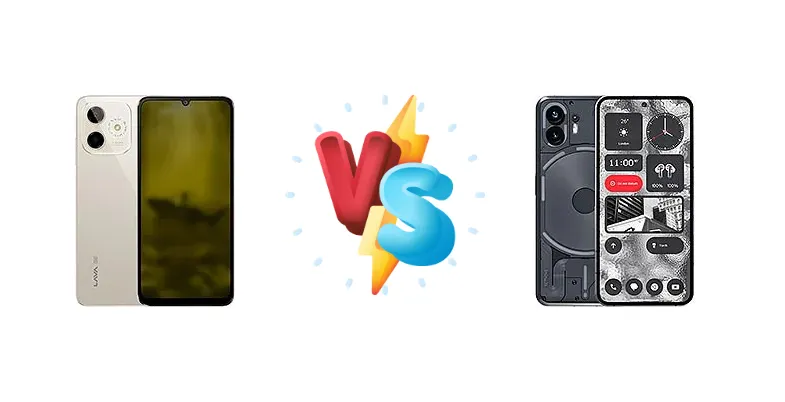
The Lava Shark enters the arena as a budget-focused contender, while the Nothing Phone (2) aims for a premium mid-range experience. This comparison dissects their core components to determine which device delivers the best value for your money, focusing on the significant performance gap created by their respective chipsets and the implications for everyday use.
🏆 Quick Verdict
For the average user prioritizing performance and a refined experience, the Nothing Phone (2) is the clear winner. Its Snapdragon 8+ Gen 1 chipset offers a substantial leap in processing power and efficiency compared to the Lava Shark’s Unisoc T765. However, the Lava Shark presents a compelling option for those on a strict budget who prioritize basic functionality.
| Network |
|---|
| 2G bands | GSM 850 / 900 / 1800 / 1900 | GSM 850 / 900 / 1800 / 1900 |
| 3G bands | HSDPA 850 / 900 / 2100 | HSDPA 800 / 850 / 900 / 1700(AWS) / 1900 / 2100 |
| 4G bands | LTE | 1, 2, 3, 4, 5, 7, 8, 12, 17, 18, 19, 20, 25, 26, 28, 30, 32, 34, 38, 39, 40, 41, 42, 48, 66, 71 |
| 5G bands | SA/NSA | 1, 2, 3, 5, 7, 8, 12, 20, 25, 28, 30, 38, 40, 41, 66, 71, 75, 77, 78 SA/NSA |
| Speed | HSPA, LTE, 5G | HSPA, LTE, 5G |
| Technology | GSM / HSPA / LTE / 5G | GSM / HSPA / LTE / 5G |
| Launch |
|---|
| Announced | 2025, May 23 | 2023, July 11 |
| Status | Available. Released 2025, May 23 | Available. Released 2023, July 17 |
| Body |
|---|
| Build | - | Glass front (Gorilla Glass 5), glass back (Gorilla Glass 5), aluminum frame |
| Dimensions | - | 162.1 x 76.4 x 8.6 mm (6.38 x 3.01 x 0.34 in) |
| SIM | Nano-SIM + Nano-SIM | Nano-SIM + Nano-SIM |
| Weight | - | 201.2 g (7.09 oz) |
| Display |
|---|
| Protection | - | Corning Gorilla Glass 5 |
| Resolution | 720 x 1612 pixels, 20:9 ratio (~262 ppi density) | 1080 x 2412 pixels, 20:9 ratio (~394 ppi density) |
| Size | 6.75 inches, 109.5 cm2 | 6.7 inches, 108.0 cm2 (~87.2% screen-to-body ratio) |
| Type | IPS LCD, 90Hz | LTPO OLED, 1B colors, 120Hz, 1920Hz PWM, HDR10+, 1600 nits (HBM), 1600 nits (peak) |
| Platform |
|---|
| CPU | Octa-core (2x2.3 GHz Cortex-A76 & 6x2.1 GHz Cortex-A55) | Octa-core (1x3.0 GHz Cortex-X2 & 3x2.5 GHz Cortex-A710 & 4x1.80 GHz Cortex-A510) |
| Chipset | Unisoc T765 (6 nm) | Qualcomm SM8475 Snapdragon 8+ Gen 1 (4 nm) |
| GPU | Mali-G57 MC2 | Adreno 730 |
| OS | Android 15 | Android 13, upgradable to Android 15, up to 3 major Android upgrades, Nothing OS 3.0 |
| Memory |
|---|
| Card slot | microSDXC | No |
| Internal | 64GB 4GB RAM | 128GB 8GB RAM, 256GB 12GB RAM, 512GB 12GB RAM |
| Main Camera |
|---|
| Dual | - | 50 MP, f/1.9, 24mm (wide), 1/1.56", 1.0µm, PDAF, OIS
50 MP, f/2.2, 114˚ (ultrawide), 1/2.76", 0.64µm, AF |
| Features | LED flash, HDR, panorama | LED flash, panorama, HDR |
| Single | 13 MP, (wide), AF | - |
| Video | 1080p@30fps | 4K@30/60fps, 1080p@30/60fps, gyro-EIS, live HDR, OIS |
| Selfie camera |
|---|
| Features | - | HDR |
| Single | 5 MP | 32 MP, f/2.5, (wide), 1/2.74", 0.8µm |
| Video | Yes | 1080p@30fps |
| Sound |
|---|
| 35mm jack | Yes | No |
| Loudspeaker | Yes | Yes, with stereo speakers |
| Comms |
|---|
| Bluetooth | 5.0, A2DP, LE | 5.3, A2DP, LE, aptX HD, aptX Adaptive |
| NFC | No | Yes |
| Positioning | GPS, GLONASS | GPS (L1+L5), GLONASS (L1), BDS (B1I+B1c), GALILEO (E1), QZSS (L1), NavIC |
| Radio | Unspecified | No |
| USB | USB Type-C, OTG | USB Type-C 2.0, OTG |
| WLAN | Wi-Fi 802.11 b/g/n/ac, dual-band | Wi-Fi 802.11 a/b/g/n/ac/6, dual-band, Wi-Fi Direct |
| Features |
|---|
| Sensors | Fingerprint (side-mounted); unspecified sensors | Fingerprint (under display, optical), accelerometer, proximity, gyro, compass |
| Battery |
|---|
| Charging | 18W wired | 45W wired, PD3.0, PPS, QC4, 100% in 55 min
15W wireless, 100% in 130 min
5W reverse wireless |
| Type | Li-Ion 5000 mAh | Li-Ion 4700 mAh |
| Misc |
|---|
| Colors | Stellar Gold, Stellar Blue | White, Dark Gray |
| Models | - | A065 |
| Price | About 80 EUR | $ 379.99 / £ 370.00 |
Lava Shark
- Significantly lower price point
- Functional for basic smartphone tasks
- Potentially longer standby time due to less power-hungry chipset
- Substantially slower performance
- Inferior camera capabilities
- Slower charging speeds
Nothing Phone (2)
- Exceptional performance with Snapdragon 8+ Gen 1
- Fast 45W charging with multiple protocols
- Superior camera system and image quality
- Higher price tag
- May experience some thermal throttling under extreme load
- More complex software features may require a learning curve
Display Comparison
The Nothing Phone (2) boasts a significantly brighter display, reaching a measured 998 nits, ensuring excellent visibility even in direct sunlight. While the Lava Shark’s display specifications are not provided, it’s reasonable to assume a lower peak brightness. The Nothing Phone (2)'s display technology is likely to be more advanced, potentially including LTPO for adaptive refresh rates, contributing to better battery efficiency. The Nothing Phone (2)'s display is geared towards a more immersive and visually comfortable experience.
Camera Comparison
The context data for the Lava Shark’s camera is limited. The Nothing Phone (2) offers a more comprehensive camera system, likely including advanced features like optical image stabilization (OIS) and sophisticated image processing algorithms. While the specific sensor sizes and lens apertures aren't detailed, the Nothing Phone (2)'s focus on 'Photo / Video' suggests a greater emphasis on image quality and versatility. The Lava Shark will likely suffice for casual snapshots, but the Nothing Phone (2) is better suited for users who prioritize photography and videography.
Performance
The performance disparity is the most significant difference. The Nothing Phone (2) is powered by the Qualcomm SM8475 Snapdragon 8+ Gen 1 (4nm), featuring an octa-core CPU with a Cortex-X2 prime core clocked at 3.0 GHz. This architecture is designed for sustained performance and efficiency. Conversely, the Lava Shark utilizes the Unisoc T765 (6nm) with a less powerful CPU configuration (2x2.3 GHz Cortex-A76 & 6x2.1 GHz Cortex-A55). The 4nm process node of the Snapdragon 8+ Gen 1 provides superior thermal efficiency, minimizing throttling during prolonged intensive tasks like gaming. Users demanding smooth gaming or resource-intensive applications will find the Nothing Phone (2) far more capable.
Battery Life
The Nothing Phone (2) demonstrates impressive battery life, achieving 14:21 hours of active use and an endurance rating of 103 hours. Its 45W wired charging, supporting PD3.0, PPS, and QC4, allows for a full charge in just 55 minutes. The Lava Shark’s 18W wired charging is considerably slower. While the Lava Shark’s battery capacity isn’t specified, the Nothing Phone (2)'s faster charging and efficient chipset offset any potential capacity difference, providing a more convenient and reliable charging experience. The addition of 15W wireless and 5W reverse wireless charging on the Nothing Phone (2) further enhances its versatility.
Buying Guide
Buy the Lava Shark if you need a functional smartphone for essential tasks like calls, messaging, and light social media browsing, and your budget is under $200. Buy the Nothing Phone (2) if you prioritize smooth multitasking, demanding gaming, a superior camera experience, and faster charging, and are willing to spend around $600 for a more premium device.
Frequently Asked Questions
❓ Is the Unisoc T765 in the Lava Shark capable of running modern mobile games?
While the Unisoc T765 can run some mobile games, it will likely struggle with graphically demanding titles at higher settings. Expect lower frame rates and potential lag compared to the Snapdragon 8+ Gen 1 in the Nothing Phone (2).
❓ How does the thermal management of the Nothing Phone (2) hold up during extended gaming sessions?
The Snapdragon 8+ Gen 1 is known for its efficiency, but it can still generate heat under sustained load. The Nothing Phone (2) likely incorporates thermal management solutions to mitigate throttling, but some performance reduction may occur during prolonged gaming.
❓ Does the Nothing Phone (2)'s 45W charging require a specific charger to achieve maximum speed?
The Nothing Phone (2) supports PD3.0, PPS, and QC4, meaning it will work with many USB-C Power Delivery chargers. However, to achieve the full 45W charging speed, you'll need a charger that specifically supports these protocols and delivers at least 45W of power.
❓ What kind of software experience can I expect on the Lava Shark?
Given its budget nature, the Lava Shark likely runs a relatively stock version of Android with minimal bloatware. However, software updates may be less frequent and slower to arrive compared to the Nothing Phone (2), which benefits from Nothing's dedicated software support.