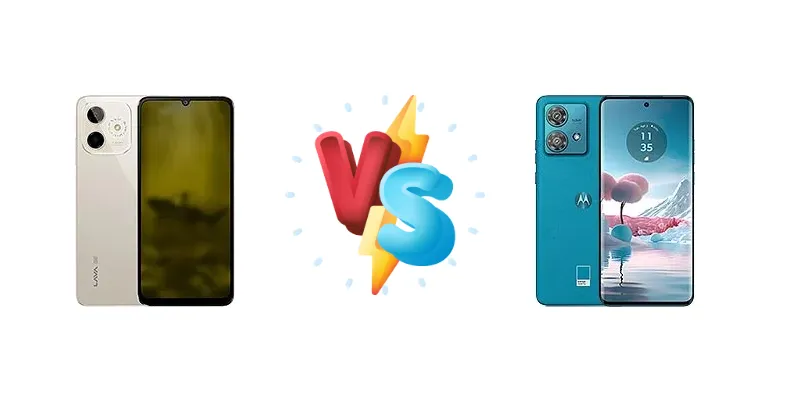
The Lava Shark and Motorola Edge 40 Neo represent distinct approaches to the mid-range smartphone market. The Lava Shark aims for aggressive affordability with a Unisoc chipset, while the Motorola Edge 40 Neo prioritizes a more balanced experience with a MediaTek Dimensity processor and faster charging. This comparison dissects their strengths and weaknesses to help you choose the right device.
🏆 Quick Verdict
For the average user prioritizing a smooth, responsive experience and rapid charging, the Motorola Edge 40 Neo is the better choice. Its Dimensity 7030 chipset and 68W charging significantly outperform the Lava Shark's Unisoc T765 and 18W charging, justifying the likely price difference.
| Network |
|---|
| 2G bands | GSM 850 / 900 / 1800 / 1900 | GSM 850 / 900 / 1800 / 1900 |
| 3G bands | HSDPA 850 / 900 / 2100 | HSDPA 800 / 850 / 900 / 1700(AWS) / 1900 / 2100 |
| 4G bands | LTE | 1, 2, 3, 4, 5, 7, 8, 12, 13, 17, 18, 19, 20, 25, 26, 28, 32, 38, 38, 39, 40, 41, 42, 43, 48, 66 |
| 5G bands | SA/NSA | 1, 2, 3, 5, 7, 8, 20, 28, 38, 40, 41, 66, 77, 78 SA/NSA |
| Speed | HSPA, LTE, 5G | HSPA, LTE, 5G |
| Technology | GSM / HSPA / LTE / 5G | GSM / HSPA / LTE / 5G |
| Launch |
|---|
| Announced | 2025, May 23 | 2023, September 14 |
| Status | Available. Released 2025, May 23 | Available. Released 2023, September 14 |
| Body |
|---|
| Build | - | Glass front (Gorilla Glass 3), plastic frame, plastic back |
| Dimensions | - | 159.6 x 72 x 7.9 mm (6.28 x 2.83 x 0.31 in) |
| SIM | Nano-SIM + Nano-SIM | · Nano-SIM + eSIM· Nano-SIM + Nano-SIM |
| Weight | - | 170 g or 172 g (6.00 oz) |
| Display |
|---|
| Protection | - | Corning Gorilla Glass 3 |
| Resolution | 720 x 1612 pixels, 20:9 ratio (~262 ppi density) | 1080 x 2400 pixels, 20:9 ratio (~402 ppi density) |
| Size | 6.75 inches, 109.5 cm2 | 6.55 inches, 103.6 cm2 (~90.1% screen-to-body ratio) |
| Type | IPS LCD, 90Hz | P-OLED, 1B colors, 144Hz, HDR10+, 1300 nits (peak) |
| Platform |
|---|
| CPU | Octa-core (2x2.3 GHz Cortex-A76 & 6x2.1 GHz Cortex-A55) | Octa-core (2x2.5 GHz Cortex-A78 & 6x2.0 GHz Cortex-A55) |
| Chipset | Unisoc T765 (6 nm) | MediaTek Dimensity 7030 (6 nm) |
| GPU | Mali-G57 MC2 | Mali-G610 MC3 |
| OS | Android 15 | Android 13, up to 2 major Android upgrades |
| Memory |
|---|
| Card slot | microSDXC | No |
| Internal | 64GB 4GB RAM | 128GB 8GB RAM, 256GB 8GB RAM, 256GB 12GB RAM |
| Main Camera |
|---|
| Dual | - | 50 MP, f/1.8, (wide), 1/1.55", 1.0µm, multi-directional PDAF, OIS
13 MP, f/2.2, 120˚ (ultrawide), 1/3.0", 1.12µm, PDAF |
| Features | LED flash, HDR, panorama | LED flash, HDR, panorama |
| Single | 13 MP, (wide), AF | - |
| Video | 1080p@30fps | 4K@30fps, 1080p@30/60/120/240fps, gyro-EIS |
| Selfie camera |
|---|
| Features | - | HDR |
| Single | 5 MP | 32 MP, f/2.4, (wide), 1/3.0", 0.7µm |
| Video | Yes | 4K@30fps, 1080p@30fps |
| Sound |
|---|
| 35mm jack | Yes | No |
| Loudspeaker | Yes | Yes, with stereo speakers |
| Comms |
|---|
| Bluetooth | 5.0, A2DP, LE | 5.4, A2DP, LE |
| NFC | No | Yes |
| Positioning | GPS, GLONASS | GPS, GLONASS, GALILEO |
| Radio | Unspecified | No |
| USB | USB Type-C, OTG | USB Type-C 2.0, OTG |
| WLAN | Wi-Fi 802.11 b/g/n/ac, dual-band | Wi-Fi 802.11 a/b/g/n/ac/6e, tri-band, Wi-Fi Direct |
| Features |
|---|
| Sensors | Fingerprint (side-mounted); unspecified sensors | Fingerprint (under display, optical), accelerometer, gyro, proximity, compass |
| Battery |
|---|
| Charging | 18W wired | 68W wired, 50% in 15 min |
| Type | Li-Ion 5000 mAh | Li-Po 5000 mAh |
| Misc |
|---|
| Colors | Stellar Gold, Stellar Blue | Black, Soothing Sea, Caneel Bay, Peach Fuzz |
| Models | - | XT2307-1 |
| Price | About 80 EUR | $ 299.00 / € 168.73 / ₹ 19,900 |
Lava Shark
- Most affordable option
- Functional for basic tasks
- 6nm chipset offers decent efficiency
- Slow 18W charging
- Less powerful processor
- Likely lower display quality
Motorola Edge 40 Neo
- Fast 68W charging
- More powerful Dimensity 7030 chipset
- Brighter, higher-quality display
- Higher price point
- May not be significantly better for extremely basic use cases
- Potential for software bloat (typical of Motorola)
Display Comparison
The Motorola Edge 40 Neo boasts a significantly brighter display, reaching a measured 1073 nits. This is crucial for outdoor visibility, a clear advantage over the Lava Shark, whose display brightness is not specified but is likely lower given its budget positioning. While panel technology isn't specified for either, the Edge 40 Neo's brightness suggests a higher-quality panel. Bezels are likely comparable, but the superior brightness makes the Motorola device more usable in direct sunlight.
Camera Comparison
The context data for both devices is limited regarding camera specifics. However, the Motorola Edge 40 Neo’s branding suggests a greater emphasis on camera quality, likely featuring a more sophisticated image processing pipeline. While both phones likely include standard photo and video modes, the Motorola’s marketing typically highlights camera capabilities, implying a more competitive offering. The Lava Shark likely focuses on basic image capture, while the Edge 40 Neo aims for a more versatile camera experience.
Performance
The Motorola Edge 40 Neo’s MediaTek Dimensity 7030 (6nm) offers a performance edge over the Lava Shark’s Unisoc T765 (6nm). The Dimensity 7030 utilizes Cortex-A78 cores clocked at 2.5 GHz, a step up from the Lava Shark’s Cortex-A76 cores at 2.3 GHz. This translates to faster app loading times and smoother multitasking. Both chips are fabricated on a 6nm process, suggesting similar efficiency, but the architectural advantage of the A78 cores favors the Motorola. The Edge 40 Neo is likely to handle demanding games with higher frame rates and less throttling.
Battery Life
The Motorola Edge 40 Neo excels in charging speed with its 68W wired charging, capable of reaching 50% charge in just 15 minutes. This is a massive advantage over the Lava Shark’s slow 18W charging. While the Lava Shark’s battery capacity isn’t specified, the Edge 40 Neo’s endurance rating of 80 hours and active use score of 10:28h demonstrate strong battery life. The faster charging of the Motorola mitigates any potential capacity difference, making it the more convenient option for users who need quick top-ups.
Buying Guide
Buy the Lava Shark if you need a functional smartphone for basic tasks and prioritize absolute affordability above all else. It's a solid option for users on a very tight budget. Buy the Motorola Edge 40 Neo if you prefer a more refined user experience, faster charging, and a brighter, more vibrant display – it’s ideal for media consumption and those who demand quicker power-ups.
Frequently Asked Questions
❓ Is the Unisoc T765 in the Lava Shark capable of running popular games like PUBG or Call of Duty?
The Unisoc T765 can run PUBG and Call of Duty, but likely at lower graphics settings and frame rates compared to the Motorola Edge 40 Neo. Expect some frame drops during intense gameplay. It's suitable for casual gaming, but not ideal for competitive players.
❓ How does the 68W charging on the Motorola Edge 40 Neo compare to standard fast charging?
68W charging is considerably faster than typical fast charging solutions. The Edge 40 Neo can reach 50% charge in just 15 minutes, providing a significant boost in battery life during short breaks. This is a major convenience factor for users who are always on the go.
❓ Does the Motorola Edge 40 Neo have a high PWM dimming frequency, and is it safe for users sensitive to screen flicker?
While the exact PWM frequency isn't specified, Motorola generally uses relatively high PWM frequencies in their displays. This reduces the risk of screen flicker and makes the Edge 40 Neo a safer option for users sensitive to flicker, compared to some other budget phones with lower frequencies.
❓ What type of storage does the Lava Shark use, and is it expandable?
The context data doesn't specify the storage type or expandability of the Lava Shark. However, given its budget positioning, it's likely to use eMMC storage, which is slower than UFS. Expandability via microSD card is possible, but not guaranteed.