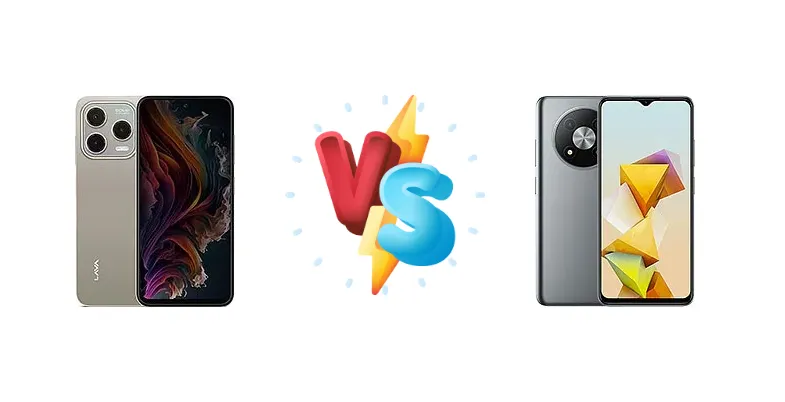
The Lava Shark 4G and ZTE Blade A73 5G represent compelling options in the sub-$200 smartphone market. While both rely on Unisoc chipsets, they target slightly different priorities: the Lava Shark focuses on established 4G connectivity, while the ZTE Blade A73 5G pushes for future-proofing with 5G. This comparison dissects their core components to determine which device offers the best overall experience.
🏆 Quick Verdict
For most users, the ZTE Blade A73 5G emerges as the stronger choice. Its Unisoc T760, fabricated on a more efficient 6nm process, delivers noticeably improved performance and future-proof 5G connectivity. While the Lava Shark 4G remains a viable option, the A73 5G’s superior chipset justifies the potential price difference.
| Network |
|---|
| 2G bands | GSM 900 / 1800 | GSM 850 / 900 / 1800 / 1900 |
| 3G bands | HSDPA 900 / 2100 | HSDPA 850 / 900 / 1900 / 2100 |
| 4G bands | 1, 3, 5, 8, 28, 40, 41 | 1, 2, 3, 4, 5, 7, 8, 20, 28, 38, 40, 41 |
| 5G bands | - | 1, 3, 7, 8, 20, 28, 38, 40, 41, 77, 78 SA/NSA |
| Speed | HSPA, LTE | HSPA, LTE, 5G |
| Technology | GSM / HSPA / LTE | GSM / HSPA / LTE / 5G |
| Launch |
|---|
| Announced | 2025, March 25 | 2023, August 10 |
| Status | Available. Released 2025, April | Available. Released 2023, September |
| Body |
|---|
| Dimensions | 165.8 x 77.2 x 8.5 mm (6.53 x 3.04 x 0.33 in) | 163.5 x 75.2 x 8.5 mm (6.44 x 2.96 x 0.33 in) |
| SIM | Nano-SIM + Nano-SIM | Nano-SIM + Nano-SIM |
| Weight | 200 g (7.05 oz) | 197 g (6.95 oz) |
| Display |
|---|
| Resolution | 720 x 1612 pixels, 20:9 ratio (~269 ppi density) | 720 x 1600 pixels, 20:9 ratio (~269 ppi density) |
| Size | 6.67 inches, 103.7 cm2 (~81.0% screen-to-body ratio) | 6.52 inches, 102.6 cm2 (~83.5% screen-to-body ratio) |
| Type | IPS LCD, 120Hz | IPS LCD, 90Hz |
| Platform |
|---|
| CPU | Octa-core (2x1.6 GHz Cortex-A75 & 6x1.6 GHz Cortex-A55) | Octa-core (1x2.2 GHz Cortex-A76 & 3x Cortex-A76 & 4x Cortex-A55) |
| Chipset | Unisoc T606 (12 nm) | Unisoc T760 (6 nm) |
| GPU | Mali-G57 MP1 | Mali-G57 |
| OS | Android 14 | Android 13 |
| Memory |
|---|
| Card slot | microSDXC | No |
| Internal | 64GB 4GB RAM | 128GB 4GB RAM |
| Main Camera |
|---|
| Dual | - | 50 MP (13 MP in Asia), (wide), AF
Auxiliary lens |
| Features | LED flash, HDR, panorama | LED flash |
| Single | 50 MP, (wide), AF | - |
| Video | 1080p@30fps | 1080p@30fps |
| Selfie camera |
|---|
| Single | 8 MP | 5 MP |
| Video | Yes | 1080p@30fps |
| Sound |
|---|
| 35mm jack | Yes | Yes |
| Loudspeaker | Yes | Yes |
| Comms |
|---|
| Bluetooth | 5.0, A2DP, LE | 5.2, A2DP, LE |
| Infrared port | Yes | - |
| NFC | No | Yes (market/region dependent) |
| Positioning | GPS, GLONASS | GPS |
| Radio | FM radio | FM radio |
| USB | USB Type-C, OTG | USB Type-C 2.0, OTG |
| WLAN | Wi-Fi 802.11 b/g/n/ac, dual-band | Wi-Fi 802.11 a/b/g/n/ac, dual-band |
| Features |
|---|
| Sensors | Fingerprint (side-mounted), accelerometer, proximity | Accelerometer, proximity |
| Battery |
|---|
| Charging | 18W wired | - |
| Type | Li-Ion 5000 mAh | Li-Ion 5000 mAh |
| Misc |
|---|
| Colors | Titanium Gold, Stealth Black | Gray, Blue |
| Price | About 80 EUR | About 120 EUR |
| SAR EU | - | 1.42 W/kg (head) 1.69 W/kg (body) |
Lava Shark 4G
- Potentially lower price point
- Reliable 4G connectivity
- Simple and straightforward user experience
- Less powerful chipset
- Less efficient processor
- No 5G support
ZTE Blade A73 5G
- More powerful Unisoc T760 chipset
- Future-proof 5G connectivity
- Improved power efficiency
- Potentially higher price
- 5G availability may be limited in some areas
- May require a 5G-enabled SIM card
Display Comparison
Neither device’s display specifications are provided, so a direct comparison is limited. However, given the price bracket, both likely utilize LCD panels. The ZTE Blade A73 5G’s more powerful chipset *could* support a higher refresh rate display, offering smoother scrolling and animations, but this is speculative. Bezels are likely comparable, and color accuracy will be standard for this segment.
Camera Comparison
Without detailed camera specifications, analysis is limited. Both phones likely feature a multi-camera setup, but the quality will heavily depend on sensor size and image processing. It’s reasonable to assume the ZTE Blade A73 5G, benefiting from its more powerful chipset, will have superior image processing capabilities, resulting in better dynamic range and noise reduction. The Lava Shark 4G will likely suffice for casual photography, but the A73 5G should offer a more refined camera experience.
Performance
The core difference lies in the chipsets. The ZTE Blade A73 5G’s Unisoc T760 (6nm) is a significant upgrade over the Lava Shark 4G’s Unisoc T606 (12nm). The 6nm process inherently offers better power efficiency and thermal performance, allowing the T760 to sustain higher clock speeds for longer. The CPU configuration further favors the A73 5G: a single 2.2 GHz Cortex-A76 core versus the Shark 4G’s dual 1.6 GHz Cortex-A75 cores. While both are octa-core, the A76 architecture is more modern and efficient. The A73 5G’s additional A76 cores also contribute to multi-core performance gains, benefiting multitasking and demanding applications.
Battery Life
Battery capacity isn’t specified for either device. However, the Unisoc T760’s 6nm process in the ZTE Blade A73 5G offers a significant advantage in power efficiency. This means the A73 5G is likely to achieve comparable or better battery life than the Lava Shark 4G, even with a similar battery capacity. The Lava Shark 4G’s 18W charging is standard for this price point, and the A73 5G likely offers similar charging speeds, meaning 0-100% times will be comparable.
Buying Guide
Buy the Lava Shark 4G if you prioritize a proven, reliable 4G experience and are on a very tight budget. It’s a solid choice for basic smartphone tasks and users who don’t anticipate needing 5G. Buy the ZTE Blade A73 5G if you want a phone that’s ready for the future, offering faster processing speeds, 5G connectivity, and a more responsive user experience, even if it means spending slightly more.
Frequently Asked Questions
❓ Will the ZTE Blade A73 5G actually get faster download speeds in my area?
5G speeds are heavily dependent on network coverage and your carrier. Check your carrier’s 5G coverage map to determine if 5G is available in your location. Even with 5G, real-world speeds will vary based on network congestion and signal strength.
❓ Is the Unisoc T760 chipset comparable to a Snapdragon 695?
The Unisoc T760 generally performs similarly to the Snapdragon 695 in CPU tasks, but the Snapdragon 695 often has a slight edge in GPU performance. Both are capable chipsets for mid-range smartphones, but the Snapdragon 695 benefits from Qualcomm’s more mature software optimization.
❓ Does the Lava Shark 4G support VoLTE and VoWiFi?
Given its target market, the Lava Shark 4G likely supports VoLTE (Voice over LTE) for improved call quality on 4G networks. VoWiFi (Voice over Wi-Fi) support is less certain and depends on carrier compatibility. Check with your carrier to confirm VoWiFi support.
❓ What type of storage does the ZTE Blade A73 5G use (UFS or eMMC)?
Storage type isn't specified. However, given the chipset and price point, it's likely to utilize eMMC storage. While slower than UFS, eMMC is still adequate for everyday tasks. UFS would be a welcome addition for faster app loading times.