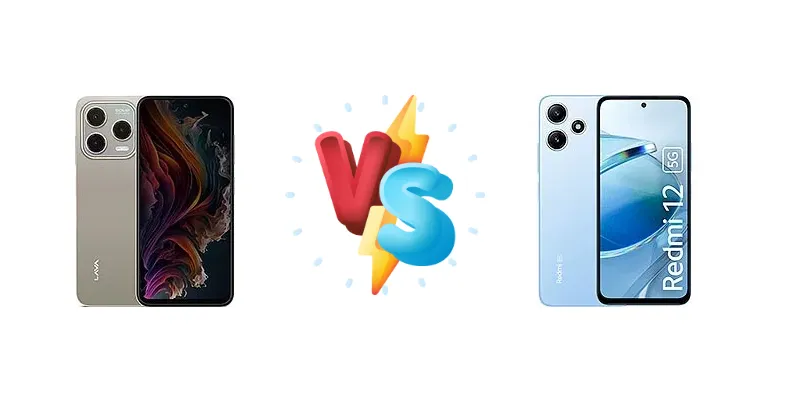
The sub-$150 smartphone market is fiercely competitive. The Lava Shark 4G offers a familiar 4G experience, while the Xiaomi Redmi 12 5G brings the promise of next-generation connectivity and a more modern chipset. This comparison dissects the key differences to help you decide which device delivers the best value.
🏆 Quick Verdict
For most users, the Xiaomi Redmi 12 5G is the superior choice. Its Snapdragon 4 Gen 2 chipset, built on a 4nm process, provides a significant performance advantage and future-proofs the device with 5G connectivity. While both phones share 18W charging, the Redmi 12 5G’s more efficient processor translates to better battery life in real-world usage.
| Network |
|---|
| 2G bands | GSM 900 / 1800 | GSM 850 / 900 / 1800 / 1900 |
| 3G bands | HSDPA 900 / 2100 | HSDPA 850 / 900 / 2100 |
| 4G bands | 1, 3, 5, 8, 28, 40, 41 | 1, 3, 5, 8, 40, 41 |
| 5G bands | - | 1, 3, 5, 8, 28, 40, 78 SA/NSA |
| Speed | HSPA, LTE | HSPA, LTE, 5G |
| Technology | GSM / HSPA / LTE | GSM / HSPA / LTE / 5G |
| Launch |
|---|
| Announced | 2025, March 25 | 2023, August 01 |
| Status | Available. Released 2025, April | Available. Released 2023, August 04 |
| Body |
|---|
| Build | - | Glass front (Gorilla Glass), plastic frame, glass back (Gorilla Glass) |
| Dimensions | 165.8 x 77.2 x 8.5 mm (6.53 x 3.04 x 0.33 in) | 168.6 x 76.3 x 8.2 mm (6.64 x 3.00 x 0.32 in) |
| SIM | Nano-SIM + Nano-SIM | Nano-SIM + Nano-SIM |
| Weight | 200 g (7.05 oz) | 199 g (7.02 oz) |
| Display |
|---|
| Protection | - | Corning Gorilla Glass |
| Resolution | 720 x 1612 pixels, 20:9 ratio (~269 ppi density) | 1080 x 2460 pixels (~396 ppi density) |
| Size | 6.67 inches, 103.7 cm2 (~81.0% screen-to-body ratio) | 6.79 inches, 109.5 cm2 (~85.1% screen-to-body ratio) |
| Type | IPS LCD, 120Hz | IPS LCD, 90Hz, 550 nits |
| Platform |
|---|
| CPU | Octa-core (2x1.6 GHz Cortex-A75 & 6x1.6 GHz Cortex-A55) | Octa-core (2x2.2 GHz Cortex-A78 & 6x1.95 GHz Cortex-A55) |
| Chipset | Unisoc T606 (12 nm) | Qualcomm SM4450 Snapdragon 4 Gen 2 (4 nm) |
| GPU | Mali-G57 MP1 | Adreno 613 |
| OS | Android 14 | Android 13, upgradable to Android 15, HyperOS 2 |
| Memory |
|---|
| Card slot | microSDXC | microSDXC (uses shared SIM slot) |
| Internal | 64GB 4GB RAM | 128GB 4GB RAM, 128GB 6GB RAM, 128GB 8GB RAM, 256GB 8GB RAM |
| Main Camera |
|---|
| Dual | - | 50 MP, f/1.8, (wide), PDAF
Auxiliary lens |
| Features | LED flash, HDR, panorama | LED flash, HDR |
| Single | 50 MP, (wide), AF | - |
| Video | 1080p@30fps | 1080p@30fps |
| Selfie camera |
|---|
| Features | - | HDR |
| Single | 8 MP | 8 MP, f/2.0, (wide), 1.12µm |
| Video | Yes | 1080p@30fps |
| Sound |
|---|
| 35mm jack | Yes | Yes |
| Loudspeaker | Yes | Yes |
| Comms |
|---|
| Bluetooth | 5.0, A2DP, LE | 5.3, A2DP, LE |
| Infrared port | Yes | Yes |
| NFC | No | Unspecified |
| Positioning | GPS, GLONASS | GPS, GLONASS, GALILEO, BDS |
| Radio | FM radio | No |
| USB | USB Type-C, OTG | USB Type-C |
| WLAN | Wi-Fi 802.11 b/g/n/ac, dual-band | Wi-Fi 802.11 a/b/g/n/ac, dual-band |
| Features |
|---|
| Sensors | Fingerprint (side-mounted), accelerometer, proximity | Fingerprint (side-mounted), accelerometer, compass |
| Battery |
|---|
| Charging | 18W wired | 18W wired, PD |
| Type | Li-Ion 5000 mAh | Li-Po 5000 mAh |
| Misc |
|---|
| Colors | Titanium Gold, Stealth Black | Jade Black, Pastel Blue, Moonstone Silver |
| Models | - | 23076RN4BI, 23076RN8DY, 2AFZZRN8DY |
| Price | About 80 EUR | € 104.09 / ₹ 15,999 |
| SAR | - | 1.09 W/kg (head) 0.88 W/kg (body) |
| SAR EU | - | 0.98 W/kg (head) 1.00 W/kg (body) |
Lava Shark 4G
- Potentially lower price point
- Reliable 4G connectivity
- Established brand presence (Lava)
- Less powerful Unisoc T606 chipset
- Less efficient 12nm process
- Lacks 5G connectivity
Xiaomi Redmi 12 5G
- More powerful Snapdragon 4 Gen 2 chipset
- More efficient 4nm process
- 5G connectivity for future-proofing
- Slightly higher price
- Xiaomi’s MIUI software can be polarizing
- May not be available in all markets
Display Comparison
Neither device boasts a standout display. Both likely utilize LCD panels, common in this price bracket. The key difference lies under the hood: processing power impacts UI smoothness. While display specs are unavailable, the Redmi 12 5G’s more powerful GPU will contribute to a more responsive visual experience, especially during scrolling and animations. Bezels are expected to be similar, prioritizing cost-effectiveness over premium aesthetics.
Camera Comparison
Without detailed camera specs, it’s difficult to make a definitive judgment. However, the Redmi 12 5G likely benefits from Qualcomm’s image signal processor (ISP), which generally provides better image processing capabilities than those found in Unisoc chipsets. Expect the Redmi 12 5G to deliver more detailed and vibrant photos, particularly in challenging lighting conditions. Both phones likely include a standard macro camera, which are often of limited utility due to low resolution.
Performance
The performance gap is the most significant differentiator. The Xiaomi Redmi 12 5G’s Qualcomm Snapdragon 4 Gen 2 (4nm) is a substantial upgrade over the Lava Shark 4G’s Unisoc T606 (12nm). The 4nm fabrication process delivers superior power efficiency and thermal management, meaning the Redmi 12 5G will sustain peak performance for longer periods. The Snapdragon’s Cortex-A78 cores (2x2.2 GHz) also offer a performance advantage over the Shark 4G’s Cortex-A75 cores (2x1.6 GHz). This translates to faster app loading times, smoother multitasking, and a more enjoyable gaming experience. The Redmi 12 5G also benefits from 5G connectivity, offering significantly faster data speeds where available.
Battery Life
Both devices feature 18W wired charging, suggesting similar charging speeds (approximately 2-3 hours for a full charge). However, the Redmi 12 5G’s more efficient Snapdragon 4 Gen 2 processor will consume less power during everyday tasks. This translates to longer battery life, even with a similar battery capacity (which is currently unknown for both devices). The 4nm process is a key advantage here, minimizing power waste and maximizing runtime.
Buying Guide
Buy the Lava Shark 4G if you prioritize a known brand with a reliable 4G experience and are on a very tight budget where 5G isn't a necessity. Buy the Xiaomi Redmi 12 5G if you want a faster, more efficient processor, 5G connectivity for future-proofing, and are willing to spend slightly more for a noticeable performance boost.
Frequently Asked Questions
❓ Will the Redmi 12 5G’s 5G connectivity actually make a difference in my daily use?
The benefit of 5G depends on your location and carrier coverage. If 5G is available in your area, you’ll experience significantly faster download and upload speeds, especially for data-intensive tasks like streaming video or downloading large files. Even if 5G isn’t widely available now, the Redmi 12 5G is future-proofed for when 5G networks expand.
❓ Is the Unisoc T606 in the Lava Shark 4G capable of handling popular games like PUBG Mobile or Call of Duty Mobile?
The Unisoc T606 can run PUBG Mobile and Call of Duty Mobile, but you’ll likely need to lower the graphics settings to achieve a smooth frame rate. The Redmi 12 5G’s Snapdragon 4 Gen 2 will provide a significantly better gaming experience, allowing for higher graphics settings and more stable performance.
❓ Does the Xiaomi Redmi 12 5G support Power Delivery (PD) charging, and does that matter?
Yes, the Redmi 12 5G supports PD charging. While both phones have 18W charging, PD allows for more efficient charging with compatible chargers, potentially reducing charging time and improving battery health over the long term. It also offers wider compatibility with various chargers.